
Grow buttonwood in full sun on coastal ground that drains, and water a new plant until the roots take. Buttonwood is Conocarpus erectus, the button mangrove of Florida coasts.
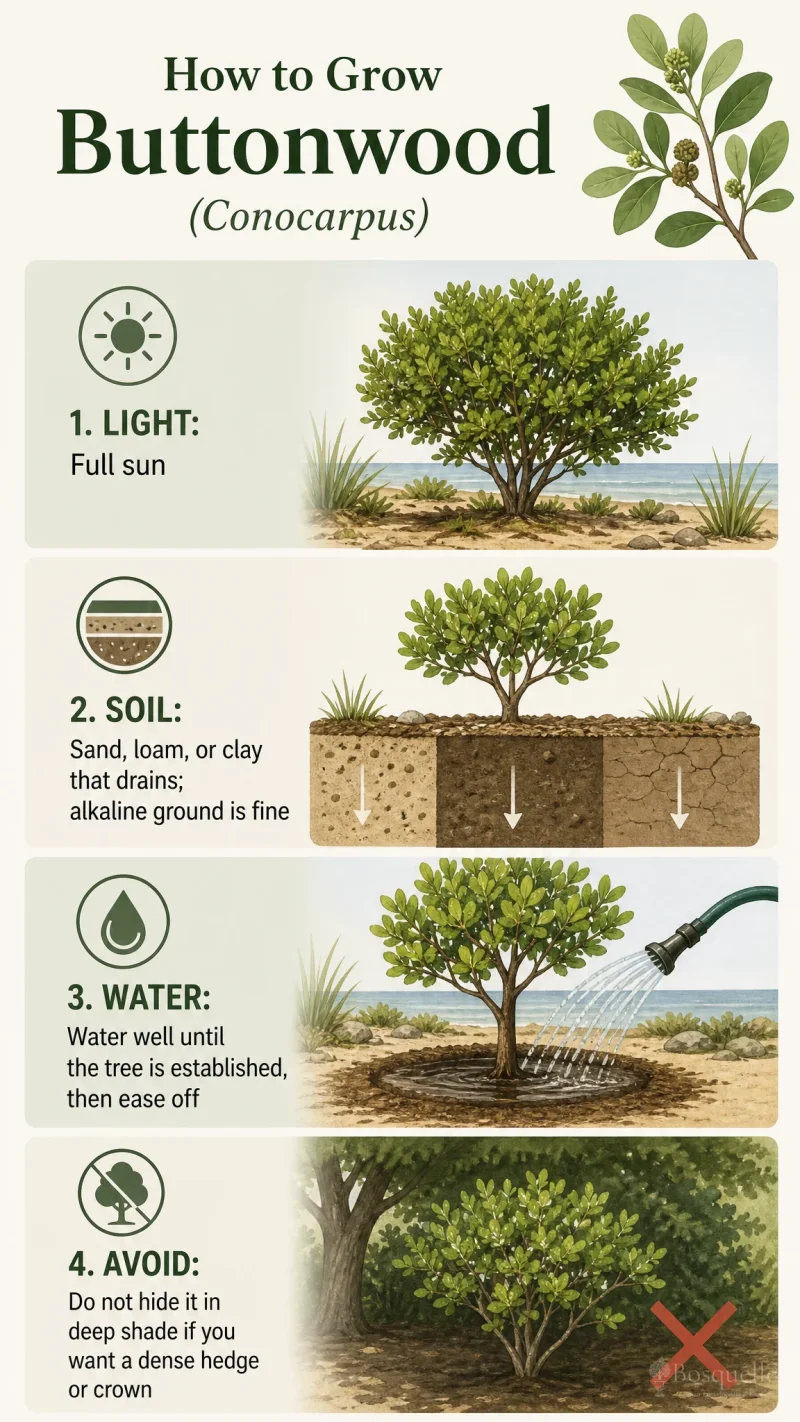
Give it full sun, salt spray, and soil that drains
| Factor | Recommended | Avoid |
|---|---|---|
| Light | Full sun | Do not hide it in deep shade if you want a dense hedge or crown |
| Water | Water well until the tree is established, then ease off | Do not skip water on a new root ball, and do not leave an established tree in bone-dry fill for months |
| Soil | Sand, loam, or clay that drains; alkaline ground is fine | Do not plant into a hole that stays full of salt water |
| Salt | Coastal wind, spray, and salty soil once the tree is established | Do not set it where salt water stands |
| Frost | Frost-free coastal ground; the silver-leaf form is less cold-hardy than the green | Do not leave a young plant unsheltered through a hard freeze north of the coast |
| Room | A landscape tree is about 20 to 40 feet tall and wide; a sheared hedge stays smaller | Do not plant a street tree against a foundation as if it will stay a 3-foot shrub |
| Leaf color | Green smooth leaves, or silver hairy leaves on the same species | Do not plant the silver form well inland if sooty mold is already a problem on hairy leaves |
buttonwood is Conocarpus erectus, an evergreen with leathery oblong leaves and small cone-like fruit that look like buttons. Give it full sun, and water a new tree until it is established. After that, it takes dry spells and coastal spray. [1] Salt spray and brackish soil are fine. Standing salt water is a different problem: skip a site that floods with seawater. [2] Green and silver leaves are two color morphs of this species, not two plants. The silver form is usually smaller and shrubbier. Inland, the hairs on silver leaves hold honeydew, and sooty mold follows — plant the smooth green form there instead of reaching for a spray.
How much sun does buttonwood need?
Full sun. Deep shade thins a hedge and opens the crown.
How often should I water buttonwood?
Water well until the roots take, then ease off. An established tree takes dry spells. A new planting still needs a deep soak in heat.
Does buttonwood take salt spray?
Yes. Wind and spray are the coastal job. Do not plant it where salt water stands.
What is the difference between green and silver buttonwood?
Same species. Green leaves are smooth and the tree grows taller. Silver leaves are hairy and the plant stays shrubbier. Both want the same sun, salt spray, and drainage.
Plant a nursery tree with room to mature, or space a hedge you will shear
Set a nursery tree where it can reach about 20 to 25 feet in the open, or 40 feet if you leave it alone for decades. Homeowners often plant it against a foundation because the young plant looks small. That crowding is the usual reason the tree later has to be cut hard.
- Pick a frost-free, draining site in full sun. Salt spray is fine; standing salt water is not.
- For a street or parking-lot tree, buy a plant already trained to one trunk.
- Slide the plant out of the pot. Set the root ball even with the surrounding soil, and do not bury the trunk.
- Space street trees about 15 feet apart if you want a closed canopy. For a hedge, set plants so the mature crowns can meet, then shear.
- Water well after you plant, then until the tree is established.
How far apart do I plant it?
About 15 feet for a street canopy. A hedge is closer, so the crowns can meet and you can shear. Leave a specimen room for a 20- to 40-foot spread.
Train one trunk for a street tree, or shear a hedge
Decide hedge versus tree while the plant is young. Buttonwood takes clipping, so a screen or a formal hedge is a real use. A street tree needs one trunk from the start, because cutting several trunks off later makes more sprouts at the base.
- For a street tree, keep one leader and raise the lowest branches as it grows.
- For a hedge or screen, shear during the warm growing season. Cut only what you must on a specimen, and leave the picturesque wind-shaped crown near the shore.
- Do not shear a 40-foot tree into a 3-foot wall. Hold a hedge on plants you intend to clip from the start.
When can I prune buttonwood?
Shear a hedge in the warm growing season. Train a street tree while it is young. After a freeze, wait until late spring and cut only dead wood.
Wait until late spring to cut after a freeze
A hard freeze can blacken leaves and kill tips, and the silver-leaf form is less cold-hardy than the green. [3] Wait until late spring. Cut only dead wood back to green tissue. Do not cut hard the week after the cold night — you open more wood to the next front.
Root a cutting so silver leaves stay silver
The usual start from a plant you already have is a stem cutting in warm weather. Seed also sprouts, and water carries it, but the silver leaf color does not come true from seed. [4] Take cuttings from the plant whose leaves you want to keep.
- Cut a 6-inch tip from a healthy stem in warm weather, and strip the lower leaves.
- Stick the bare stem in moist mix that drains, or in perlite, and keep the remaining leaves above the mix.
- Keep it warm and humid, out of hot afternoon sun, until a gentle tug meets resistance.
- Pot it up, water it until the roots take, then grow it on in full sun.
Can I start buttonwood from seed?
Yes, and nurseries do. Seed will not hold silver leaves. Take a cutting from the silver plant if color is the point.
Not buttonbush — and not a true mangrove
Buttonwood sits on the upland edge of a mangrove swamp. It does not make prop roots or pencil roots, and the seed does not sprout on the tree. Buttonbush is Cephalanthus, a wetland shrub with round white pincushion flowers — see How to Grow Buttonbush. Black mangrove is Avicennia, with pencil roots in the tide — see How to Grow Black Mangrove. Red mangrove is Rhizophora. White mangrove is Laguncularia. A street tree sold only as conocarpus in the Middle East is often Conocarpus lancifolius, a different species we do not list. Confirm the tag says Conocarpus erectus.
Is buttonwood the same as buttonbush?
No. Buttonbush is Cephalanthus, a wetland shrub with white pincushion heads. Buttonwood is Conocarpus, a coastal tree or hedge.
Is buttonwood a true mangrove?
No. It grows at the landward edge and takes salt spray, but it has no prop roots or pencil roots. Black, red, and white mangrove are other plants.
Set buttonwood in full sun on draining coastal ground, water it until the roots take, then ease off.
FAQ
Does it come back after a freeze?
Often from wood that stayed green, if the roots were not killed. Wait until late spring, then cut dead wood. The silver form is the first to take a hard freeze.
Can I grow it in a pot?
Yes, in a large pot that drains, in full sun, if you can move it in before a freeze. It will not become a 40-foot tree in a container. Bonsai is a specialist craft on this species, not ordinary patio care.
Is Mombo a different plant?
Mombo is a denser, smaller shop name on this species. It still wants full sun, drainage, and salt spray — not a second kind of care.
Was the wood used for charcoal?
Yes, historically, along the Florida coast. That is not a kitchen project for a garden tree.
Should I plant it in Hawaii?
No. It has become invasive there. Keep it on frost-free coasts where it is native, and watch seedlings near a shoreline.
Recommended plants

References
- [1] UF/IFAS Extension -
https://ask.ifas.ufl.edu/publication/ST179 - [2] Florida Native Plant Society -
https://www.fnps.org/plant/conocarpus-erectus - [3] Lady Bird Johnson Wildflower Center -
https://www.wildflower.org/plants/result.php?id_plant=coer2 - [4] Institute for Regional Conservation -
https://regionalconservation.org/beta/nfyn/plantdetail.asp?tx=Conoerec
More first-season notes by plant are gathered in How to Grow Guides.
Updated: Reviewed by Bosquelle Editors