
Grow bat flower in shade or bright filtered light, in mix that stays evenly moist but drains, and raise humidity around the pot. It is Tacca chantrieri, also sold as black bat flower, not cat's whiskers the mint and not a bat orchid.

Keep it in shade, evenly moist, and humid
| Factor | Recommended | Avoid |
|---|---|---|
| Light | Shade outdoors, or bright light with no harsh midday sun indoors | Do not set it in hot afternoon sun, which scorches the leaves |
| Water | Keep the mix evenly moist, like a wrung-out sponge, then let extra water drain | Do not let the rhizome sit in a soggy saucer, and do not let the mix go bone-dry |
| Humidity | Keep the air around 50% or higher with a pebble tray or a humidifier | Do not soak the leaves in a closed, dripping bag |
| Warmth | Keep it above about 55°F, in still air that is not a cold draft | Do not leave the pot out once nights drop into the 40s |
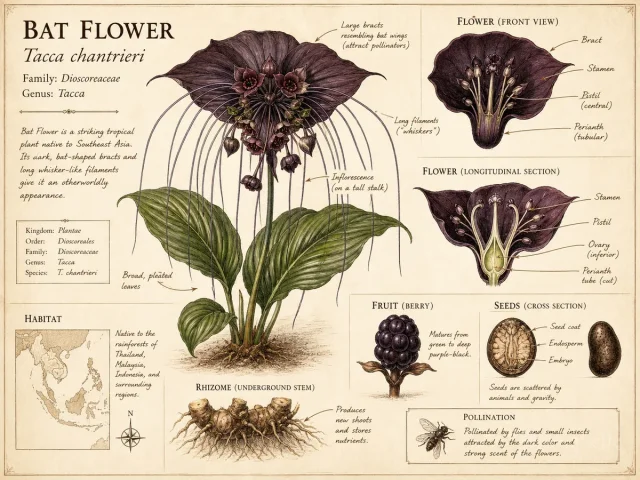
bat flower is Tacca chantrieri, a rhizome from tropical forest shade. The true flowers sit in a cluster under two wing-like bracts, with long thread-like bracteoles hanging like whiskers. [1] Keep it out of direct sun at all times. Outdoors that means shade. Indoors that means a bright window with no harsh midday beam. The mix should stay evenly moist and still drain, because a soggy pot rots the rhizome and a dry pot stalls the leaves. [2] It also wants humid air and a little airflow, the same kind of room you would give a terrestrial orchid. If the room stays below about 50% humidity, set the pot on a pebble tray or run a humidifier nearby. Do not treat a mist bottle as the whole method. [3] Flowers usually come after the plant has at least two strong leaves, in late spring through fall when light, moisture, and humidity hold. Take divisions on How to Propagate Bat Flower.
How much light does a bat flower need?
Shade outdoors, or bright light with no harsh midday sun indoors. Hot afternoon sun scorches the leaves.
How often should I water it?
Keep the mix evenly moist, then let extra water drain. Do not leave the rhizome in a soggy saucer, and do not let the mix go bone-dry.
How do I raise humidity?
Use a pebble tray or a humidifier so the air around the pot stays about 50% or higher. Grouping plants helps. Do not soak the leaves.
Bring the pot in before cold nights
This plant will not take frost. Where summers are warm, set the pot in outdoor shade, then bring it in before nights drop into the 40s, and keep it above about 55°F. Give it as much indirect light as you can in winter. If the leaves die back in a cool room, water less so the rhizome does not rot. In a warm room that stays in leaf, keep the mix evenly moist and skip feed until new growth starts.
When do I bring it indoors?
Before nights drop into the 40s. Keep the pot above about 55°F, out of cold drafts and heating vents.
Plant the rhizome in a wide pot that drains, with the top just showing
Most U.S. gardens keep this plant in a container. Choose a wide, shallow pot with a drainage hole, and a rich mix that still drains — pine bark, peat, and a little sand, or a peat mix cut with perlite. Set the rhizome upright so the top sits just above the mix, about half an inch showing, then water once to settle. [4] A 10- to 12-inch pot is enough for a mature clump. When roots fill it, move up one size in spring, or trim the roots and return it to the same pot with fresh mix. Plant in the ground only where frost never hits, in shade, in soil that stays moist but drains.
- Choose a wide pot with a drainage hole. Empty the saucer after you water.
- Fill it with a rich mix that still drains. Do not pack garden soil that stays wet.
- Set the rhizome upright so the top and the leaf bases sit just above the mix, about half an inch showing. Do not bury it deep.
- Water once to settle, then keep the mix evenly moist, not soggy.
- Repot in spring when roots fill the pot, or trim crowded roots and refresh the mix in the same pot.
How do I pot the rhizome?
Use a wide pot with a hole. Set the rhizome upright so the top sits just above the mix, about half an inch showing, then keep the mix evenly moist.
Not cat's whiskers — and not a bat orchid
Bat flower is Tacca chantrieri. Shops also print cat's whiskers, devil flower, and tiger beard on the tag. Those names describe the long bracteoles. They do not mean Orthosiphon, the sun-grown mint sold as cat's whiskers, with white or pale purple stamens that stick out like whiskers. A bat orchid is an orchid. Tiger lily is Lilium — see How to Grow Lilies.
White bat flower is Tacca integrifolia, a related species with pale bracts. It wants the same shade and humidity. Black bat on its own is the animal, not this plant.
Is this cat's whiskers?
Not the mint. Orthosiphon is a sun plant with long stamens. This plant is Tacca chantrieri; the whiskers are thread-like bracteoles on a dark bract.
Is this a bat orchid?
No. A bat orchid is an orchid. Bat flower is Tacca, a yam-family rhizome with wing-like bracts.
If leaf edges brown, raise humidity and keep the mix evenly moist. If the rhizome turns soft, empty the saucer and let the pot drain.
FAQ
Is black bat flower the same plant?
Yes. Black bat flower, devil flower, and tiger beard are other names for Tacca chantrieri, the plant sold as bat flower.
Do you list white bat flower?
White bat flower is Tacca integrifolia, a related species with pale bracts. The plant here is Tacca chantrieri.
Is it a perennial?
Yes, as a tropical rhizome. It stays in leaf where nights stay warm. Where frost hits, keep it in a pot you can bring inside.
Is it safe around pets?
It is not on the ASPCA plant lists. Keep pets from chewing the leaves, as you would with any houseplant you have not confirmed.
Can I cut the flowers for a vase?
No. The blooms decline fast once they are cut. Leave them on the plant.
Can I eat the rhizome?
No. Polynesian arrowroot is another Tacca species. Grow this plant for the bloom, not for the kitchen.
Related guides

Recommended plants
References
- [1] University of Arkansas Extension -
https://www.uaex.uada.edu/yard-garden/resource-library/plant-week/Tacca-chantrieri-Black-Bat-Flower-10-28-2016.aspx - [2] Gardening Know How -
https://www.gardeningknowhow.com/ornamental/flowers/bat-flower/growing-bat-flowers.htm - [3] UF/IFAS Gardening Solutions -
https://gardeningsolutions.ifas.ufl.edu/plants/ornamentals/bat-flower/ - [4] Easy To Grow Bulbs -
https://www.easytogrowbulbs.com/pages/tacca-planting-guide
This note is part of Tacca Guides.
More first-season notes by plant are gathered in How to Grow Guides.
Updated: Reviewed by Bosquelle Editors