
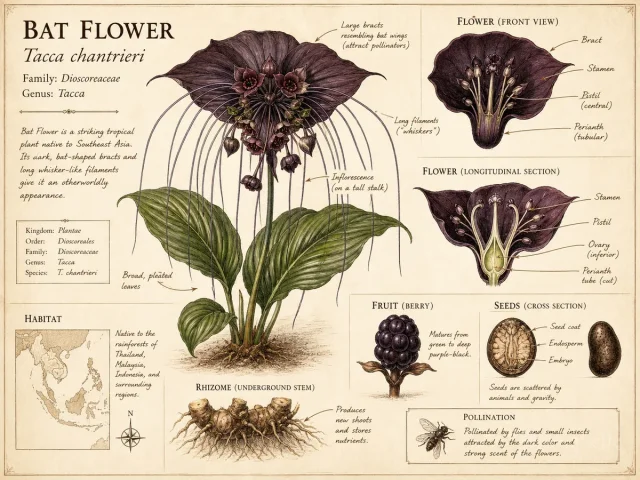
Propagate bat flower by dividing the rhizome in spring. Each piece needs at least one bud. Pot it in fresh mix that drains, and keep that mix barely moist until a new leaf shows. Seed can sprout; division is the usual home start.

Divide the rhizome in spring, with at least one bud on each piece
| Factor | Recommended | Avoid |
|---|---|---|
| When | Spring, at repotting, before new leaves take off | Do not split a plant that is in full bloom if you can wait |
| Piece | A firm rhizome with at least one visible bud, and some roots if you have them | Do not pot a soft, rotten section, and do not bury a piece with no bud |
| Mix | Fresh, rich mix that still drains, in a pot with a hole | Do not pack a large pot of wet soil around a small piece |
| Water | Keep the mix barely moist until a new leaf shows | Do not sit the new pot in a full saucer |
bat flower multiplies from the rhizome. When you repot in spring, you can split a crowded clump and start a new pot. [1] Each piece needs at least one bud. You can also cut a firm rhizome into short sections, each with a bud, and pot those pieces. [2] Divide when the tubers are crowding the pot, not on a calendar for its own sake. [3] Plant one piece per pot so the new plant has room. Keep it warm, in bright light without harsh sun, until new leaves show.
- Knock the plant out in spring, before strong new growth, and brush or rinse mix off the rhizomes.
- Look for natural breaks. Cut only where you must, with a clean knife, so each piece is firm and has at least one bud.
- Discard any section that is soft or rotten. Let a fresh cut dry for a short time if it weeps.
- Pot each piece in a small, wide pot with a hole, in fresh mix that drains. Set it so the top of the rhizome sits just above the mix.
- Water once to settle, then keep the mix barely moist. Do not feed until a new leaf is growing.
When do I divide a bat flower?
In spring, when you repot, before new leaves take off. Split it when the rhizomes crowd the pot.
What fails a division?
A piece with no bud, a soft rotten section, or a small piece sitting wet in a large pot. Use draining mix and keep it barely moist.
Seed is slow, so division is the usual start
You can sow seed on the surface in a warm, moist mix, around 75°F. Barely cover it, keep it in bright indirect light, and wait. Seed may take weeks or months, and packets are often unreliable. [4] Division gives you a plant that already knows how to make leaves. A stem cutting is not the home method; this plant does not root from a leafy snip the way a coleus does. Once a new leaf shows, grow it on How to Grow Bat Flower.
Can I grow it from seed?
Yes, but it is slow. Sow on the surface in warm, moist mix and wait months. Division is the usual home start.
If a division collapses, use a smaller pot, draining mix, and keep it barely moist until a new leaf shows.
FAQ
Can I take a stem cutting?
No. This plant starts from a rhizome piece with a bud, not from a leafy stem snip.
Can I leave a division in water?
No. Pot it in mix that drains. A rhizome sitting in water rots.
Will seed match the parent?
Species seed comes close. If you want the same plant you already like, divide the rhizome.
Related guides

Recommended plants
References
- [1] UF/IFAS Gardening Solutions -
https://gardeningsolutions.ifas.ufl.edu/plants/ornamentals/bat-flower/ - [2] Royal Horticultural Society -
https://www.rhs.org.uk/plants/133122/tacca-chantrieri/details - [3] University of Arkansas Extension -
https://www.uaex.uada.edu/yard-garden/resource-library/plant-week/Tacca-chantrieri-Black-Bat-Flower-10-28-2016.aspx - [4] Guide to Houseplants -
https://www.guide-to-houseplants.com/bat-flower.html
This note is part of Tacca Guides.
More notes on making another plant live in Propagating Guides.
Updated: Reviewed by Bosquelle Editors