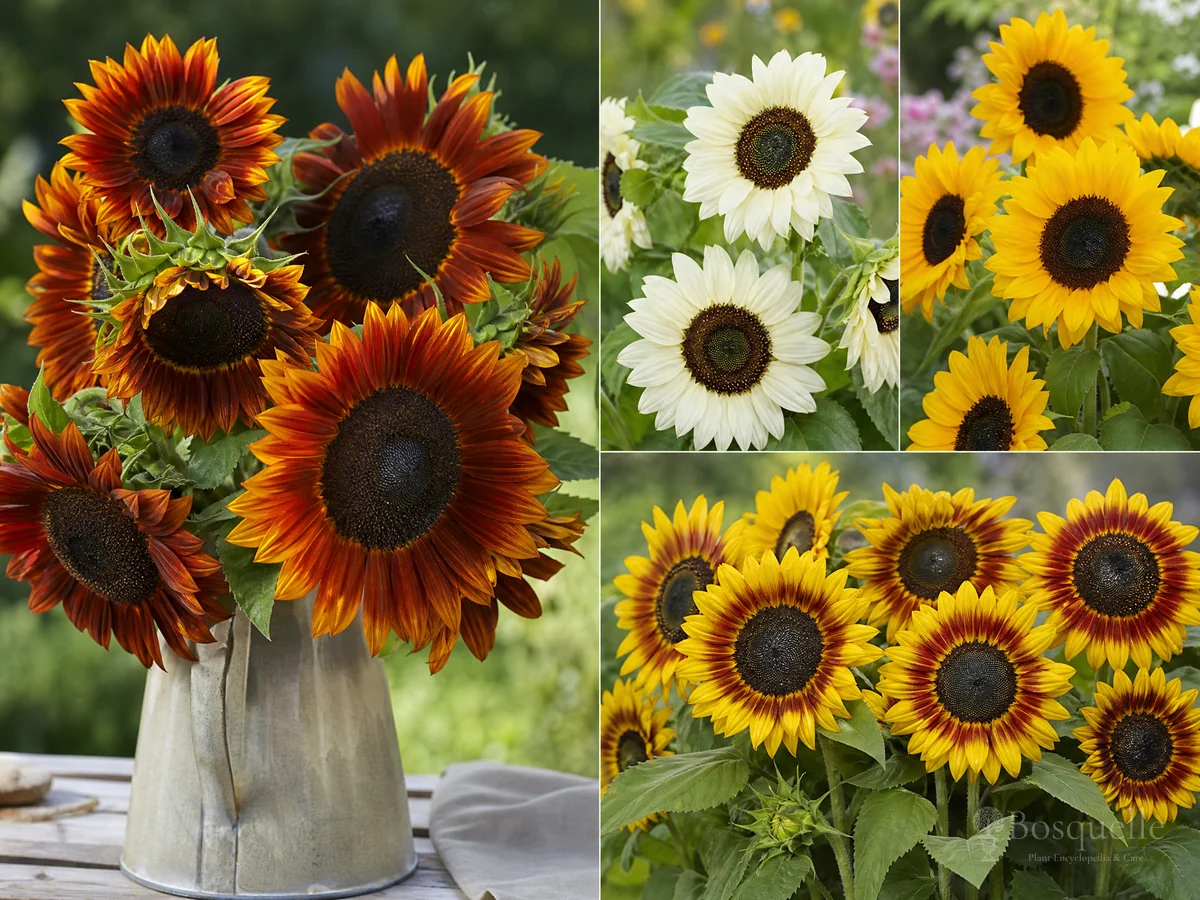
Cut sunflowers from a pollen-free series or a branching garden kind, not from a 12-foot seed giant. ProCut Red, ProCut White Nite, Vincent's Choice, and Sunrich Gold are the florist-style annuals. Soraya branches. Harvest in the cool morning when the first petals lift. Scent is not the job.

Pollen-free stems, not giant heads
| Factor | Recommended | Avoid |
|---|---|---|
| Kind | Pollen-free singles (ProCut, Sunrich) or branching cuts | A mammoth seed head in a kitchen vase |
| Pollen | Pollen-free for a clean table and longer vase life | A pollen-shedding garden mix over a white cloth |
| Spacing | Singles 4–6 inches for long stems; branching 18–24 inches | Giant 2-foot spacing copied onto a cutting row |
| Harvest | First petals lifting from the disc; morning cut | Fully open, pollen-dusted heads in noon heat |
Florists want a stiff neck and a vase that does not shed pollen. Oregon State University Extension: pollen-free series such as ProCut and Sunrich are bred for cut flowers and a long vase life; the largest garden kinds are awkward in a normal vase. Site, frost, and water stay on How to Grow Sunflowers.
Single-stem hybrids give one main harvest per plant, so sow every week or two if you want a steady bucket. Branching kinds such as Soraya, Floristan, Claret, and Ring of Fire give more stems from one plant and a slightly shorter vase life. Both are still annuals.
Do not grow Russian Mammoth for the vase. The head is a seed and show job. Compact Teddy Bear is a garden double; it can sit in a small arrangement but it is not a 36-inch florist stem.
Space singles tight so stems stay long and heads stay a florist size. Wide spacing on a ProCut row makes a garden plant with a thicker neck — fine in a border, clumsy in a mixed bouquet. Branching kinds need the wider gap or the side shoots rot in a wet week.
How to cut sunflowers for the vase
Cut when the head is just opening. Utah State University Extension: sunflower is a full-sun cut crop; harvest and cool storage keep stems usable. Fully open flowers fade faster.
- Cut in the morning, or in the evening, when stems are firm. Skip the hot noon window. Take a bucket of water into the row.
- Harvest when the first one or two petals lift from the disc and the center is still tight. Do not wait until the whole head is flat and dusty with pollen.
- Cut a stem about 24 to 36 inches if the plant allows. Use clean shears. Place the stem in water at once.
- Strip leaves that would sit under water. Recut the stem at an angle if it sat dry. Use a clean vase.
- Hold in a cool room out of direct sun. Change water and recut every few days. Floral preservative helps; dirty water does not.
- For single-stem rows, sow again after you cut so the next wave is coming. One ProCut plant is one main stem.
Pollen-free singles often last about 7 to 14 days if you cut at the right stage. Branching garden kinds often run closer to 7 to 10. A fully open head on a hot afternoon is already behind.
Do not store a bucket in a closed hot car. Do not smash heads into a vase so tight that necks kink. Stake the row if you want straight stems — a lodged cutting plant is a bent neck in the bucket.
If petals never open indoors, you cut too tight a bud. If the vase is full of yellow dust the next day, you cut a pollen-bearing kind too late. Next stems: earlier, cooler, pollen-free if the table matters.
ProCut, branching, and what fails a bouquet
What fails: a mammoth head; waiting until seed shows; cutting in heat; leaving submerged leaves; treating scent as the reason to grow these. Sunflowers are not a perfume crop. Color and a clean disc are the look. Kinds you might buy next live on Types of Sunflowers.
ProCut Red and ProCut White Nite are the series we hold for red and pale florist looks. Vincent's Choice and Sunrich Gold are yellow-gold cutting annuals. Soraya is the branching orange. Floristan, Claret, and Ring of Fire are darker or bicolor garden cuts. All still want full sun and a frost-free sow.
If you need bees on the patch, keep a branching pollen-bearing row separate from the pollen-free cutting row. If you need seed, grow a giant in a different strip and do not cut those heads for the table.
Succession sowing is the cutting calendar. One May row is one June bucket. Sow again on a staggered date using the same frost-and-sun method.
Condition overnight in a cool dark room if you can. Recut slimy stems. A clean bucket beats a fancy preservative in dirty water. Do not mix sunflower stems with a vase of rotting foliage from another crop — change the water.
Choose pollen-free singles or branching cut kinds, not a mammoth seed head. Cut in the cool morning when the first petals lift. Strip submerged leaves. Sow again for the next bucket. Scent is not the reason to grow these. Stake the row so necks stay straight. Sow the next strip before this one peaks. Strip leaves under the waterline the same day you cut. Change the vase water every few days. Use clean shears.
FAQ
What are the best sunflowers for cutting?
Pollen-free series such as ProCut and Sunrich, or branching kinds such as Soraya. Skip giants.
When do I cut sunflowers?
In the morning, when the first petals lift from the disc and the center is still tight.
Why choose pollen-free sunflowers?
They shed less mess on a table and often last longer in the vase than pollen-bearing garden mixes.
How long do cut sunflowers last?
About 7 to 14 days for pollen-free singles cut at the right stage. Fully open heads fade sooner.
Can I cut Russian Mammoth?
You can, but the head is too large for a normal vase. Grow it for seed and height, not florist stems.
Do I need rooting hormone to cut sunflowers?
No. You are harvesting a bloom, not rooting a stem. Put the cut stem in water.
Should I grow single-stem or branching?
Singles for uniform long stems and succession sowing. Branching for more flowers per plant.
Are cut sunflowers fragrant?
Fragrance is not the job. Grow them for color, a clean disc, and vase life.
Where is spacing and frost timing?
How to Grow Sunflowers. Types of Sunflowers if you are choosing annual versus perennial.
Related guides


Recommended plants


This note is part of Helianthus Guides.
More job shortlists live in Best Plant Picks Guides.
Updated: Reviewed by Bosquelle Editors