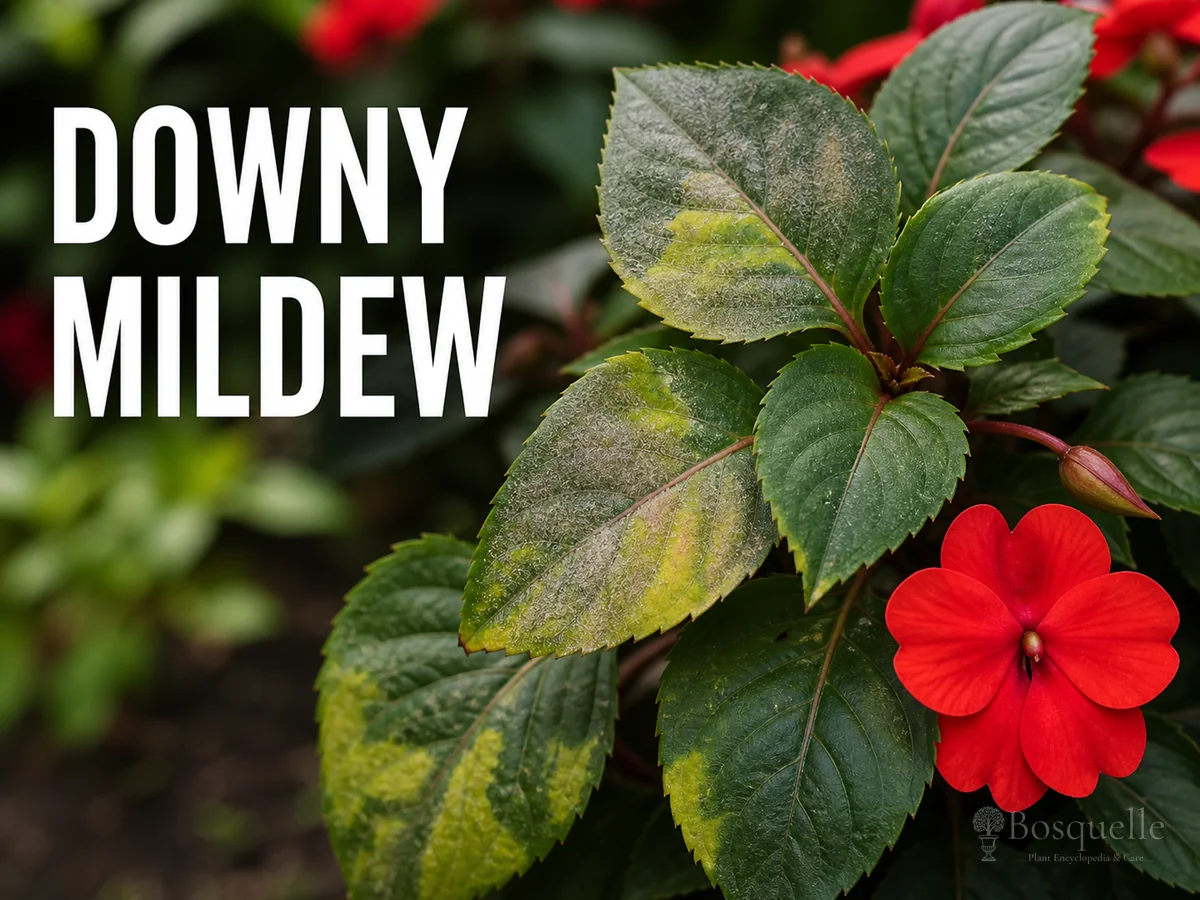
Downy mildew is a leaf disease caused by fungus-like water molds (oomycetes), not the same organisms as powdery mildew and not the petal-rot job of gray mold. Yellow blotches on the upper surface often pair with pale, gray, or purplish fuzz underneath, and the yellow frequently stops at a vein. If you need to flip a leaf tonight, stop watering the canopy, and know why a powdery-mildew spray did nothing.
Do this first: flip a yellowing leaf. If the underside is fuzzy and the blotch is quilted, bag the worst leaves, water at the base in the morning, and leave the powdery bottle on the shelf.
Flour on top, fuzz underneath, or a rotting petal
| What you see | Likely | Do this first |
|---|---|---|
| Angular or quilted yellow on top; gray, white, or purple fuzz underneath | Downy mildew | Dry the canopy; bag badly hit leaves |
| Wipeable white flour on the leaf face; tissue still firm | Powdery mildew | See powdery mildew — different organism |
| Fuzzy gray coat on a softening bloom, bud, or berry | Gray mold | See gray mold — bag the mush |
| Yellow with no fuzz and no vein pattern | Often nutrient or virus lookalike | Flip more leaves on a humid morning before you spray |
Powdery mildew often dusts a finger. Downy does not wipe off; it grows inside the leaf and sporulates underneath. Gray mold collapses petals and fruit. If the leaf is still a leaf and the underside is downy, you are here.
Quilted yellow that stops at the vein
Look at the top of the leaf first: pale green, yellow, purple, or brown blotches, often with a straight edge where a vein blocked spread. Then flip it. Matching fuzz on the underside may be white, gray, or purple. On lettuce the angles are obvious. On rose or foxglove the fuzz can be hard to see even with a lens — cool wet weather plus vein-bound blotch still counts. Young leaves and seedlings show it first. Edges may curl down. Stems and stalks often look fine while the canopy yellows, which is why people wait too long. On cucurbits the yellow mosaic turns brown and the fruit then sunscalds because the leaves are gone. Spores can vanish after a few dry days, so an “empty” underside does not clear the disease.
The bottle said mildew — it was the wrong mildew
Gardeners buy one “mildew” product and use it on both jobs. Powdery mildew is a true fungus. Downy mildew is an oomycete. A spray labelled only for powdery mildew often misses downy entirely. Confirm the leaf-flip first. Then change wet hours — morning base water, air, spacing — before any labelled downy product. Skip the brand aisle. Do not reach for a second bottle that also says mildew before you have flipped a leaf.
Lettuce, cucurbits, impatiens, roses — not one disease
Gardeners say “downy mildew,” but lettuce, cucumbers, busy lizzies, and roses each meet a different pathogen. Culture overlaps: dry leaves, air, resistant types when you replant. A resistant lettuce does not protect impatiens. Impatiens downy mildew stays on impatiens — it will not jump to your roses — but rose downy is still a wet-leaf job on roses. Check the plant you grow. Host cards below are the live list; On cucumbers and melons, trellis so leaves dry, and expect fruit to scald once the canopy is gone — that is the crop loss, not a separate URL.
Eight to twelve wet hours
Spores landing on a host germinate and infect in about eight to twelve hours if the plant is wet. Cool air — roughly forty to seventy degrees Fahrenheit — plus high humidity or free moisture on the leaf keeps the clock running. Evening overhead water and a closed greenhouse after dusk are how a “careful” gardener feeds it overnight. Water at the base in the morning so the underside dries by night. Open vents even on cool days. Fail if foliage is still wet at bedtime and you reach for a bottle instead of a tap change. Heat and drying winds shut outbreaks down; a cool wet week starts them.
Busy lizzies that strip to bare stems
Classic garden impatiens (Impatiens walleriana) can look only a little mottled, then drop leaves and flowers until a bare stem remains — people blame rabbits. Flip a curled leaf: white-gray fuzz underneath is the sign. Once it is in the plant, landscape sprays do not finish it. Bag the whole plant, roots and fallen debris included, and take it off the bed. Do not compost it. New Guinea impatiens, SunPatiens, and resistant series such as Beacon or Imara are a different rung. Wait two to three years before putting walleriana back on a hit bed, or plant begonia or coleus instead (coleus has its own downy — not this one). Inspect new packs before they share a shade bed.
Resting spores wait in the soil
Airborne spores die quickly. Oospores inside rotting tissue are tougher. They drop into the soil as leaves break down and can wait years — up to five on some hosts — then infect through roots when you replant the same crop. That is why a “clean” busy-lizzie bed fails the next spring. Rotate vegetables. Do not drop the same ornamental host on last year’s grave for at least a year, longer for impatiens. Bag the worst debris. A cold compost heap is a hotel. Do not till infected leaves into the bed and call it feeding the soil.
Dry the foliage — labelled downy last
- Flip before you treat: quilted yellow plus underside fuzz is this disease. Flour that wipes is powdery. Petal mush is gray mold.
- Water at the base in the morning so leaves dry by night. Stop evening overhead. Fail if the canopy is still wet at bedtime.
- Open air: space, thin, trellis cucurbits, and vent a greenhouse daily even in cool weather.
- Bag badly blotched leaves and destroy a collapsing impatiens, roots and all. Do not compost the worst tissue.
- Replant honestly: resistant lettuce or basil where listed; New Guinea or Beacon — not walleriana — on a hit shade bed.
- Fungicide last: if culture fails, follow a local label that names downy mildew — skip the brand aisle. Fail if you still spray “mildew” without a leaf-flip.
Related reading
- Powdery mildew — white flour on the leaf face; often different weather and a different organism.
- Gray mold or Botrytis — fuzzy gray rot on soft flowers and fruit in cool damp air.
FAQ
Is downy mildew the same as powdery mildew?
No. Powdery mildew is a true fungus that often sits as wipeable white flour on the leaf face. Downy mildew is an oomycete — a water mold — that yellows the top in a quilted, vein-bound blotch and fuzzes the underside. Flip the leaf before you treat.
How do I tell powdery mildew from downy mildew?
Rub the white. If it dusts off like flour and the tissue stays firm, see powdery mildew. If nothing wipes and the underside is gray, purple, or white and fuzzy, you are here. Gray mold rots petals and fruit, not a mature leaf blade.
Will a powdery mildew spray kill downy mildew?
Usually no. The organisms are not the same, so a product labelled only for powdery mildew often misses downy entirely. Flip first. Then dry the canopy. Use only a product whose label names downy mildew. Skip the brand aisle.
How do I get rid of downy mildew naturally?
Stop evening overhead water, space and thin so leaves dry, bag badly blotched leaves, and choose a tougher type when you replant. Culture is the job. Baking-soda recipes belong to powdery-mildew searches, not this organism.
Do I need wet leaves for downy mildew?
Yes. Spores need free moisture. About eight to twelve hours of wet leaf — or air stuck near ninety percent humidity — is enough. Water at the base in the morning. Fail if foliage is still wet at bedtime.
Does downy mildew kill plants?
It rarely kills a tough woody shrub at a few blotches. Seedlings, lettuce, cucurbits, and garden impatiens can defoliate fast. Busy lizzies often strip to bare stems and then collapse. Bag the worst and dry the rest before the bed is a spore source.
Should I throw away impatiens with downy mildew?
Yes, once leaves yellow, curl down, and show white-gray fuzz underneath. Bag the whole plant, roots and fallen leaves included. Landscape sprays do not cure an infected walleriana. Fail if it stays in the shade bed 'to see'.
Can I replant busy lizzies in the same bed?
Wait two to three years, or plant New Guinea impatiens, SunPatiens, Beacon, or Imara types — or begonia and coleus. The impatiens pathogen is not your rose downy, but oospores can wait in that soil. Do not drop walleriana on last year's grave.
Are New Guinea impatiens safe?
New Guinea and SunPatiens are a different rung from classic busy lizzie. They are reported tolerant or resistant to impatiens downy mildew. Still keep leaves dry. They are not a spray.
Will it spread from impatiens to my roses?
Not that pathogen. Impatiens downy mildew stays on impatiens. Roses, lettuce, and cucurbits each meet a different downy. Wet leaves still spread whichever one you actually have — flip the host you grow.
Can I compost infected leaves?
Do not compost the worst tissue. Oospores survive in debris and soil for years — up to five on some hosts. Bag and bin, or hot-compost only if the pile truly cooks. A cold heap returns the disease.
Why did my powdery-mildew spray fail?
You may have treated the wrong mildew. Downy does not wipe off as flour. Do not reach for a second bottle before you have flipped a leaf, if the canopy is still wet overnight. Dry hours beat a second wrong bottle.
Does downy mildew wipe off?
No. The fuzz is anchored in the leaf. Powdery mildew often dusts a finger. If the white stays put and the underside is downy, stay here.
Is baking soda for downy mildew?
That search belongs to powdery mildew. Do not import a kitchen recipe onto an oomycete. Change the wet hours first. If you later use a product, the label must name downy mildew.
Why are the spots angular?
Leaf veins often stop the organism, so yellow on one side of a vein stays green on the other — a quilted look. Circular white patches that ignore veins are more often powdery.
Host plants
A few garden examples linked on this site — open a plant for care context.

Related diseases




Related pests



Updated: Reviewed by Bosquelle Editors