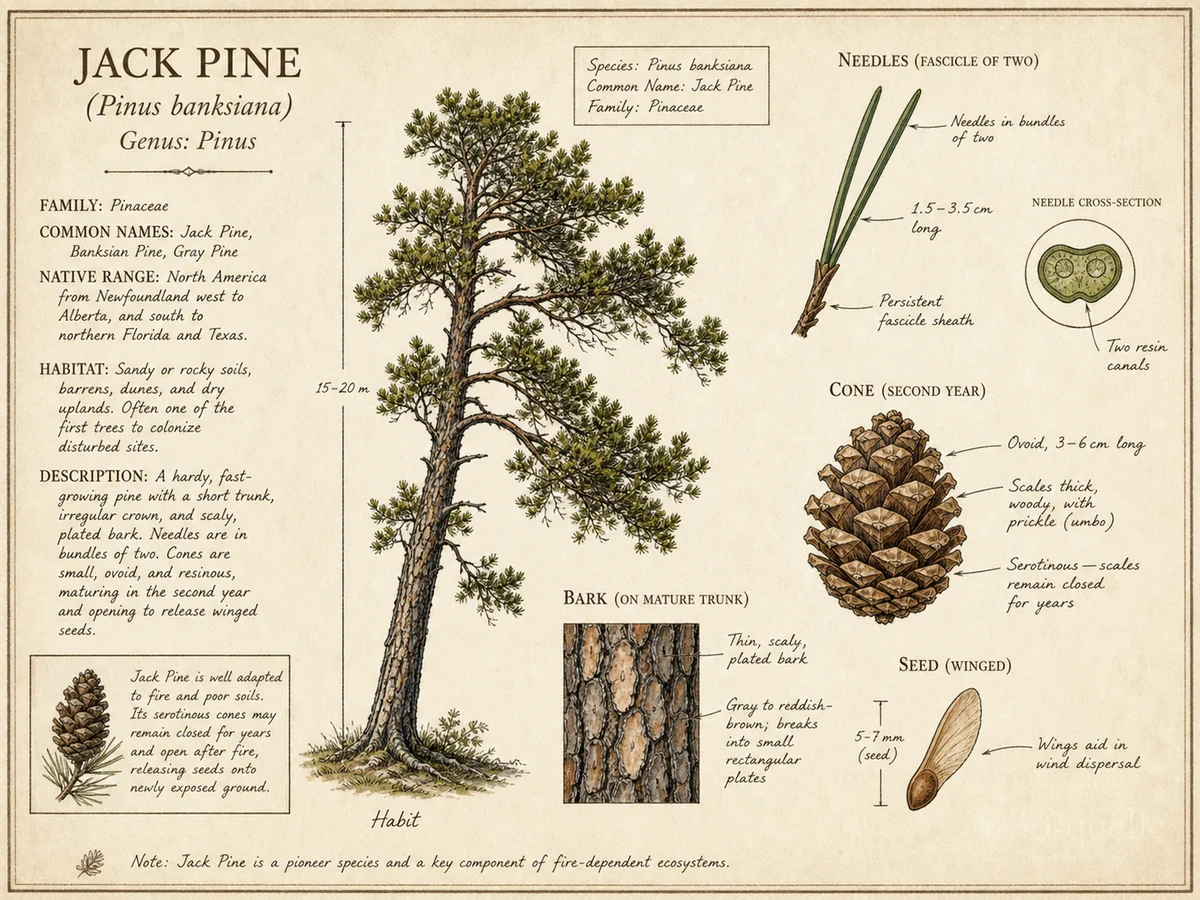
About Jack Pine
Jack Pine (Pinus banksiana) is grown for garden performance matched to its site needs. Expect full sun, typically 10.7–15.2 m tall, low water once established.
Can Jack Pine take your winter? Type your ZIP below and compare it with Zones 3–8.
2023 USDA ZIP listings (PRISM / USDA-ARS). Find Your USDA Hardiness Zone · Official USDA map.
Is Jack Pine Right for Your Garden?
Best for
- Larger gardens needing height, structure, or screening
- Dry gardens, gravel schemes, or water-restricted sites
- Open, sunny positions with good air movement
Not recommended if
- Small or confined spaces where root and canopy spread is a problem
- Permanently moist or boggy ground
- Dense shade or north-facing walls
Trade-off to know
Jack Pine is tolerant once established, but needs consistent water in the first season. Drought tolerance builds slowly — expect 1–2 years before it can fend for itself in dry spells.
Growing Conditions for Jack Pine
Site checklist
- Sun: full sun
- Soil drainage: Moist but Well Drained
- Water: Low
- Hardiness zones: 3, 4, 5, 6, 7, 8
Adjustments
- Wrong light level is the most common cause of weak performance
- Fix drainage before treating leaf symptoms
Shared growing steps for this plant’s group: How to Grow Pine. Notes below stay specific to this plant.
How to Care for Jack Pine
Establishment
- Plant Jack Pine in a site matching its sun and drainage needs
- Water regularly until roots settle, then match watering to the plant’s need
Ongoing care
- Mulch to buffer moisture swings
- Remove dead or damaged growth in season
- Avoid constant wet foliage where disease pressure is high
- Plan support or pruning for long-term structure
Diagnosing Problems with Jack Pine
| Symptom | Likely cause | Confirming sign | Action |
|---|---|---|---|
| Leaves wilting or scorching at tips in dry weather | Drought stress | Soil dry 5+ cm deep; leaf tips brown and crisp, not soft | Water Jack Pine deeply at the base once weekly in dry spells. Mulch around the root zone to retain moisture. |
| Sudden wilting on one branch while rest of plant looks healthy | Root rot from poor drainage in one spot | Affected branch has dark, mushy roots when gently uncovered | Cut back affected branch to healthy wood. Improve drainage in that area before the next growing season. |
| Dieback of branch tips after winter | Frost damage or wind scorch | Damage consistent across exposed side; wood brown inside tip | Prune Jack Pine back to healthy green wood in late spring once growth resumes. Do not prune earlier — wait to confirm what has survived. |
Leaves wilting or scorching at tips in dry weather
- Likely cause
- Drought stress
- Confirming sign
- Soil dry 5+ cm deep; leaf tips brown and crisp, not soft
- Action
- Water Jack Pine deeply at the base once weekly in dry spells. Mulch around the root zone to retain moisture.
Sudden wilting on one branch while rest of plant looks healthy
- Likely cause
- Root rot from poor drainage in one spot
- Confirming sign
- Affected branch has dark, mushy roots when gently uncovered
- Action
- Cut back affected branch to healthy wood. Improve drainage in that area before the next growing season.
Dieback of branch tips after winter
- Likely cause
- Frost damage or wind scorch
- Confirming sign
- Damage consistent across exposed side; wood brown inside tip
- Action
- Prune Jack Pine back to healthy green wood in late spring once growth resumes. Do not prune earlier — wait to confirm what has survived.
Jack Pine FAQ
-
Is Jack Pine easy to grow?
Jack Pine is relatively undemanding once established, particularly in dry conditions. The most common mistakes are poor drainage and incorrect sun placement.
-
How big does Jack Pine get?
Jack Pine typically reaches 10.7–15.2 m. Final size depends on soil quality and available root space. Allow adequate spacing at planting — most plants reach their full spread within 5–10 years.
-
How much sun does Jack Pine need?
Jack Pine grows best in full sun. Planting in the wrong light level is the single most common cause of poor performance. Check the aspect of your site before choosing a position.
-
Is Jack Pine suitable for a small garden?
Jack Pine can reach a significant size and is better suited to larger gardens where root and canopy spread are not a constraint. For smaller spaces, consider a more compact alternative in the same genus or a dwarf cultivar if one is available.
What Jack Pine Symbolises
Bosquelle AI — generated content, not human-reviewed botanical research.
- enduring
- constant
- steadfast
- reliable
References
- [1] GBIF occurrence phenology — Bloom months inferred from StillImage observation seasonality (temperate Northern Hemisphere filter). Not an official cultivar calendar. -
https://www.gbif.org/species/5285533 - [2] GBIF species distributions — Native range summarised from GBIF distribution records; locality noise filtered to country and macro-region terms. -
https://www.gbif.org/species/5285533 - [3] NC State Extension -
https://plants.ces.ncsu.edu/plants/pinus-banksiana/
Taxonomic identifiers
https://www.gbif.org/species/5285533(GBIF 5285533)https://www.wikidata.org/wiki/Q806838(Wikidata Q806838)https://powo.science.kew.org/taxon/kew-2563220(POWO kew-2563220)https://www.ipni.org/n/262801-1(IPNI 262801-1)