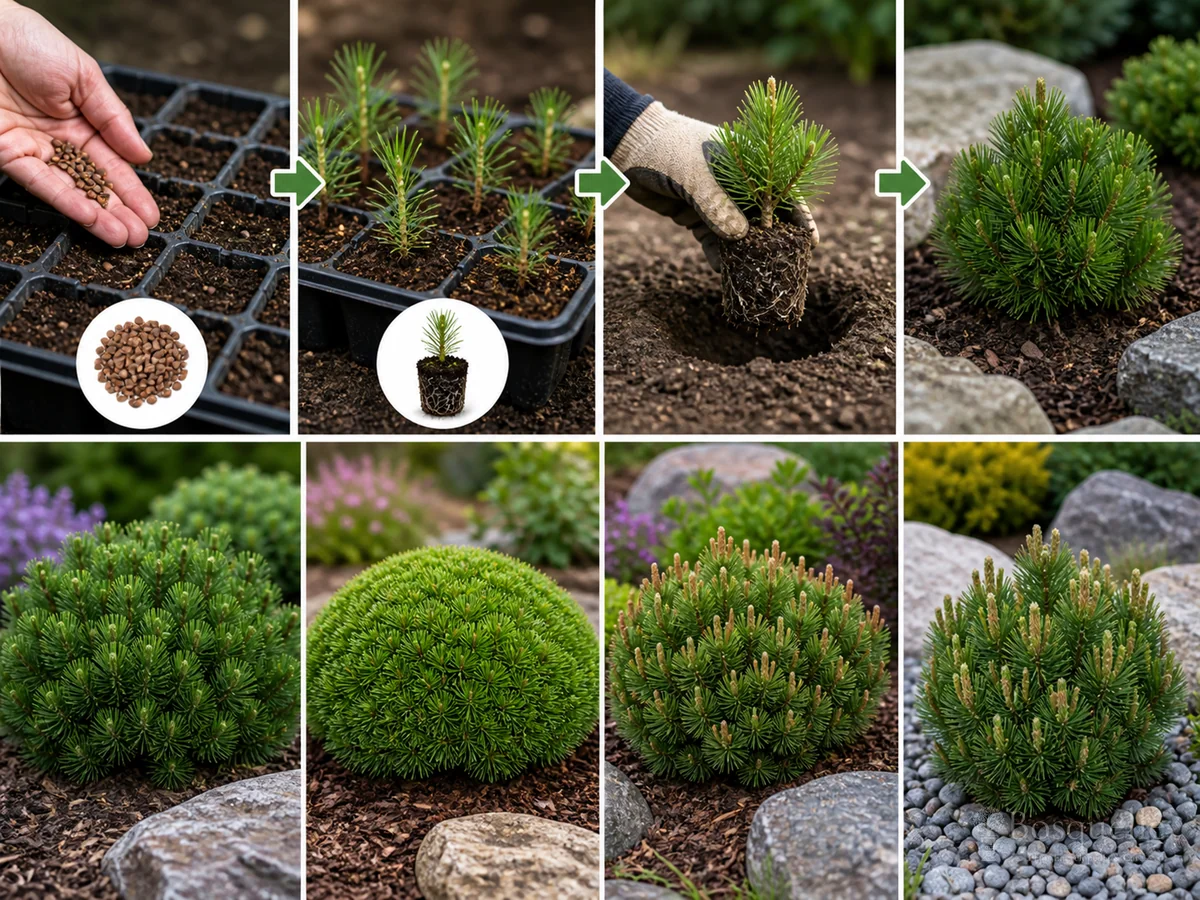
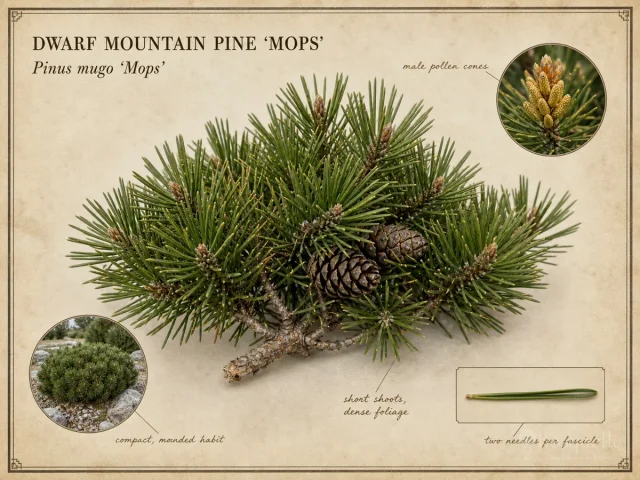
Plant pine with the root flare at ground level, spaced for the mature size on the tag. Bare-root trees go in early spring. ‘Mops’ and Eastern white pine use the same depth; they do not use the same spacing.

Room to mature, spring or a watered container day
| Factor | Recommended | Avoid |
|---|---|---|
| When | Bare-root in early spring; container in the growing season with water | A wilted plug in midsummer clay with no follow-up water |
| Where | Full sun, draining ground, room for tagged height and width | Under power lines, over a septic field, or against a driveway |
| Depth | Root flare even with the surrounding soil | Burying the stem |
| Mulch | A flat 2–4 inch ring off the bark | A volcano piled on the trunk |
Early spring, as soon as the ground can be worked, is the kindest week for bare-root pines. Container trees can go in later if you water them. [1] Mugo has no taproot and moves reasonably if the hole drains. [2]
Give the tagged mature width, not the nursery pot. Species white pine will not stay small because you prune it later. [3]
When should I plant a pine tree?
Bare-root in early spring after frost leaves the ground. Container pines can go in during the growing season if you water them through establishment.
Keep-alive light stays on How to Grow Pine. Choose the habit on Types of Pines before you dig.
How to plant
- For a container tree: dig a hole as deep as the root ball and about twice as wide, with sloped sides. Set the flare level with the surrounding ground. Tease circling roots.
- For a bare-root or plug seedling: soak the roots, open a slot as deep as the roots, set them straight (not in a J), close the slit, and firm. [4]
- Water until it settles. If the soil drops, top off — do not mound soil onto the stem.
- Mulch a flat ring, not touching the bark. Keep grass off the collar.
- Water through the first six to eight weeks, then during dry spells the first season. Fresh soil stays wet longer than the old ground, so do not keep a daily soak going if the hole is still soggy.
How deep should I plant a pine?
The root flare sits at the same height as the surrounding soil. A buried stem invites rot. A dwarf mugo and a white pine use that same depth; they do not use the same spacing.
What fails a pine planting
- A bathtub hole that holds water — wet feet from day one.
- Spacing from the pot, not the tag — a window well with a future timber tree.
- Mulch volcano — bark stays wet and rodents hide.
- Cutting the leader to “keep it small” — buy a dwarf instead.
- The old daily hose in a new, wet backfill — rot before roots run.
Flare at ground level, room to mature, water the first season. Then grow it on How to Grow Pine.
FAQ
Can I plant a balled-and-burlapped pine?
Yes. Set the flare level, cut the twine, and pull burlap off the top of the ball so it cannot girdle. Water in.
Should I stake a pine?
Only if wind will rock a tall, newly planted tree. Remove the ties after a season so the trunk can strengthen.
Can I plant pine in summer?
Container trees can, if you water them. Bare-root seedlings belong in early spring.
How far from the house should I plant a pine?
Far enough for the tagged mature width, plus room to walk. Keep trees off foundations, septic lines, and power lines.
Should I water right after planting?
Yes, to settle soil. Then water through the first weeks and during drought the first season. Do not leave a saucer of standing water.
When do I candle-prune a newly planted mugo?
After it is taking hold, on the spring candle window. The pinch steps live on How to Grow Pine.
Related guides
Recommended plants





References
This note is part of Pinus Guides.
More planting notes by plant are gathered in Planting Guides.
Updated: Reviewed by Bosquelle Editors