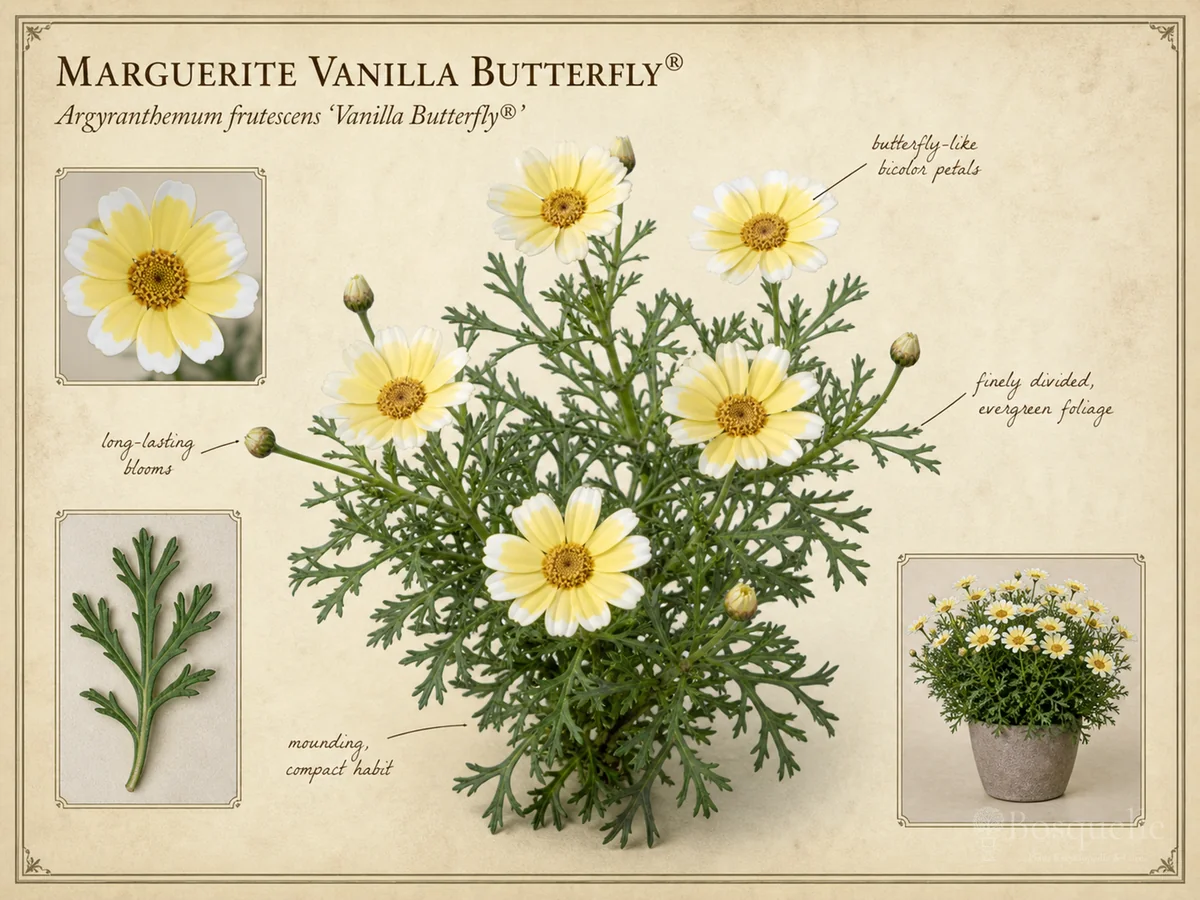
About Marguerite Vanilla Butterfly®
Marguerite Vanilla Butterfly® (Argyranthemum frutescens Vanilla Butterfly®) is grown for garden performance matched to its site needs. Expect full sun, typically 0.3–0.91 m tall, low water once established.
Can Marguerite Vanilla Butterfly® take your winter? Type your ZIP below and compare it with Zones 9–11.
2023 USDA ZIP listings (PRISM / USDA-ARS). Find Your USDA Hardiness Zone · Official USDA map.
Is Marguerite Vanilla Butterfly® Right for Your Garden?
Best for
- Mixed borders and general garden use
- Dry gardens, gravel schemes, or water-restricted sites
- Open, sunny positions with good air movement
Not recommended if
- Permanently moist or boggy ground
- Dense shade or north-facing walls
Trade-off to know
Marguerite Vanilla Butterfly® is tolerant once established, but needs consistent water in the first season. Drought tolerance builds slowly — expect 1–2 years before it can fend for itself in dry spells.
Growing Conditions for Marguerite Vanilla Butterfly®
Site checklist
- Sun: full sun
- Soil drainage: Moist but Well Drained
- Water: Low
- Hardiness zones: 9, 10, 11
Adjustments
- Wrong light level is the most common cause of weak performance
- Fix drainage before treating leaf symptoms
Shared growing steps for this plant’s group: How to Grow Marguerite Daisy. Notes below stay specific to this plant.
How to Care for Marguerite Vanilla Butterfly®
Establishment
- Plant Marguerite Vanilla Butterfly® in a site matching its sun and drainage needs
- Water regularly until roots settle, then match watering to the plant’s need
Ongoing care
- Mulch to buffer moisture swings
- Remove dead or damaged growth in season
- Avoid constant wet foliage where disease pressure is high
Diagnosing Problems with Marguerite Vanilla Butterfly®
| Symptom | Likely cause | Confirming sign | Action |
|---|---|---|---|
| Leaves wilting or scorching at tips in dry weather | Drought stress | Soil dry 5+ cm deep; leaf tips brown and crisp, not soft | Water Marguerite Vanilla Butterfly® deeply at the base once weekly in dry spells. Mulch around the root zone to retain moisture. |
| Sudden wilting on one branch while rest of plant looks healthy | Root rot from poor drainage in one spot | Affected branch has dark, mushy roots when gently uncovered | Cut back affected branch to healthy wood. Improve drainage in that area before the next growing season. |
Leaves wilting or scorching at tips in dry weather
- Likely cause
- Drought stress
- Confirming sign
- Soil dry 5+ cm deep; leaf tips brown and crisp, not soft
- Action
- Water Marguerite Vanilla Butterfly® deeply at the base once weekly in dry spells. Mulch around the root zone to retain moisture.
Sudden wilting on one branch while rest of plant looks healthy
- Likely cause
- Root rot from poor drainage in one spot
- Confirming sign
- Affected branch has dark, mushy roots when gently uncovered
- Action
- Cut back affected branch to healthy wood. Improve drainage in that area before the next growing season.
Marguerite Vanilla Butterfly® FAQ
-
Is Marguerite Vanilla Butterfly® easy to grow?
Marguerite Vanilla Butterfly® is relatively undemanding once established, particularly in dry conditions. The most common mistakes are poor drainage and incorrect sun placement.
-
How big does Marguerite Vanilla Butterfly® get?
Marguerite Vanilla Butterfly® typically reaches 0.3–0.91 m. Final size depends on soil quality and available root space. Allow adequate spacing at planting — most plants reach their full spread within 5–10 years.
-
How much sun does Marguerite Vanilla Butterfly® need?
Marguerite Vanilla Butterfly® grows best in full sun. Planting in the wrong light level is the single most common cause of poor performance. Check the aspect of your site before choosing a position.
What Marguerite Vanilla Butterfly® Symbolises
Bosquelle AI — generated content, not human-reviewed botanical research.
- enduring
- constant
- steadfast
- reliable
References
- [1] GBIF occurrence phenology — Bloom months inferred from StillImage observation seasonality (temperate Northern Hemisphere filter). Not an official cultivar calendar. -
https://www.gbif.org/species/3104491 - [2] GBIF species distributions — Native range summarised from GBIF distribution records; locality noise filtered to country and macro-region terms. -
https://www.gbif.org/species/3104491
Taxonomic identifiers
https://www.gbif.org/species/3104491(GBIF 3104491)https://www.wikidata.org/wiki/Q2062517(Wikidata Q2062517)https://powo.science.kew.org/taxon/gcc-38385(POWO gcc-38385)https://www.ipni.org/n/178745-1(IPNI 178745-1)