Look in the bark cracks, not at the needles first. Reddish-orange boring dust packed in the crevices is Douglas-fir beetle. Peel a patch of bark. A straight gallery about five to ten inches long, packed with that dust, confirms it. Popcorn pitch tubes belong on pine, not on this beetle. If beetles are already under the bark, take the tree down and get the wood off the lot before they fly in April. A spray on the needles will not reach them.
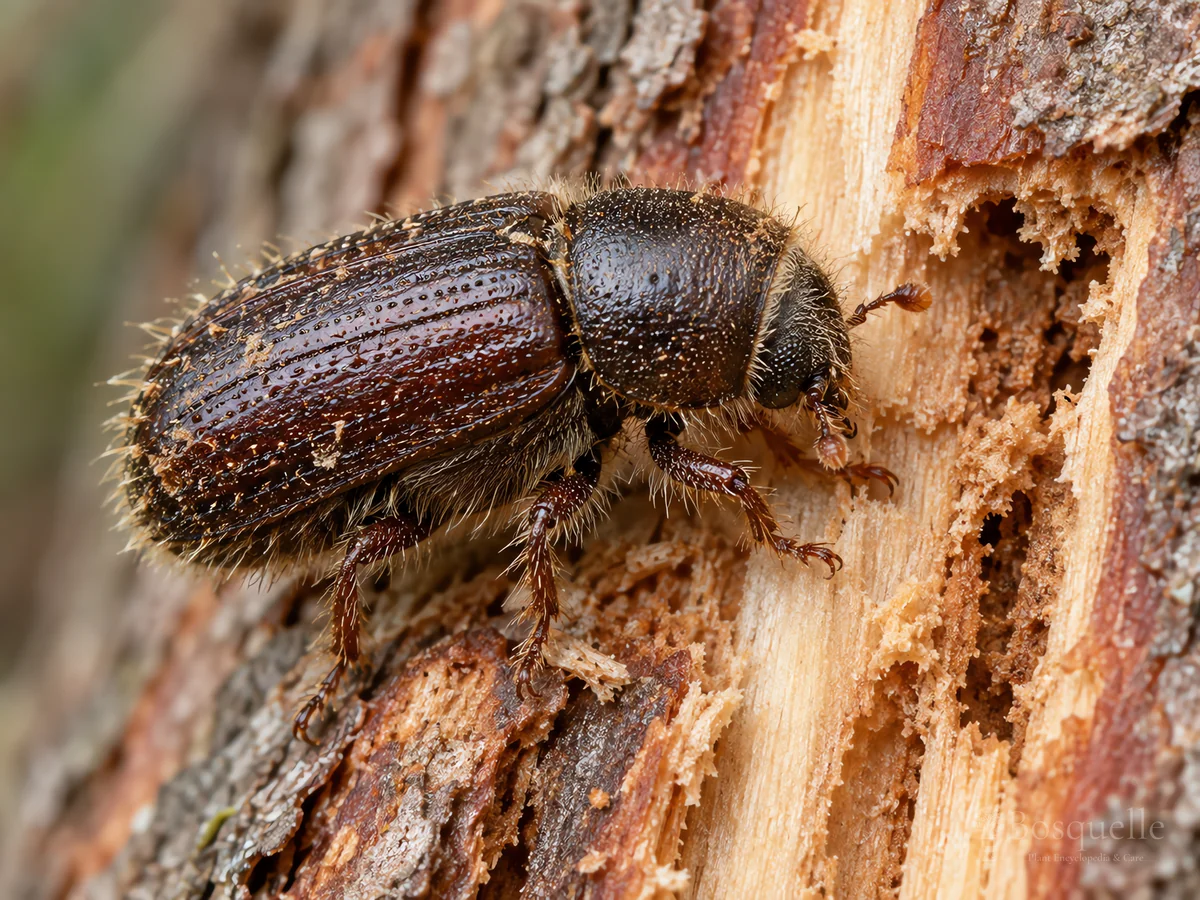
The adult is a stout bark beetle, about a quarter inch long, with a black head and reddish-brown wing covers. It is native. The larva is cream, legless, and feeds in the inner bark. It cuts off water in a large Douglas-fir, especially after drought, windthrow, fire, or a heavy budworm year. Needles may stay green for months after a successful attack.
- Orange-tan dust in the bark cracks confirms it.
- If beetles are under the bark, take the tree down before April.
- Water the Douglas-firs you mean to keep.
Take an infested tree down before beetles fly in April
Larvae already in the inner bark have cut the water. A bottle will not grow that cambium back. Once you find packed galleries, or live beetles under the bark, take the tree down. Hire a faller so the trunk does not scar the next Douglas-fir. Fresh wounds pull the next flight. Keep stumps low. Get every infested log and every windthrown piece thicker than about ten inches off the lot before the April flight, when adults leave to find the next green tree.
A rust-red crown often means last year's beetles already flew. Still take a hazard tree down. Hunt this year's dust on trees that are still green, including midway up the bole where the first attacks usually start. Fail if you wait for a brick-red crown before you look.
How do I get rid of Douglas-fir beetle?
If beetles are already under the bark, take the tree down before they fly in April and chip, peel, or solarize the wood. Water the Douglas-firs you mean to keep. MCH packets or a labeled bark spray only protect a still-green tree. A needle spray will not reach the larvae.
Can I save a Douglas-fir with this beetle?
Not once galleries are packed under the bark. The inner bark is already cut, and blue-stain fungi clog the water. Take that tree down. Water and, if the tree is still green, MCH or a labeled bark spray are for neighbors that have not been entered yet.
Will Douglas-fir beetle kill the tree?
A successful mass attack usually kills a large Douglas-fir. Needles fade months later. Strip attacks that only take part of the bole can leave a live side until beetles return.
When do Douglas-fir beetles fly?
The heavy flight is April into early June, once days stay near 60°F. A lighter second flight can run in July and August. Take infested wood off the lot before that first April flight.
Water the Douglas-fir you mean to keep
This beetle does poorly in a vigorous tree. Inland yards in a dry summer are the usual door. Resin is how a healthy Douglas-fir pushes beetles out. A drought-stressed tree cannot make enough. Deep-water through dry weather so the whole root zone is wet. Mulch two to four inches over the roots. Keep mulch off the bark. Keep a trencher and a grade cut off those roots.
Do not pile extra fertilizer on a tree that is already fading. Nearby Douglas-firs that still look fine are worth watering too, because adults move from a dying bole. Water is the job. A foliar mix is not.
Reddish dust and a vertical gallery confirm this beetle
The first useful sign is orange-tan boring dust, sometimes called frass, in bark crevices, in small piles at the base, or caught in spider webs on the trunk. Rain and wind wash it away. Attacks often start midway up, so eye-level bark can look clean. Clear resin may streak down from the upper bole. Popcorn pitch tubes are not the usual sign on Douglas-fir.
Peel a small patch with a knife or hatchet. You should see a straight vertical egg gallery about five to ten inches long, packed with dust, and short side tunnels in clusters that alternate from one side to the other. The adult is about a quarter inch. The larva is cream with a brown head. Needles fade from green to yellow to rust, often six to fifteen months later, often after the adults have already left. Brown, crumbly inner bark under a still-green crown is a current attack. Pink, moist inner bark is still alive.
| Where you see it | What it is | Try this |
|---|---|---|
| Orange-tan dust in cracks; clear resin streaks midway up a Douglas-fir; 5–10 in vertical gallery packed with dust | Douglas-fir beetle | Take the tree down before April; chip, peel, or solarize the wood |
| Top wilt, no dust, no galleries under the bark | Drought or root stress | Water deeply; confirm again after a soak |
| Popcorn pitch tubes on pine | Mountain pine beetle | Different insect, different tree |
| Fading white fir or grand fir; horizontal egg gallery | Fir engraver | See fir engraver beetle — not this method |
| Fine dust on a small Douglas-fir top | Pole beetle | Not this beetle's full job |
| Pale coarse dust; large oval holes | Wood borer after death | Different insect |
| Yellow needles with wool at the base; bark intact | Cooley adelgid | See adelgids — not a bark beetle |
What does Douglas-fir beetle damage look like?
Orange-tan boring dust in bark cracks, sometimes in spider webs or in piles at the base. Clear resin may streak from midway up the trunk. Peel a patch. A straight gallery five to ten inches long, packed with dust, confirms it. Needles often stay green for months.
Should I wait until the needles turn red?
No. A rust-red crown often means last year's beetles already left. Look for this year's dust on trees that are still green, including midway up the trunk.
Popcorn pitch tubes on pine are a different beetle
Mountain pine beetle makes popcorn pitch tubes on pine. This beetle works Douglas-fir and usually does not. Confirm the tree and the gallery before you treat. A catch-all bark-beetle label does not tell you which wood is dying.
Fir engraver is a different insect on true fir — white fir, grand fir, and their kin. Its egg gallery runs across the grain, not straight up the bole. See fir engraver beetle. Do not run that sanitation calendar here. Douglas-fir pole beetle leaves finer dust in small tops. Wood borers and carpenter ants push paler, coarser dust. Wool stuck to Douglas-fir needles is Cooley adelgid — see adelgids — not a beetle in the trunk. Drought wilts the top the same way until you peel bark and find nothing.
Is it mountain pine beetle or Douglas-fir beetle?
Mountain pine beetle makes popcorn pitch tubes on pine. This beetle is on Douglas-fir and usually does not make those tubes. Confirm the tree and the gallery. Do not treat a pine as this insect.
Is fir engraver the same insect?
No. Fir engraver works true firs and cuts a horizontal egg gallery. This beetle works Douglas-fir and cuts a straight vertical gallery. See fir engraver beetle for the true-fir job.
Chip, peel, or solarize the wood so nothing emerges
Adults chew out of a log the same way they leave a standing trunk. Chip infested wood, or peel the bark and leave the logs in the weather, or stack them in full sun under clear plastic until the bark itself is hot, about 110°F. Burn locally where that is allowed, well clear of living Douglas-fir so you do not scorch the next trunk. Do not haul bark-on firewood to another yard.
If you want the wood for a stove, peel it and leave it exposed over winter. Beetles survive in a sheltered, bark-on pile. After a windstorm, logs thicker than about ten inches are a brood pile until April. Debark a high stump. Downed western larch can hold brood the same way. Fail if the finish is a shaded log pile for next winter's stove.
Can I use the wood as firewood?
Peel all the bark and leave the wood in the weather over winter. Do not stack bark-on logs in a shed or haul them to another yard. Adults still emerge from a sheltered pile.
MCH and a bark spray only protect a still-green tree
Larvae under bark are out of reach of a soap, an oil, or a foliar mix. MCH packets tell incoming beetles the tree is full. Staple them on still-green Douglas-fir before the April flight. They will not clear larvae already inside. A labeled bark spray, applied by someone who can wet the whole bole, is last: only on a high-value tree that is still green, and only before beetles fly. Skip the brand aisle as the plan.
If more than the tree is already packed with galleries, skip the packet and the spray and take it down. Funnel traps near a specimen Douglas-fir can pull beetles in. Do not hang one as a yard fix.
Does MCH save a tree that is already infested?
No. MCH tells new beetles to keep flying. It does not kill larvae already in the inner bark. Use it on still-green Douglas-fir before April, not on a packed trunk.
Confirm the dust, then remove, water, or protect
- Confirm the beetle. Orange-tan dust in the bark cracks plus a straight packed gallery. Popcorn tubes on pine are a different insect. Blotched, woolly needles are not this job.
- If beetles are under the bark, take the tree down before the April flight. Chip, peel, solarize, or peel firewood. Do not scar the next Douglas-fir when it falls.
- Water the trees you mean to keep, through dry weather. Mulch the roots. Do not fertilize a fading crown.
- MCH packets or a labeled bark spray are last, and only on a still-green high-value tree, before beetles fly. Nearby healthy Douglas-firs are worth watering too.
Related reading
- Fir engraver beetle — true fir with a horizontal gallery, not this beetle in Douglas-fir.
- Spruce budworm — defoliation that stresses a Douglas-fir and then this beetle finds it.
- Adelgids — wool on Douglas-fir needles, not dust in the bark cracks.
FAQ
Does neem oil kill Douglas-fir beetle?
Not once the larva is under the bark. Oil needs contact on a soft insect. This job is take-down, wood disposal, water, or a labeled preventative on a tree that is still green.
Will dish soap kill Douglas-fir beetle?
No. A kitchen mix on the needles does not reach larvae in the inner bark, and it can burn foliage. It is not a labeled treatment for this beetle.
Do Douglas-fir beetles bite people?
No. Adults bore into bark. Larvae stay under bark. The harm is to the tree, not to you or a dog.
Should I fell a healthy tree as a trap?
Not as a yard shortcut. Trap trees are a logging program: the felled tree must come off the lot before beetles emerge. A forgotten trap log is a brood pile.
Is the blue stain a rot I cannot use?
Blue-stain fungi discolor the sapwood and clog water in a living tree. They are not a wood-rot in the lumber sense. The stain is why you still peel and move infested wood on time.
Related pests





Related diseases



Updated: Reviewed by Bosquelle Editors