
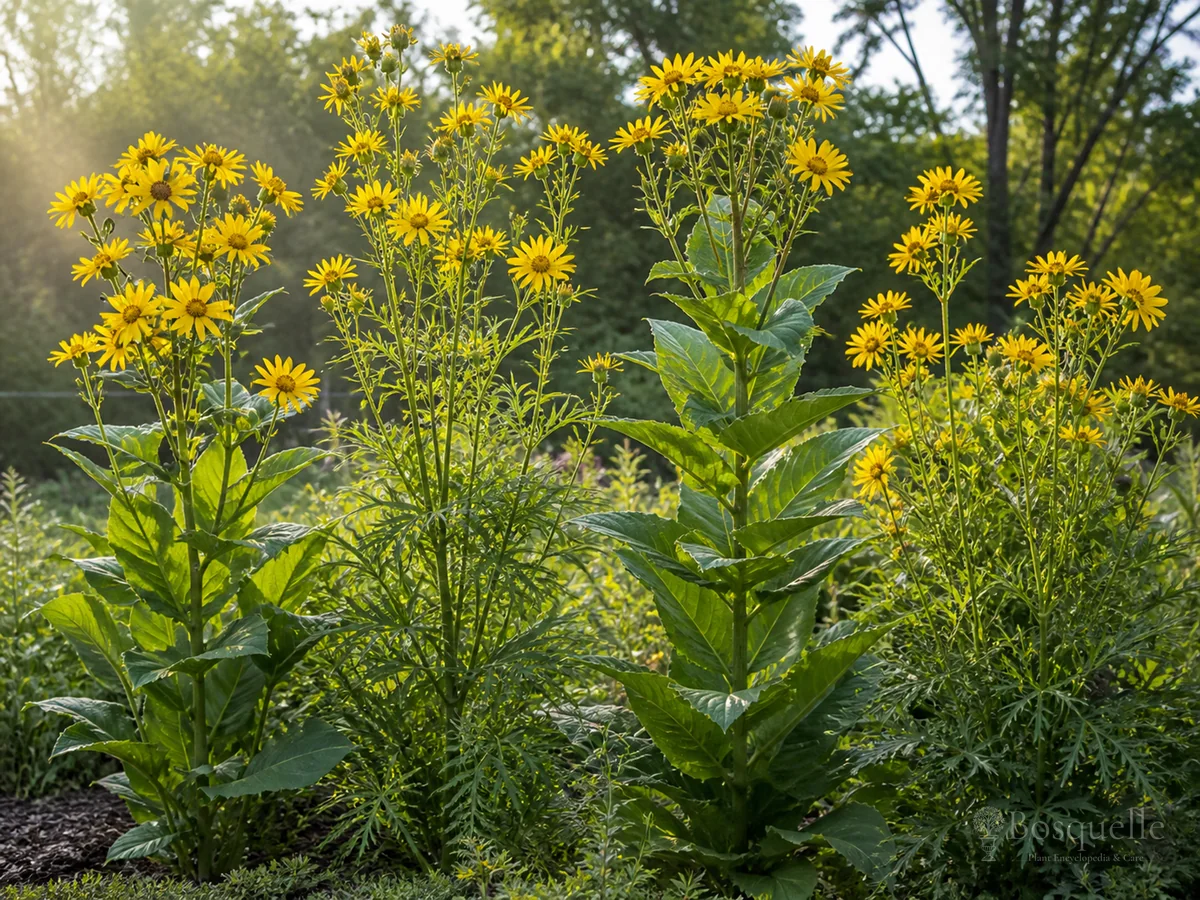
Choose Silphium by leaf and manners: cup plant, compass plant, prairie dock, or wholeleaf rosinweed. We list four kinds.

Choose cup plant, compass plant, prairie dock, or wholeleaf rosinweed
| Factor | Recommended | Avoid |
|---|---|---|
| Cup plant | Fused leaf cups and moist-site vigour | A small mixed border with no deadhead plan |
| Compass plant | Deeply cut leaves and one deep-rooted clump | Expecting a polite 2-foot edging plant |
| Prairie dock | Huge basal leaves and a towering bloom stalk | A walkway the leaves will arch across |
| Wholeleaf rosinweed | Entire leaves at meadow scale, often shorter | Treating it as a different watering rule |
Know your USDA hardiness zone before you pick a type of silphium that will take your winter. Type your ZIP below.
2023 USDA ZIP listings (PRISM / USDA-ARS). Find Your USDA Hardiness Zone · Official USDA map.
Read the leaves. The four we list are S. perfoliatum, S. laciniatum, S. terebinthinaceum, and S. integrifolium. [1] Culture is the same full sun and a permanent taproot. Height and manners are the choice. [2]
Does the Compass Plant spread?
Usually as a deepening clump with a taproot, plus some seed. Cup plant is the kind that seeds and colonizes faster in moist ground.
How tall does a Compass Plant get?
Often 5 to 10 feet in full sun, sometimes more. Give prairie-scale room.
Browse by kind
Cup plant
S. perfoliatum joins opposite leaves around a square stem so rain sits in a cup. It seeds and can thicken in moist rich ground — pick it only where that vigour is welcome.
Compass plant
S. laciniatum carries deeply cut basal leaves that often stand north–south. One deep taproot stands at the back of a prairie strip.
Prairie dock
S. terebinthinaceum puts huge unlobed basal leaves on the ground and sends a tall, mostly leafless stalk up in late summer. Commit the footprint.
Wholeleaf rosinweed
S. integrifolium keeps entire opposite leaves on the stem and stays somewhat shorter than cup plant or compass plant. Same sun, less height.
All four share sandpaper leaves and yellow daisy heads. Pick cup plant only where seed rain is welcome; pick compass or dock when one deep-rooted specimen sits at the back of the meadow. [3]
Not the ancient herb named Silphium
The prairie daisy genus took a Greek name that once meant a resin plant from northern Africa, now extinct as a crop. A search that asks whether Silphium still grows, or what can replace it, is that herb — not cup plant. [4]
If the tag says Helianthus or Heliopsis, that is a different daisy. Confirm Silphium before you plant.
Does Silphium still grow?
The prairie species do. The ancient Mediterranean herb that shares the name does not. Cup plant, compass plant, prairie dock, and wholeleaf rosinweed are North American natives.
If the tag says sunflower or the ancient herb, that is not this prairie daisy — read the Latin before you plant.
FAQ
Do we list extra shop mixes as extra kinds?
No. We list four species: cup plant, compass plant, prairie dock, and wholeleaf rosinweed. Extra nursery names use the same sun and taproot.
Is Indian cup a different plant?
No. Indian cup is another common name for cup plant, Silphium perfoliatum.
Is prairie burdock a different plant?
Prairie burdock is a catalog alias for prairie dock. Same Silphium terebinthinaceum.
What is another name for the cup plant?
Cup plant, Indian cup, and cup rosinweed are the same Silphium perfoliatum. Compass plant is a different species in the same genus.
Related guides

References
- [1] Dyck Arboretum -
https://dyckarboretum.org/silphiums-four-pillars-tallgrass-prairie/ - [2] University of Illinois Extension -
https://extension.illinois.edu/blogs/good-growing/2018-08-05-silphiums-standing-tall-over-prairie - [3] Lady Bird Johnson Wildflower Center -
https://www.wildflower.org/plants/result.php?id_plant=SILA3 - [4] NC State Extension -
https://plants.ces.ncsu.edu/plants/silphium-integrifolium/
This note is part of Silphium Guides.
More type comparisons by plant are gathered in Types of Plants Guides.
Updated: Reviewed by Bosquelle Editors