
Choose Lantana by the job you can keep: an upright bedding mound, a trailing spill, Texas heat, or Buttonsage when the tag names involucrata. Do not buy from a slogan about rainbow clusters.
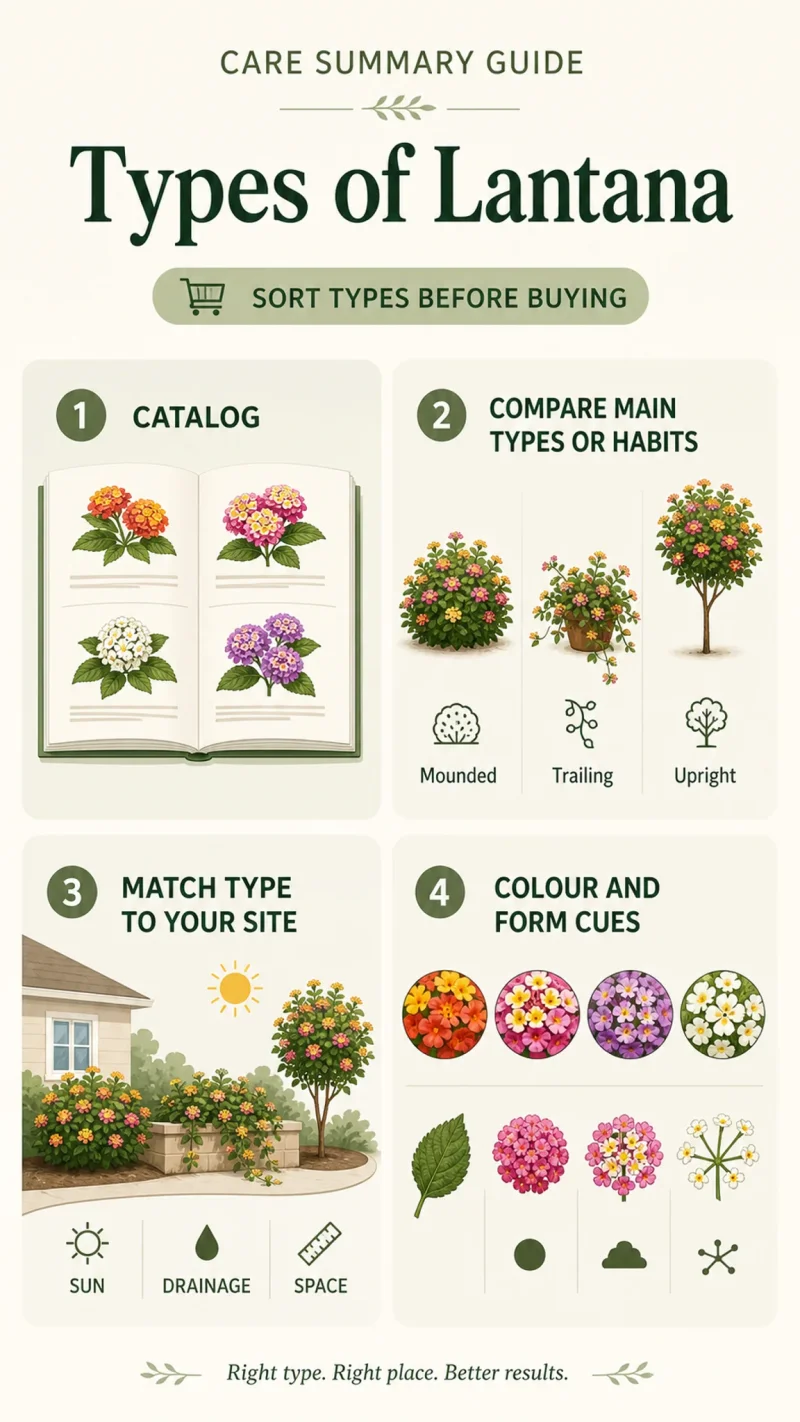
Match a band across 11 catalog faces, then open species. Heat, spread, toxicity, and frost stay on How to Grow Lantana.
Choose Lantana by habit and job
| Factor | Recommended band | Avoid |
|---|---|---|
| Upright mound / bedding / patio pot | Camara series (Bigleaf Lantana, Landmark Citrus) | Expecting trailing spill height from a Lucky mound |
| Spill from basket, wall, or hot bank | Trailing montevidensis (Trailing Lantana) | Using a trailer as an upright hedge |
| Texas / regional heat face | Urticoides (Texas Lantana) | Swapping a random camara tag for Texas habit |
| Buttonsage when tagged involucrata | Involucrata (Buttonsage) | Treating colour similarity as identity |
Know your USDA hardiness zone before you pick a type of lantana that will take your winter. Type your ZIP below.
2023 USDA ZIP listings (PRISM / USDA-ARS). Find Your USDA Hardiness Zone · Official USDA map.
Habit does not rewrite heat, spread risk, or toxicity. Bigleaf Lantana and Trailing Lantana share the same sun engine and the same household caution. Culture stays on How to Grow Lantana.
Bigleaf Lantana is the library's upright camara hero — the Bigleaf look Landmark and Lucky series refine. Lock the habit band before you shop paint chips.
Upright bedding camara — Landmark, Little Lucky, Lucky
Landmark, Little Lucky, and Lucky series keep the upright camara job in tighter mounds for beds and pots. Landmark Citrus and Little Lucky Red are typical compact faces. Landmark Peach Sunrise sits in the same band. They still want heat and sun. Compact habit does not cancel toxicity or warm-climate spread.
Little Lucky Peach Glow, Lucky Lavender, Lucky Lemon Glow, and Lucky White extend colour inside this upright band. Pick colour after you accept the mound habit.
Trailing montevidensis for spill and groundcover
Trailing Lantana is the spill and groundcover lane — baskets, wall tops, and hot banks. Same heat and sun as camara. It is not freestanding border height. Give it room to cascade without smothering keepers.
Montevidensis stems stay prostrate and the leaves are usually smaller than a Bigleaf camara mound. A camara that flopped in shade is still an upright plant in the wrong light — it is not a trailer. Buy the species for spill, not a collapsed mound.
Texas Lantana — urticoides when the tag names it
Texas Lantana is Lantana urticoides — a distinct species from typical camara bedding forms. Confirm Latin on the packet. Colour similarity does not rewrite height or regional fit. Heat, toxicity, and frost still follow How to Grow Lantana.
Orange-to-red marketing copy is common on Texas tags. Colour does not prove urticoides. Read the Latin, then check habit on a well-grown plant: Texas is sold as a distinct species, not as a Landmark colour chip.
Buttonsage involucrata when it is distinct
Buttonsage is Lantana involucrata. Buy it when the tag names involucrata or Buttonsage — not because a camara cluster looks similar. Same sun and drain. Distinct species entry in this catalog.
Pale or white clusters on Buttonsage are not a white Lucky camara. Involucrata is a separate catalog line. If the receipt only says shrub verbena, ask for the species before you plan height or a native-range story.
Colour inside upright camara
Once the upright band is locked, colour is a paint-chip choice: citrus, peach, red, lavender, lemon, white. Culture does not change with the chip. Deadhead if local seed pressure matters. Do not treat a colour name as a species.
Series names (Landmark, Lucky, Little Lucky) are mound-size cues inside camara, not a second genus. A Lucky pot still wants the same sun and drain as Bigleaf. A trailing tag still wants spill room. If the packet cannot say camara, montevidensis, urticoides, or involucrata, leave it until the Latin is clear.
Frost-north shoppers should still pick a habit: compact upright for a patio pot you can move, trailing for a seasonal basket, Texas or Buttonsage only when the tag matches. Winter survival is a climate job on the care pillar, not a colour job on this page.
Wrong Lantana buys that look like a types page
- Trailing stock for an upright hedge: montevidensis spills; it does not make a camara mound.
- Texas on the sign, camara on the tag: confirm urticoides Latin.
- Shade restoration strip: Lantana wants heat and sun; it also seeds in frost-free wildland.
- Pet-graze beds: toxic if eaten, every band.
- Buying by rainbow slogan alone: lock habit and Latin first.
- Assuming compact equals sterile: mound size does not prove low seed. Ask before a frost-free edge.
Full catalog by habit band (11)
Bands follow upright camara, trailing, Texas, and Buttonsage. Lock habit first, then open one or two faces in the matching band. Heat and frost stay on the care pillar.
Upright Lantana camara (8)
Mounded bedding and shrub forms — Landmark, Little Lucky, Lucky, and Bigleaf series. Heat and sun; colour sub-browse inside this band.
Trailing Lantana montevidensis (1)
Spill and groundcover habit for baskets, walls, and hot banks — not freestanding border height.
Texas Lantana (1)
Lantana urticoides when the tag names it — distinct species from typical camara bedding forms.
Buttonsage (1)
Lantana involucrata — distinct species entry; buy when the tag names involucrata or Buttonsage.
Where heat, spread, toxicity, and frost live
Full sun, invasive and toxicity rules, plant/prune, and frost-north culture: How to Grow Lantana. Plant-out calendar: Planting Lantana. Heat-sun partners: Lantana Companion Plants. This page only sorted habit band.
Shop checklist: Latin on the tag, habit band, a hot sunny pocket, a containment plan where camara is weedy, and a pet fence. Prefer Lantana on receipts even when the display says only shrub verbena.
If a mixed tray stacks camara, trailing, and Texas under one “lantana mix” header, sort the tags before you pay. Sun looks shared; height and spread jobs do not.
Write the Latin on your plant list the day you buy. Colour names drift between growers. Habit band does not. Keep the receipt until the plant has grown enough to show mound or spill.
FAQ
Upright or trailing Lantana?
Upright camara mounds for beds. Trailing montevidensis spills for baskets and banks. Choose by the job, not by flower colour.
What is Texas Lantana?
Lantana urticoides — a distinct species from typical camara bedding. Confirm Latin on the tag.
Is Buttonsage the same as Bigleaf Lantana?
No. Buttonsage is Lantana involucrata. Bigleaf is usually camara. Buy when the tag names the species you want.
Do compact Lucky types need less sun?
No. Compact habit is a size job. They still want full sun and heat.
Will colour choice fix a shady bed?
No. Every band here wants heat and sun. Fix the site on How to Grow Lantana.
Are all Lantana types toxic?
Treat every class as toxic if eaten. Colour does not cancel that.
Where do I learn planting depth and spacing?
Planting Lantana. This Types page only sorts habit bands.
Where is heat, spread, and frost culture?
How to Grow Lantana. Types only sorted which job fits the bed or basket.
Related guides

This note is part of Lantana Guides.
More type comparisons by plant are gathered in Types of Plants Guides.
Updated: Reviewed by Bosquelle Editors