
Choose fritillary by size and moisture: a crown imperial, a snake's-head, a Persian bell, or a smaller species.
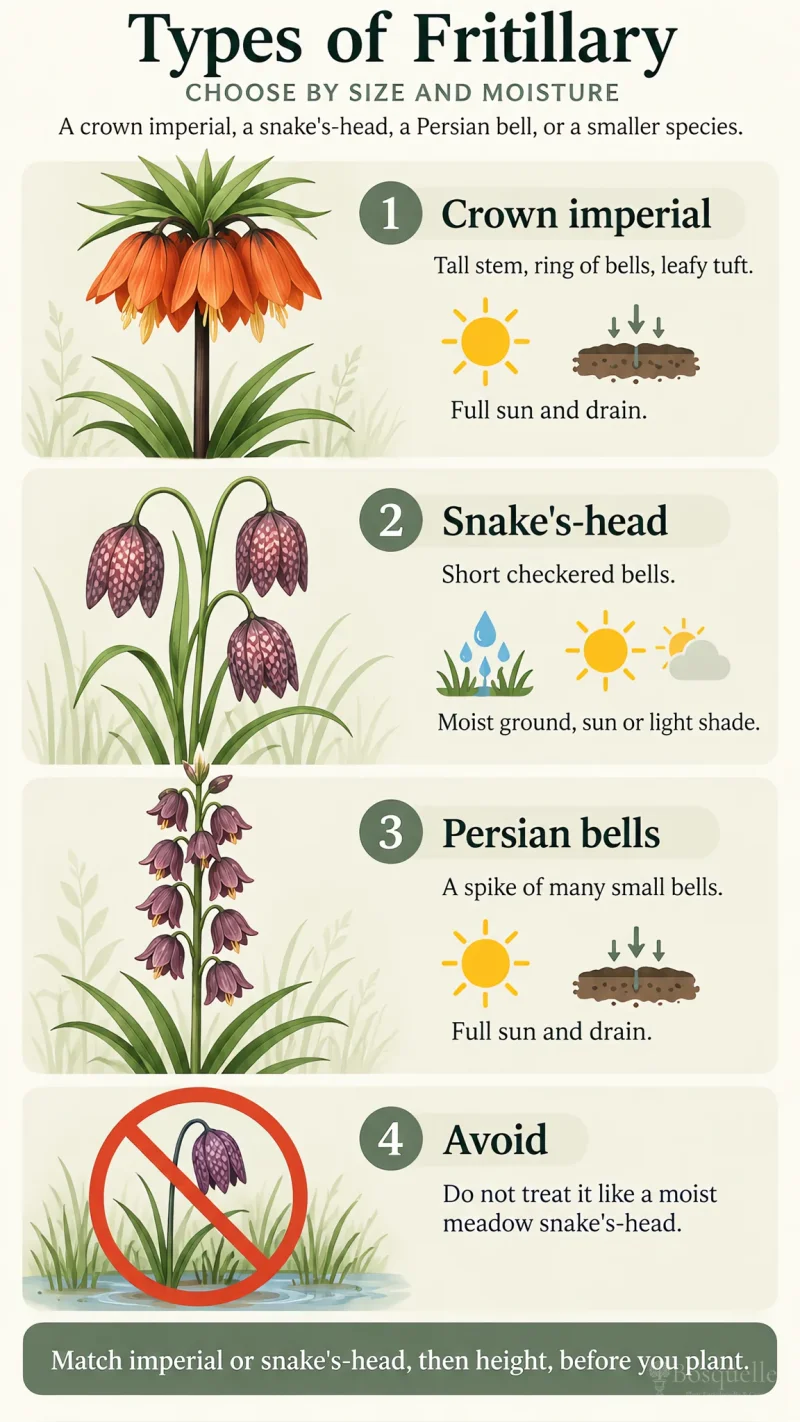
Choose a crown imperial, a snake's-head, a Persian bell, or a smaller species first
| Factor | Recommended | Avoid |
|---|---|---|
| Crown imperial | Tall stem, ring of bells, leafy tuft. Full sun and drain | Do not treat it like a moist meadow snake's-head |
| Snake's-head | Short checkered bells. Moist ground, sun or light shade | Do not site it in a bone-dry rock garden built for imperial |
| Persian bells | A spike of many small bells. Same sun and drain as imperial | Do not buy it as a true lily |
| Species and natives | Shorter garden species and West Coast natives. Read the Latin | Do not assume every checkered bell is meleagris |
Know your USDA hardiness zone before you pick a type of fritillaria that will take your winter. Type your ZIP below.
2023 USDA ZIP listings (PRISM / USDA-ARS). Find Your USDA Hardiness Zone · Official USDA map.
Read the tag for height and moisture, then the Latin. The eight we list are Aurora, Rubra Maxima, Maxima Lutea, Ivory Bells, Adiyaman, snake's-head, checker lily, and Michael's Flower. [1] Crown imperial is the 3- to 4-foot drain class. [2] Snake's-head stays short and wants moist ground, unlike imperial. [3] Sun and water stay on How to Grow Fritillary. To set the bulbs, see Planting Fritillary.
What are types of fritillary?
Garden jobs split by size and moisture: crown imperial, snake's-head, Persian bells, and smaller species or natives.
Is snake's-head the same as checkered lily?
Snake's-head is Fritillaria meleagris, the European checkered meadow bell. Checker lily can also mean West Coast F. affinis. Read the Latin.
Is Persian lily a true lily?
No. Persian lily is Fritillaria persica, a spike in this genus, not Lilium.
Browse by kind
Crown imperial
Aurora is the orange crown. Rubra Maxima is the red imperial. Maxima Lutea is the yellow. All three are the tall drain group, not a checkered meadow bulb.
Persian bells
Ivory Bells is the pale Persian spike. Adiyaman is the dark one. A spike of many small bells is not a ring of imperial bells, and it is not a true lily.
Snake's-head
snake's-head is the checkered meadow bell. Keep it moist. It is not a 4-foot crown imperial.
Species and natives
checker lily is the West Coast checker lily, also sold as chocolate lily. Michael's Flower is a short rock-garden species. Match the Latin, not a 4-foot crown.
Extra imperial colors and shop series are still the crown-imperial job, not extra genera. [4] A short species fits a rock garden; a tall imperial is not that plant.
Is chocolate lily this plant?
On a West Coast native tag it may be Fritillaria affinis. Chocolate lily can also mean Calochortus. Check the Latin.
Match imperial or snake's-head, then height, before you plant. A meadow checkered bell and a 4-foot crown are not the same bed.
FAQ
Are extra imperial names extra plants?
Bach, Brahms, Beethoven, The Premier, and similar shop names are still crown imperial. They are not a new genus.
Do you sell yellow fritillary pudica?
Fritillaria pudica is a western native with nodding yellow bells. We do not list it. Do not treat a catalog imperial as that species.
Is Thunberg fritillary a cough herb?
F. thunbergii shows up in herbal listings. Treat the catalog plant as a garden bulb, not a cough remedy.
How many fritillary species are there?
The genus holds about 100 species. We list eight garden plants in four groups. That is enough to buy from.
Related guides


References
- [1] Chicago Botanic Garden -
https://www.chicagobotanic.org/plant-information/smart-gardener/fritillaria - [2] North Carolina Extension Gardener Plant Toolbox -
https://plants.ces.ncsu.edu/plants/fritillaria-imperialis/ - [3] University of Wisconsin Horticulture -
https://hort.extension.wisc.edu/articles/guinea-hen-flower-fritillaria-meleagris/ - [4] Gardener's Path -
https://gardenerspath.com/plants/flowers/grow-fritillaria/
This note is part of Fritillaria Guides.
More type comparisons by plant are gathered in Types of Plants Guides.
Updated: Reviewed by Bosquelle Editors