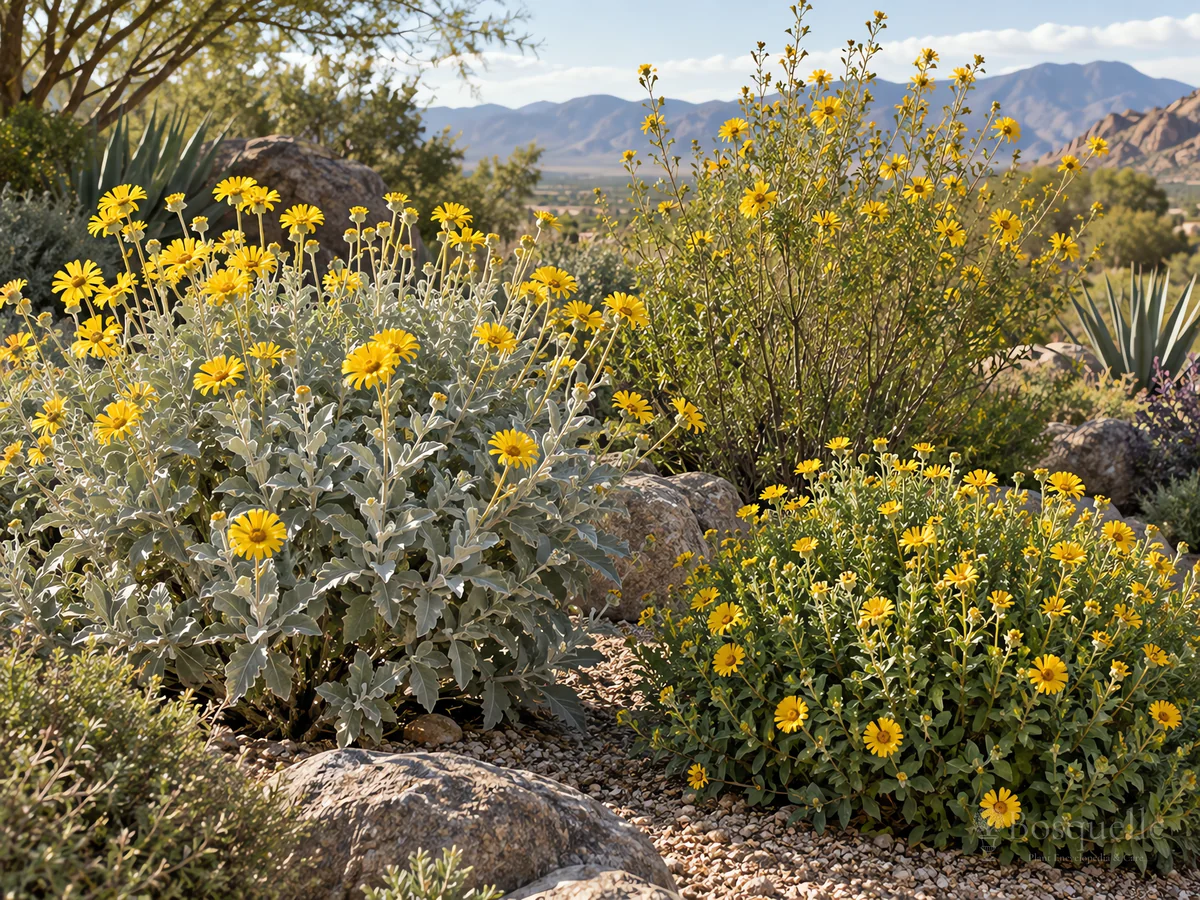
Choose desert brittlebush, coast sunflower, or Acton brittlebush first.
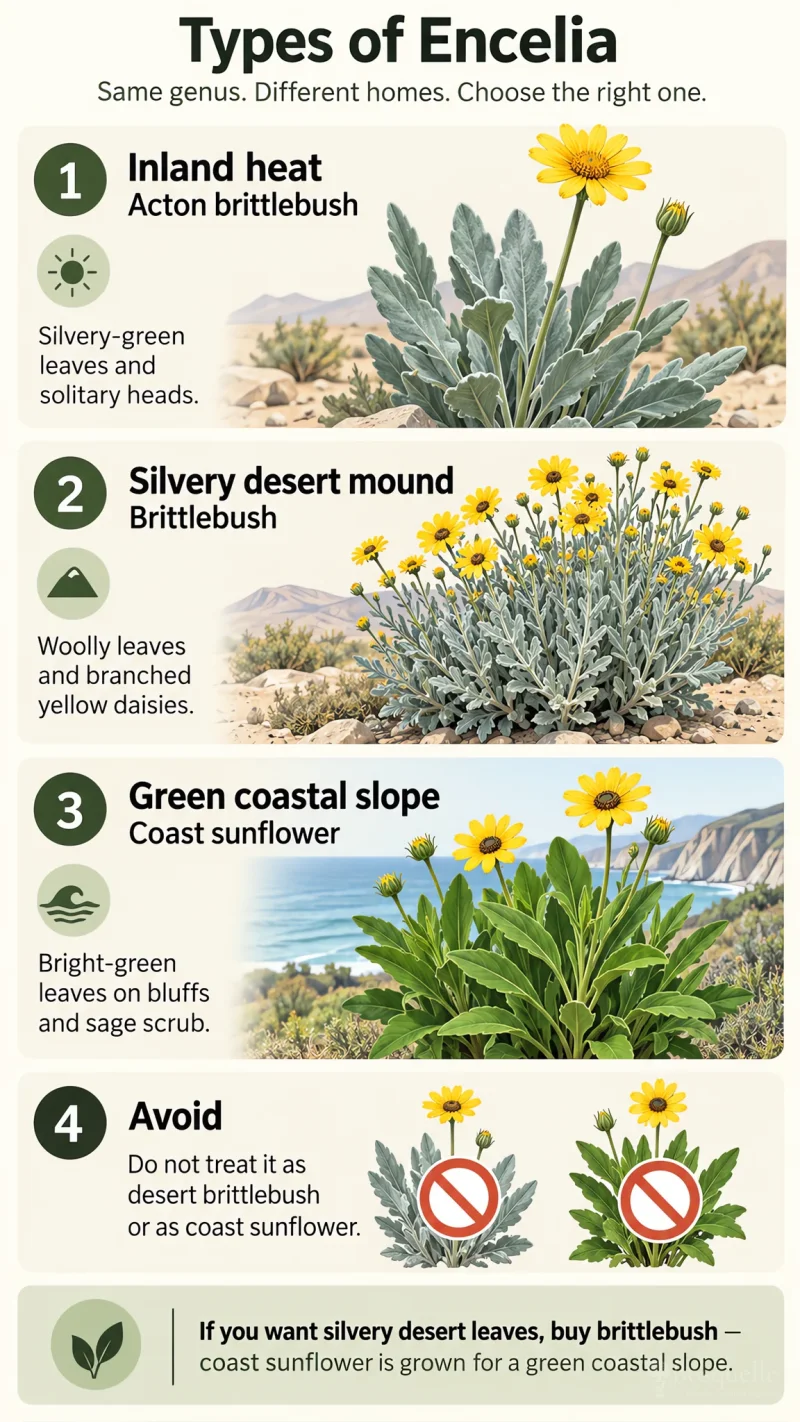
Choose desert brittlebush, coast sunflower, or Acton brittlebush first
| Factor | Recommended | Avoid |
|---|---|---|
| Silvery desert mound | Brittlebush — woolly leaves and branched yellow daisies | Do not buy it for a green coastal slope |
| Green coastal slope | Coast sunflower — bright-green leaves on bluffs and sage scrub | Do not buy a tall garden sunflower |
| Inland heat | Acton brittlebush — silvery-green leaves and solitary heads | Do not treat it as desert brittlebush or as coast sunflower |
Know your USDA hardiness zone before you pick a type of encelia that will take your winter. Type your ZIP below.
2023 USDA ZIP listings (PRISM / USDA-ARS). Find Your USDA Hardiness Zone · Official USDA map.
The first choice is the site you have. Desert brittlebush is the silvery dry-mound shrub. Coast sunflower is the green coastal shrub, and Acton brittlebush is the inland kind. If the tag only says Encelia, look at whether the leaves are woolly white or green, then pick that kind. [1] [2]
Which Encelia should I buy?
Buy brittlebush for a silvery desert mound, coast sunflower for a green coastal slope, or Acton brittlebush for inland heat.
Is coast sunflower grown as a tall sunflower?
No. Coast sunflower is Encelia californica, a green coastal shrub. A tall seed sunflower is Helianthus.
Browse by kind
Match the leaf color and the site, then pick that kind. A coast sunflower will not give you a silvery desert mound, and desert brittlebush will not fill a cool coastal bluff the same way. Read the tag for the habitat, then buy that kind. Care for the plant you already have on How to Grow Brittlebush. [3] [4]
Brittlebush
brittlebush is the silvery desert shrub with woolly leaves and yellow daisy heads on branched stalks above the foliage. Tags may say incienso or goldhills. Buy this group for a dry inland mound, not for a green coastal slope. It is Encelia farinosa, not a garden sunflower.
Coast sunflower
coast sunflower is a green coastal shrub for bluffs and sage scrub, woody mainly at the base. Tags may say California brittlebush or bush sunflower. The leaves stay greener than desert brittlebush, and each stalk usually holds one head. Buy it for a coastal slope, not for a tall seed sunflower.
Acton brittlebush
Acton brittlebush is the inland kind, with many slender branches from the base, silvery-green leaves, and solitary yellow heads. Tags may say Acton encelia. Buy it for inland heat, not as the woolly desert mound and not as coast sunflower.
If you want silvery desert leaves, buy brittlebush — coast sunflower is grown for a green coastal slope.
FAQ
Is coast sunflower a garden sunflower?
No. Coast sunflower is Encelia californica. Garden sunflowers are Helianthus. See How to Grow Sunflowers if that is the tag you have.
Is Acton brittlebush the same as desert brittlebush?
No. Desert brittlebush is Encelia farinosa, the woolly silvery mound. Acton brittlebush is Encelia actoni, an inland shrub with greener leaves and solitary heads.
Do you sell the dark-centered variety?
This catalog holds brittlebush, coast sunflower, and Acton brittlebush. Some desert plants have brown-purple disc centers. Treat a silvery desert mound as brittlebush.
Related guides


References
- [1] Lady Bird Johnson Wildflower Center -
https://www.wildflower.org/plants/result.php?id_plant=ENFA - [2] Lady Bird Johnson Wildflower Center -
https://www.wildflower.org/plants/result.php?id_plant=ENCA - [3] University of California Cooperative Extension -
https://ucanr.edu/sites/default/files/2022-07/369987.pdf - [4] UC Master Gardeners of Santa Clara County -
https://ucanr.edu/site/uc-master-gardeners-santa-clara-county/native-plant-sales
This note is part of Encelia Guides.
More type comparisons by plant are gathered in Types of Plants Guides.
Updated: Reviewed by Bosquelle Editors