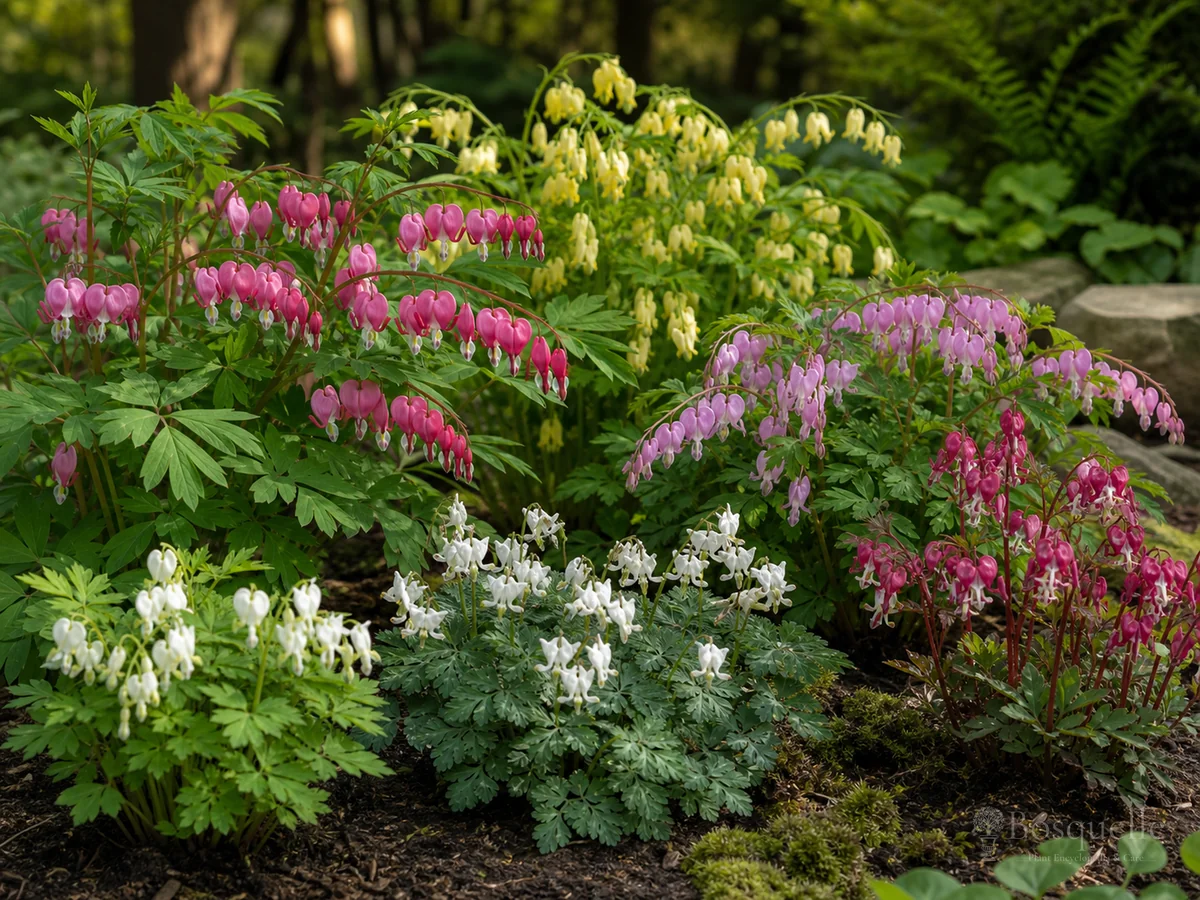
Most first bleeding-heart buys fail at the summer calendar: D. spectabilis (old-fashioned) yellows out in heat; 'Luxuriant' (fernleaf) usually stays. Sort 21 Dicentra here by old-fashioned, fernleaf, or native ephemeral. Shade and dormancy stay on How to Grow Bleeding Heart.
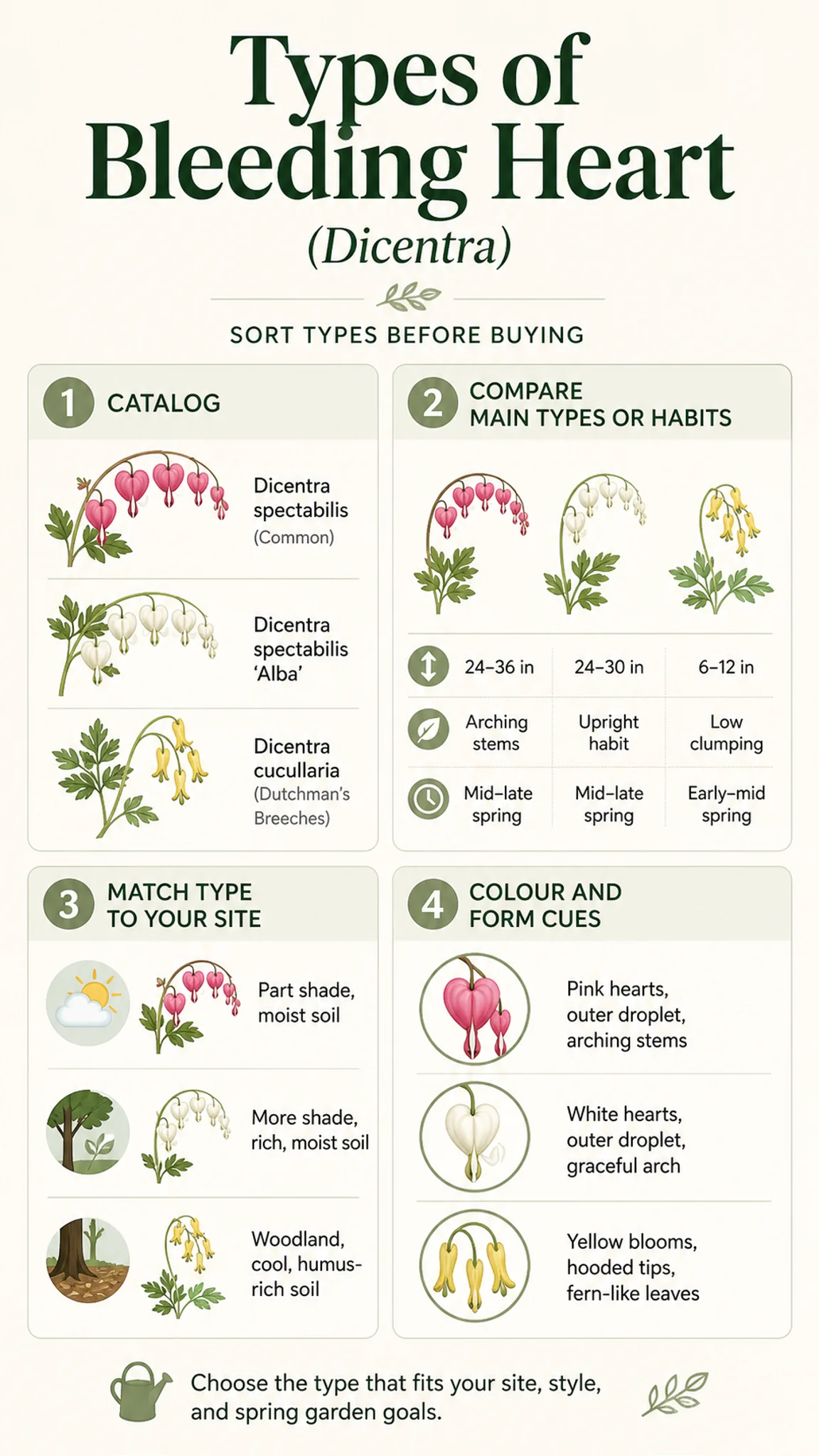
Choose old-fashioned, fernleaf, or native
| Your site | Prefer | Avoid as default |
|---|---|---|
| Spring show, then a summer gap | Old-fashioned spectabilis (Alba, Valentine, Gold Heart) | Expecting foliage until frost |
| Foliage through summer | Fernleaf / formosa / eximia (Luxuriant, King of Hearts) | Spectabilis as a “longer fernleaf” |
| Woodland ephemeral | Dutchman’s breeches, squirrel corn | A 3-foot spectabilis in a tiny wild patch |
Know your USDA hardiness zone before you pick a type of dicentra that will take your winter. Type your ZIP below.
2023 USDA ZIP listings (PRISM / USDA-ARS). Find Your USDA Hardiness Zone · Official USDA map.
Classic spectabilis (now Lamprocapnos) — 2–3 foot arching clumps that bloom in spring and go dormant in summer heat. Alba, Valentine, and Gold Heart are this class, not fernleaf. D. spectabilis, 'Alba', 'Valentine', and 'Gold Heart' are the arching 2–3 foot clump. Botanists now list the species as Lamprocapnos spectabilis; nurseries still say Dicentra. Shorter ferny foliage (D. eximia, D. formosa, and hybrids such as Luxuriant and King of Hearts). Usually holds leaves in summer if the soil stays moist. D. formosa, D. eximia, 'Luxuriant', and 'King of Hearts' stay lower, with finer leaves, and usually hold summer foliage. Woodland natives such as Dutchman’s breeches (D. cucullaria) and squirrel corn (D. canadensis). Small, early, gone by summer — not a cottage spectabilis stand-in. D. cucullaria and D. canadensis are small spring wildflowers, not a cottage-border substitute.
- If you need the bed dressed in July, buy fernleaf — or plant hosta beside spectabilis, not a second old-fashioned clump on the same crown.
- Gold Heart is spectabilis with chartreuse leaves. It still goes dormant. Color is not a calendar change.
- King of Hearts and Luxuriant are fernleaf hybrids. They are not dwarf spectabilis.
- Dutchman’s breeches is Dicentra cucullaria — white pantaloons, tiny, gone by early summer.
Wrong bleeding heart buys that look like a types page
- Spectabilis as an all-summer plant — D. spectabilis and 'Valentine' yellow in heat. That is the species, not a failed watering.
- Fernleaf as a 3-foot arch — 'Luxuriant' and 'King of Hearts' stay about a foot to 18 inches. They will not fill a spectabilis slot.
- Dutchman’s breeches as cottage bleeding heart — D. cucullaria is a woodland ephemeral. Different scale, shorter season.
- A mixed tray with no Latin — ask spectabilis vs eximia/formosa vs cucullaria before you commit a hosta gap-cover.
- Expecting seed from Gold Heart to match — named kinds are clones. Divide, or buy plants.
What height and habit offer
Old-fashioned spectabilis. About 2–3 feet tall and as wide when happy. Arching stems, pink or white hearts in early spring. 'Alba' is white. 'Valentine' is cherry-red on darker stems. 'Gold Heart' is chartreuse leaf. Wisconsin Horticulture: loose clumps, brittle roots, up to 3 feet by 4 feet. Summer rest is normal.
Fernleaf / formosa / eximia. About 12–18 inches. Finer, ferny foliage. Longer bloom if moist. Eastern D. eximia (D. eximia) and western D. formosa (D. formosa) plus hybrids ('Luxuriant', 'King of Hearts', Ivory Hearts, Bacchanal). White Flower Farm: these tolerate more sun and heat than spectabilis. They are still shade plants, not a prairie daisy.
Native ephemerals. D. cucullaria (Dutchman’s breeches) and D. canadensis (squirrel corn) are small woodland plants. Almanac: cucullaria 4–12 inches. They vanish after spring. Do not use them as a border spectabilis stand-in.
Height and summer foliage on the tag beat a pretty heart photo. Old-fashioned is the tall arch that sleeps. Fernleaf is the low mat that usually stays. Native ephemerals are the tiny wild ones. If the tag lists only “bleeding heart,” ask which of those three you are buying before you plan a hosta skirt or a woodland pocket.
Every class wants moist shade and hates a soggy crown. Open Care for dormancy and water. Open Planting for depth. Open Companions for the summer gap. A mixed tray without Latin is three jobs in one pack — split them so a tiny cucullaria does not sit where you wanted a 3-foot arch.
- Spectabilis / Alba / Valentine / Gold Heart → old-fashioned, summer dormant.
- Formosa / eximia / Luxuriant / King of Hearts → fernleaf, usually summer foliage.
- Cucullaria / canadensis → native ephemeral.
- Generic “bleeding heart” → still ask old-fashioned, fernleaf, or native.
- A 3-foot spectabilis wants about 24 inches and a marked crown for the hosta skirt. A 12-inch fernleaf can sit closer to a path.
- Squirrel corn and Dutchman’s breeches vanish by early summer. Plant them where leaf mold covers the gap, not in a formal mid-border hole sized for spectabilis.
Planting distance lives on Planting Bleeding Heart. Partners on Bleeding Heart Companion Plants.
Full catalog by class (21)
Browse all bleeding heart by group. Groups follow habit — old-fashioned spectabilis, fernleaf, native ephemeral — not a hardiness system. Open Care or Planting for method. Confirm summer foliage on the tag before you count on a July leaf. If two cards share a pink heart and not a habit, they still want different gap-covers. Gold Heart is still spectabilis; chartreuse leaves do not keep it awake in August. Luxuriant is still fernleaf; it is not a 3-foot arch. Dutchman’s breeches is still this genus; it is not a reason to water like a bog iris. Confirm the Latin before you duplicate a slot you cannot fill with hosta later, and before you plant a woodland ephemeral where you wanted a cottage clump.
Old-fashioned bleeding heart (5)
Classic spectabilis (now Lamprocapnos) — 2–3 foot arching clumps that bloom in spring and go dormant in summer heat. Alba, Valentine, and Gold Heart are this class, not fernleaf.
Fernleaf / formosa (14)
Shorter ferny foliage (D. eximia, D. formosa, and hybrids such as Luxuriant and King of Hearts). Usually holds leaves in summer if the soil stays moist.
Native ephemeral (2)
Woodland natives such as Dutchman’s breeches (D. cucullaria) and squirrel corn (D. canadensis). Small, early, gone by summer — not a cottage spectabilis stand-in.
FAQ
What is the difference between old-fashioned and fernleaf bleeding heart?
Old-fashioned (spectabilis) is taller and goes dormant in summer. Fernleaf (eximia, formosa, and hybrids) stays lower and usually holds leaves.
Is Gold Heart a fernleaf type?
No. Gold Heart is spectabilis with chartreuse foliage. It still yellows out in summer heat.
What is Dutchman’s breeches?
Dicentra cucullaria — a small native spring ephemeral, not a cottage spectabilis clump.
Will fernleaf bleeding heart go dormant?
Less often than spectabilis, if soil stays moist. Dry heat can still shut it down.
Is Lamprocapnos the same as Dicentra?
Old-fashioned bleeding heart was moved to Lamprocapnos spectabilis. Nurseries still sell it as Dicentra spectabilis. Same plant, new genus name.
Which bleeding heart for a shady border all summer?
Fernleaf types, or spectabilis with hosta and ferns to cover the gap. Companions are on Bleeding Heart Companion Plants.
How tall is Valentine?
It is an old-fashioned spectabilis — a mid-border arch, not a 12-inch fernleaf edger.
Where is planting depth?
On Planting Bleeding Heart — crown depth and spacing.
Related guides


This note is part of Dicentra Guides.
More type comparisons by plant are gathered in Types of Plants Guides.
Updated: Reviewed by Bosquelle Editors