
Choose an early apple, a midseason eating apple, or a late keeper. Pair it with a second cultivar that blooms at the same time.
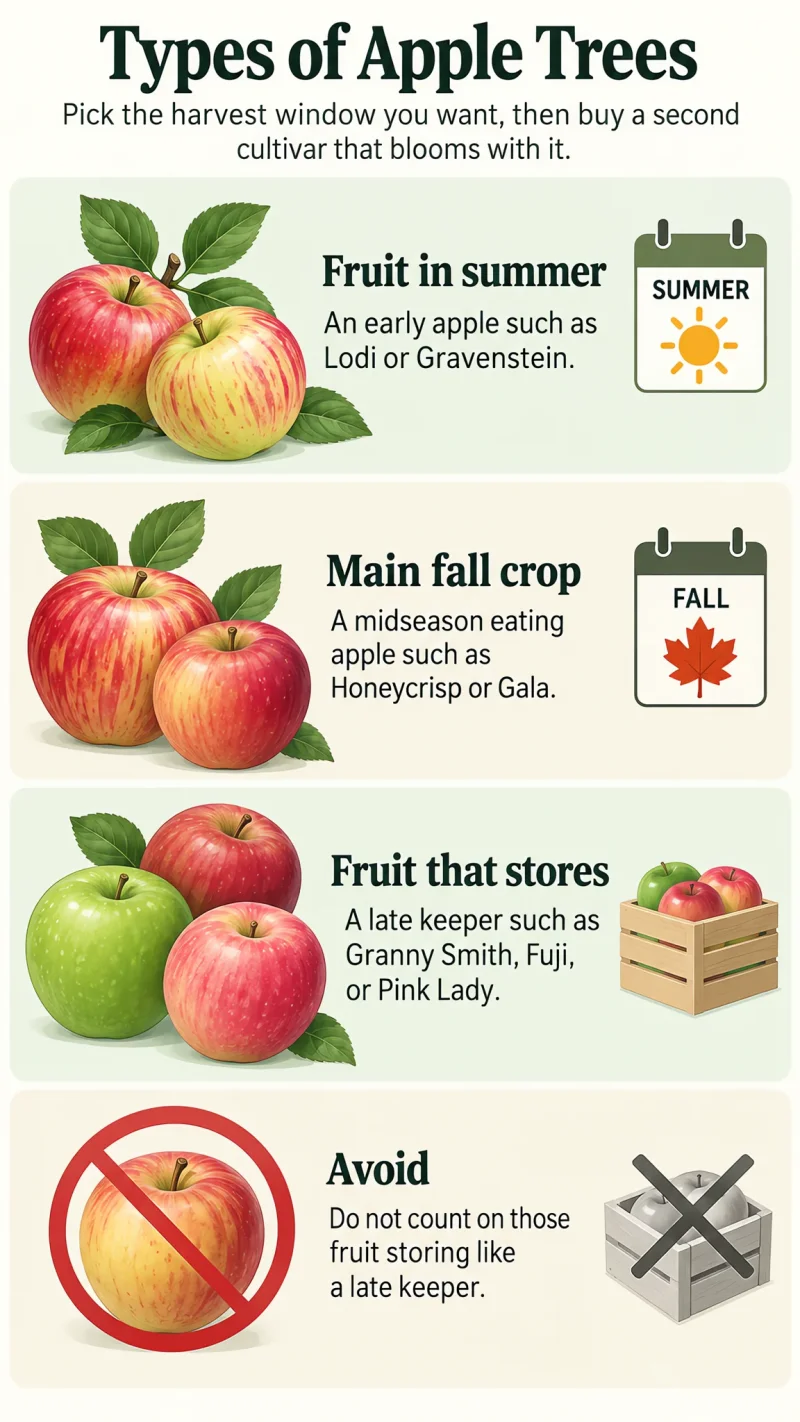
Choose an early, midseason, or late apple first
| Factor | Recommended | Avoid |
|---|---|---|
| Fruit in summer | An early apple such as Lodi or Gravenstein | Do not count on those fruit storing like a late keeper |
| Main fall crop | A midseason eating apple such as Honeycrisp or Gala | Do not plant only one cultivar and hope for a full crop |
| Fruit that stores | A late keeper such as Granny Smith, Fuji, or Pink Lady | Do not wait for a frost to decide it is ripe |
Know your USDA hardiness zone before you pick a type of apple that will take your winter. Type your ZIP below.
2023 USDA ZIP listings (PRISM / USDA-ARS). Find Your USDA Hardiness Zone · Official USDA map.
Read the harvest window on the tag, not only the cultivar name. [1] Early fruit is for eating soon. Midseason fruit is the main backyard crop. Late fruit hangs into October and keeps. [2] When the fruit is on the tree, pick it on Harvesting Apples. [3]
Which kind of apple should I plant?
An early apple if you want fruit in summer, a midseason eating apple for the main crop, or a late keeper if you want fruit that stores.
Plant two kinds that bloom together
Most eating apples need pollen from a different cultivar. Choose two that flower at the same time, or use a neighbor's apple if it blooms with yours. [4] Gravenstein and Jonagold make poor pollen, so do not use either as the only partner. A flowering crabapple can drop pollen onto an eating apple, but it is still a landscape tree, not this crop.
Do I need two different cultivars?
Yes, in most yards. Pair two eating apples that bloom together. Skip using a triploid such as Jonagold as the only pollen source.
Size comes from the rootstock, not the fruit name
Honeycrisp on dwarfing stock stays a small tree. The same scion on a standard seedling can reach orchard height. Nurseries label dwarf, semi-dwarf, and standard from the rootstock, not from the cultivar. Fruit size stays the same. Catalog cards here are the eating-apple scions, about the size of a semi-dwarf tree in the ground.
Does Honeycrisp stay a dwarf on its own?
No. Height comes from the rootstock the nursery grafted. Read dwarf, semi-dwarf, or standard on the tag.
Browse by kind
Pick the harvest window you want, then buy a second cultivar that blooms with it.
FAQ
Can I buy one tree with three kinds grafted on it?
A family tree can set fruit in a small yard, but one limb often outgrows the others unless you prune it. Two separate cultivars are the simpler backyard pair.
Related guides


References
- [1] Gardener's Path -
https://gardenerspath.com/plants/fruit-trees/best-apple-tree-varieties/ - [2] The Spruce -
https://www.thespruce.com/14-varieties-of-apple-trees-5271562 - [3] Oregon State University Extension Service -
https://extension.oregonstate.edu/catalog/fs-147-picking-storing-apples-pears - [4] University of Minnesota Extension -
https://extension.umn.edu/fruit/growing-apples
This note is part of Apple Guides.
More type comparisons by plant are gathered in Types of Plants Guides.
Updated: Reviewed by Bosquelle Editors