
Plant an apple tree while it is dormant, with the graft a few inches above the soil.

Plant while the tree is dormant, with the graft above the soil
| Factor | Recommended | Avoid |
|---|---|---|
| When | Early spring as soon as the soil can be worked, or fall where winters stay mild | Do not plant into frozen ground or a hard frost |
| Graft | Set a dwarf or semi-dwarf tree with the union two to four inches above the finished soil | Do not bury the graft, or the scion will root and the tree will lose its dwarfing |
| Hole | Twice as wide as the roots, no deeper than the root ball | Do not add fertilizer to the pit |
| Room | Leave about as much space as the tree's mature height: dwarf six to eight feet, semi-dwarf twelve to fifteen, standard twenty to twenty-five | Do not crowd two trees into one small hole |
Honeycrisp arrives as a grafted tree, not a seedling. [1] The bump on the lower trunk is where the fruiting wood meets the rootstock. Keep that union above grade on a dwarf or semi-dwarf tree. [2] Bare-root trees go in while they are still dormant. [3] A container tree can wait until after frost, but the graft still sits high. [4] Once it is in the ground, keep it in sun on How to Grow Apple Trees.
When do I plant an apple tree?
Plant a bare-root tree in early spring as soon as the soil can be worked. Delay if a hard frost is still due.
How to plant an apple tree
- Soak bare roots in a bucket for one to two hours. Do not leave them in water overnight.
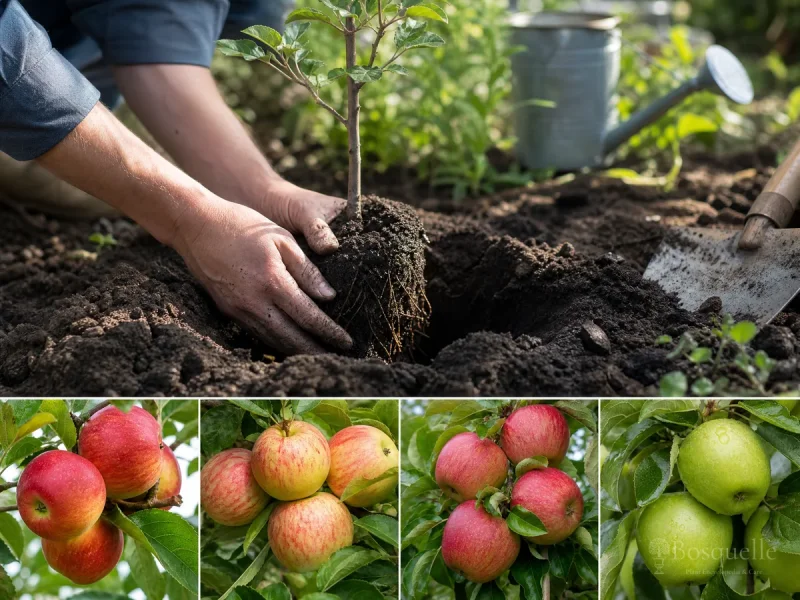
- Dig a hole twice as wide as the roots and no deeper than the root ball. Keep the topsoil in a separate pile.
- Set the tree in the center with roots spread. Hold the trunk vertical so the graft sits two to four inches above the finished soil on a dwarf or semi-dwarf tree.
- Backfill with the soil you took out. Firm as you go so air pockets close. Do not dump fertilizer in the pit.
- Water with about a gallon to settle the soil. Spread two to three inches of mulch over the root zone, and keep it off the trunk. Slide off the nursery tag so it cannot girdle the bark.
How high should the graft sit?
On a dwarf or semi-dwarf apple, leave the union two to four inches above the soil. If soil covers it, the scion can root and the tree grows full size.
What fails at planting
A buried graft is the usual reason a “dwarf” apple turns into a large tree. Wet, packed clay in the hole rots roots before the first summer. Circling pot roots that you do not tease out keep girdling as the trunk thickens. A summer plant into hot, dry soil stresses a dormant-shipped tree. Seed from a grocery apple will not give you the named fruit on the tag; buy a grafted tree, or copy one later on How to Propagate Apple Trees.
Can I grow an apple tree from the core instead of planting a tree?
You can sprout seed, but the fruit will not match the parent. Plant a grafted cultivar if you want named fruit.
If the graft is buried, lift the tree and reset it before the scion roots.
FAQ
Can I plant an apple tree in summer?
A container tree can go in after frost if you can water it. Bare-root trees belong in the dormant window.
Do I need a trunk guard?
A hardware-cloth wrap a few inches into the soil stops voles from chewing bark under mulch. Keep mulch off the trunk either way.
Related guides

Recommended plants

References
- [1] Stark Bro's -
https://www.starkbros.com/growing-guide/how-to-grow/fruit-trees/apple-trees/planting - [2] University of Minnesota Extension -
https://extension.umn.edu/fruit/growing-apples - [3] University of Illinois Extension -
https://extension.illinois.edu/fruit-trees/planting - [4] University of Missouri Extension -
https://extension.missouri.edu/media/wysiwyg/Extensiondata/Pub/pdf/agguides/hort/g06021.pdf
This note is part of Apple Guides.
More planting notes by plant are gathered in Planting Guides.
Updated: Reviewed by Bosquelle Editors