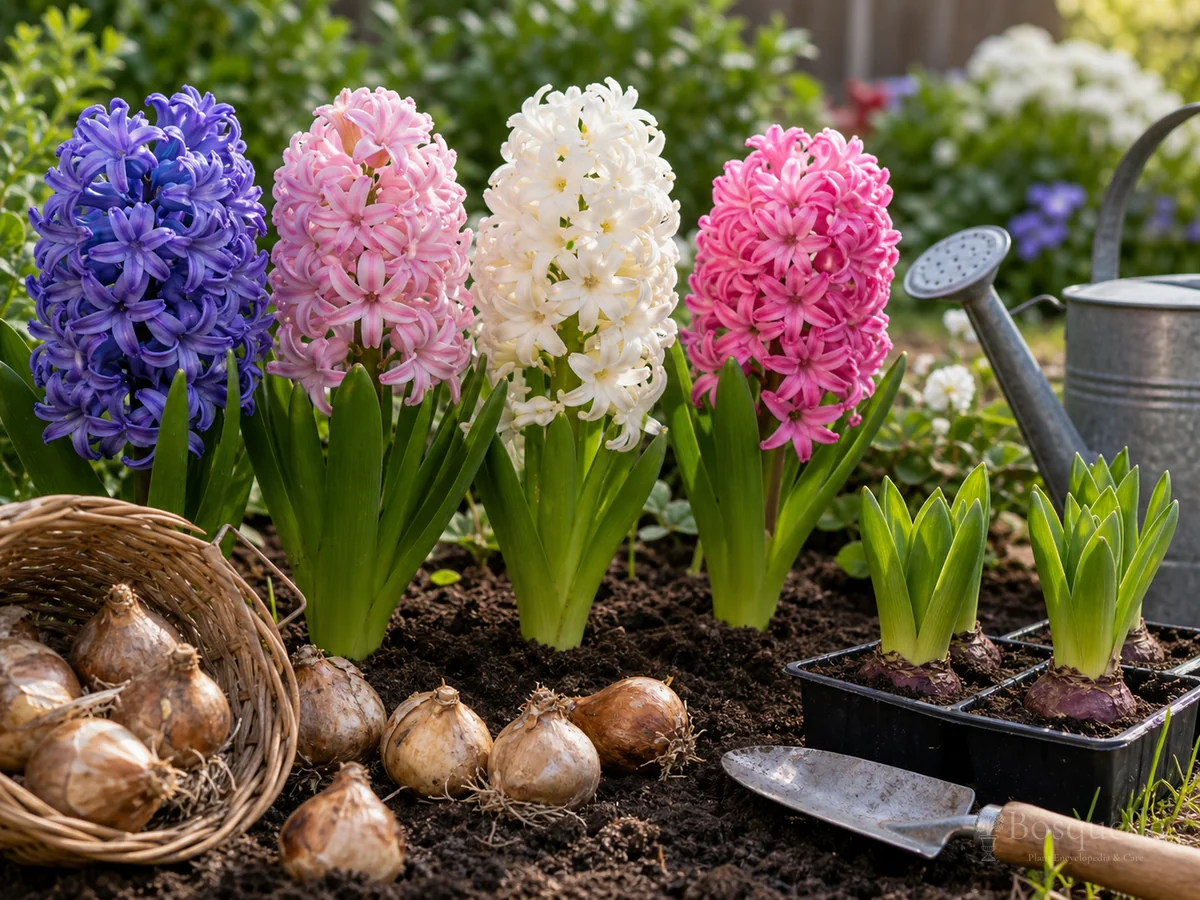
Plant hyacinth bulbs in fall, after the first frost and before the ground freezes. Set them 4 to 6 inches deep, pointed end up, 5 to 6 inches apart. Delft Blue and Jan Bos take the same hole. Water in. Wear gloves. A March plant-out of an unchilled bulb will not make a May spike.

Fall, after frost, before freeze
| Factor | Recommended | Avoid |
|---|---|---|
| Timing | Mid to late fall, soil cooling, before freeze | Warm soil in early fall; frozen ground you cannot dig |
| Depth | 4 to 6 inches, pointed end up | The nose at the surface; a foot-deep grave in wet clay |
| Spacing | 5 to 6 inches; groups of 5 to 9 | A single file line; Muscari’s 2-inch carpet spacing |
| First water | Water thoroughly after covering | A puddled hole that never drains |
Roots need time before winter. Old Farmer's Almanac: plant in mid-to-late fall, after the first fall frost and before the ground freezes; 4 to 5 inches deep; 5 to 6 inches apart; pointed end up; water thoroughly. Garden after-bloom stays on How to Grow Hyacinths.
Soil near 50–55°F is a better cue than a calendar page. If the ground is still warm and wet, wait. If a freeze is two weeks out and you can still dig, plant. In sandy soil, go a little deeper. In heavy clay, a little shallower or a raised row so the bulb is not in a sump. Mild winters that never chill the bed need a fridge pre-chill before plant-out, or you treat the display as a container force. Do not skip that step and blame the cultivar. Color does not replace cold.
How to plant hyacinth bulbs
Wear gloves. National Garden Bureau: plant in groups of five or more, about 5 inches apart on center, 4 to 5 inches deep, in soil that never gets soggy. Full sun is best.
- Wait until fall cooling. Loosen the bed deeper than the planting depth. Mix in compost. Check that rain does not pond. Wear gloves before you touch a bulb.
- Dig 4 to 6 inches deep. In a group, excavate a small patch rather than a row of tiny holes so depth stays even. Groups of five to nine read as one clump from the path.
- Set each bulb pointed end up, basal plate down. If a bulb is round and the point is dull, the flatter scarred face is the basal plate — that face goes down. Space 5 to 6 inches. Do not lay a bulb on its side.
- Cover with soil. Firm lightly. Water until the hole settles. Add a 1- to 2-inch mulch after the soil cools, not a wet blanket on warm ground.
- If squirrels work the bed, pin chicken wire on top until freeze. Do not pile rocks that trap water on the noses.
- Leave them. Roots grow until freeze. Water again only if fall is dust-dry. Do not fertilize on top of a wet clay plant-out. Mark the patch so you do not dig it in summer.
Plant all bulbs in a group at the same depth so they bloom together. A shallow one runs early and short. A deep one in wet clay rots. Mix colors in one patch if they are all Hyacinthus orientalis — kinds on Types of Hyacinths. Do not plant grape hyacinth (Muscari) at Dutch depth and spacing as if they were the same bulb. Muscari sits shallower and closer. Do not plant hyacinth bean. That is a vine.
Mild winters, gloves, and what fails
What fails: planting in March; nose down; a puddle; skipping gloves then blaming the soil for a rash; copying a tulip’s 8-inch hole without checking drain; a fridge pre-chill next to apples. Fruit gas can ruin bulbs. Keep them in a paper bag, dry, away from produce if you chill indoors. After covering, the first weeks are root weeks. Dry fall wind can dry a new planting — one deep soak if rain fails. Then stop. A weekly sprinkle on freezing nights is ice, not help.
If you missed fall, do not stuff an unchilled bulb into cold mud in January and expect April. Pot it, chill it, and treat it as a container plant, or wait until next fall. A grocery forced bowl in bloom is not a fall plant-out — enjoy it, then move it to the garden after frost risk with its leaves on. Northern edge gardens can plant on the deeper side of 4 to 6 inches and mulch after freeze. That is insulation, not a reason to use a wet peat pile. Southern mild gardens pre-chill about 10 to 14 weeks at 40–45°F, then plant when the soil has cooled. The bulb still wants drain.
- Bag bulbs for the fridge. Keep them dry and away from ripening fruit for the full chill, then plant as soon as the soil has cooled.
- Do not hold chilled bulbs on a warm shelf for weeks. The cold clock already ran; they need soil next.
- Water in after covering. Check the next morning that the hole did not pond. If it did, lift and move to a raised row.
Plant in fall after the first frost and before freeze. Set bulbs 4 to 6 inches deep, pointed end up, 5 to 6 inches apart in soil that drains. Water in. Wear gloves. Pre-chill about 10 to 14 weeks at 40–45°F away from fruit if winter will not. Do not plant an unchilled bulb in March and expect a packed spike.
FAQ
When do you plant hyacinth bulbs?
In fall, after the first frost and before the ground freezes, when soil is cooling.
How deep do I plant hyacinth bulbs?
About 4 to 6 inches, pointed end up. A little deeper in sand, a little shallower in wet clay.
How far apart should hyacinth bulbs be?
About 5 to 6 inches. Groups of five to nine look better than a single line.
Which way up does the bulb go?
Pointed end up. The flatter basal plate goes down.
Do I water after planting?
Yes, thoroughly, then only if fall stays dry. Do not leave a puddle.
Should I wear gloves?
Yes. Sap and bulb juices can irritate skin.
Can I plant hyacinths in spring?
Not for a normal May spike. They need fall roots and winter chill. Force a pot if you missed the window.
Do mild-winter gardens need to chill bulbs first?
Yes if outdoor weeks will not stay near 40–45°F. Use a refrigerator away from fruit, then plant.
Where is after-bloom and pot forcing?
How to Grow Hyacinths for leaves after the spike. Hyacinths in Containers for indoor chill.
Related guides


Recommended plants


This note is part of Hyacinthus Guides.
More planting notes by plant are gathered in Planting Guides.
Updated: Reviewed by Bosquelle Editors