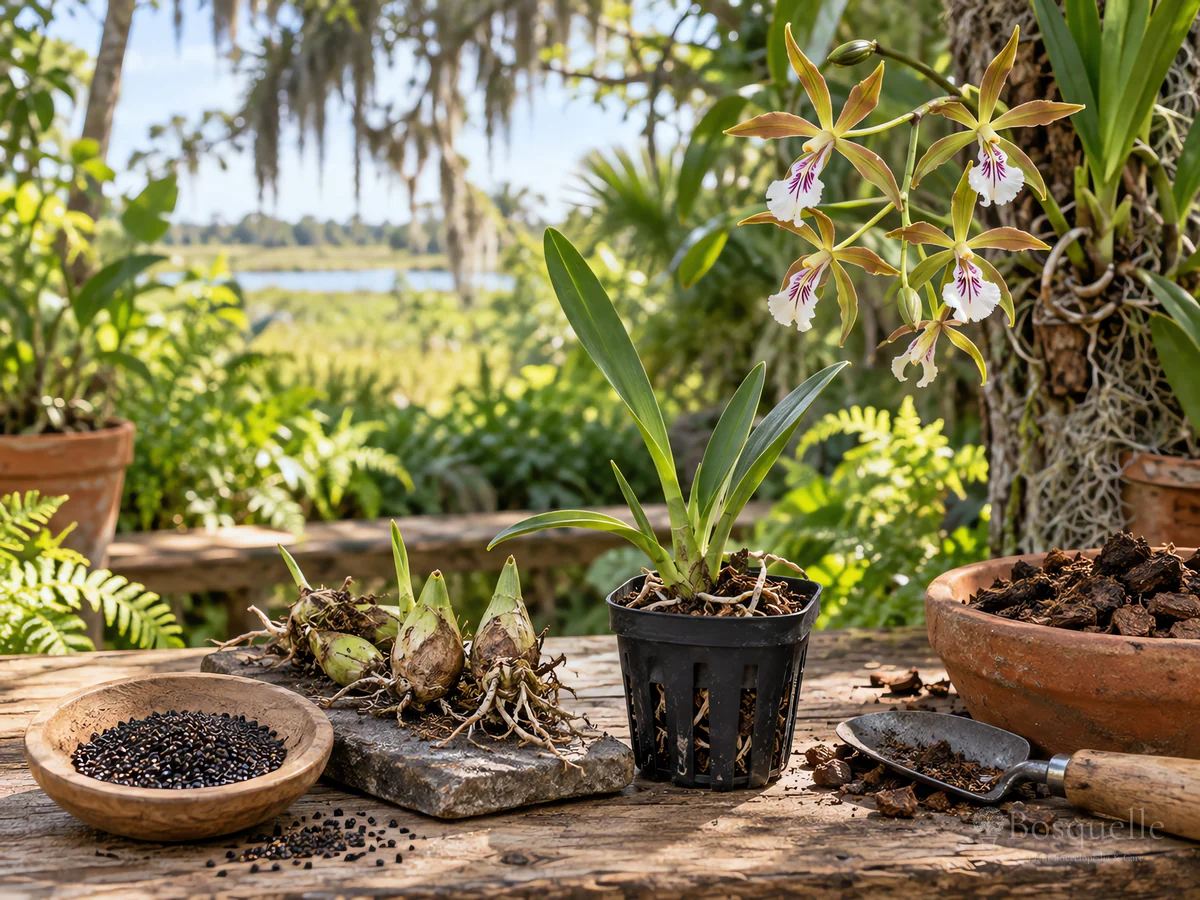
Plant Encyclia by tying a nursery plant to a live-oak limb or a cork slab. Press the bare roots against rough bark. Do not take a wild Florida plant.

Tie a nursery plant to live oak or cork — do not take a wild plant
| Factor | Recommended | Avoid |
|---|---|---|
| When | Warm, humid months while the plant is in growth, so new roots can grip | Do not attach it just before a freeze |
| Stock | A nursery-propagated plant | Do not take a plant off a wild Florida tree |
| Host | Southern live oak, or another rough-barked hardwood; cork or hardwood as a slab | Do not use smooth, peeling bark |
| Contact | Bare roots tight against the bark | Do not wrap the roots in garden soil or a thick pad of wet moss |
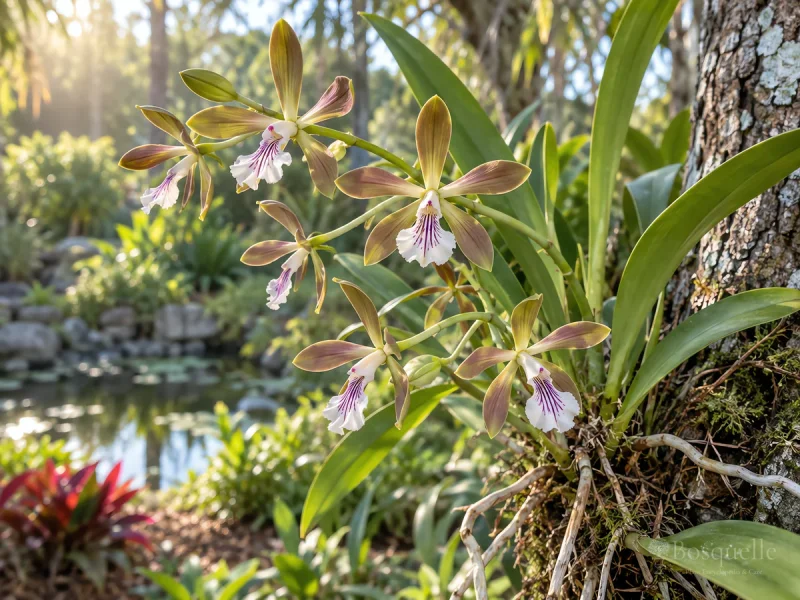
encyclia does not go in a hole. Southern live oak is the usual host. Bald cypress, red maple, buttonwood, pop ash, pond apple, mahogany, and some palms also hold it. [1] A cork or hardwood slab works when you have no tree. The plant wants the roots on the bark, not in soil. [2] Florida lists this orchid as commercially exploited. You may not harvest or sell a wild plant without a permit. Buy a nursery plant. [3] Light, watering, and later care live on How to Grow Encyclia.
Do I need a permit to take one off a Florida tree?
Yes, for wild plants. Florida treats this orchid as commercially exploited. Buy a nursery-propagated plant instead.
When do I attach it to a tree?
In warm, humid weather while the plant is growing, so new roots can grip the bark. Do not attach it just before a freeze.
How to attach Encyclia to a tree or a cork slab
Hold the plant so the newest roots touch the bark and the leaves face up. Tie it snug enough that wind cannot rock it, without crushing the pseudobulbs. [4]
- Choose a nursery plant with several firm roots. Leave wild plants on the tree.
- Pick a live-oak limb or the north or east face of a trunk, or a cork or hardwood slab. Skip smooth or peeling bark.
- Soak the roots, then press them against the bark. Do not pack garden soil or a thick wet moss pad around them.
- Tie with sisal, jute, or another natural twine so the plant cannot rock. Keep the pseudobulbs uncrushed.
- Water the roots daily in dry weather until new roots grip, then ease off to the same wet-then-dry cycle you use on an established plant.
What fails if the roots stay wet or the bark peels
Roots that sit in a crotch of standing water, or on bark that sheds, rarely attach. Treefern mounts often stay too wet for this genus. A plant that wobbles in the wind tears new roots before they grip.
- Do not lodge the plant in a hole on the branch where rain collects.
- Do not wrap the roots in a thick, wet moss pad that never dries.
- Skip peeling bark, such as some eucalyptus or paperbark, because the mount falls when the bark sheds.
- If the plant still rocks after a week, add a tie rather than soaking it every day in hope.
If a new mount still rocks, add a tie before you water again. Leave wild plants on the tree.
FAQ
Can I glue it instead of tying it?
A tight tie is the reliable home method. If you use a construction adhesive, put a small drop on the bark, let it get tacky, and press the pseudobulb — not the roots — into the drop.
Which tree if I have no live oak?
Any long-lived hardwood with rough bark and afternoon shade works. Bald cypress, red maple, pond apple, and buttonwood are common hosts. A cork slab is the indoor substitute.
Can I plant it in garden soil?
No. This orchid grows on bark, not in a hole. Garden soil around the roots stays wet and they rot.
Related guides

Recommended plants

References
- [1] Broward Native Orchids -
https://browardnativeorchids.com/wp-content/uploads/2026/04/encyclia_tampensis.pdf - [2] NC State Extension Gardener -
https://plants.ces.ncsu.edu/plants/encyclia-tampensis/ - [3] Florida Wildflower Foundation -
https://www.flawildflowers.org/flower-friday-encyclia-tampensis/ - [4] Sweetgum and Pines -
https://sweetgumandpines.wordpress.com/2022/01/16/the-genus-encyclia-part-1-introduction-and-general-notes-on-cultivation/
This note is part of Encyclia Guides.
More planting notes by plant are gathered in Planting Guides.
Updated: Reviewed by Bosquelle Editors