
Repot Encyclia when new roots start, or when the bark has gone mushy, into a snug pot of coarse mix that drains in seconds.
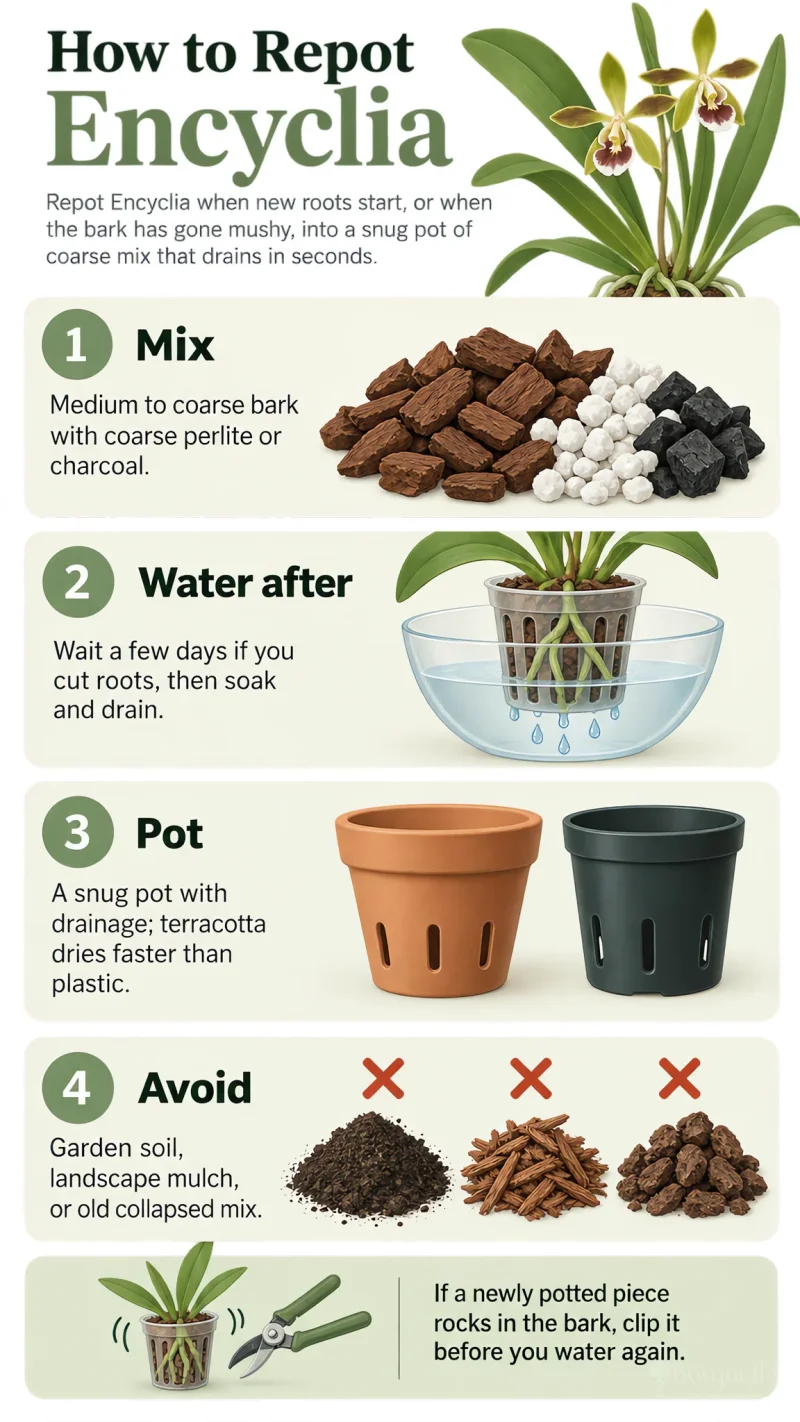
Repot when new roots start, or when the bark has gone mushy
| Factor | Recommended | Avoid |
|---|---|---|
| When | As new roots start, after flowering, or when bark turns fine and stays wet | Lifting a plant in full bloom |
| Pot | A snug pot with drainage; terracotta dries faster than plastic | An oversized pot of unused wet bark |
| Mix | Medium to coarse bark with coarse perlite or charcoal | Garden soil, landscape mulch, or old collapsed mix |
| Water after | Wait a few days if you cut roots, then soak and drain | A saucer of standing water |
You repot encyclia because old mix collapses and the roots rot, not because the plant outgrew the pot like a shrub. These orchids do not like frequent root disturbance, so wait until you see new roots or the bark has gone mushy. [1] Terracotta dries more evenly than plastic. A mix of bark chunks and coarse perlite is the usual home blend. [2] If you are tying the plant to a tree instead of a pot, that job is on Planting Encyclia. Light and the later watering cycle live on How to Grow Encyclia.
When should I repot Encyclia?
When new roots just start, or when the bark stays wet and smells sour. Skip the job while it is in bloom.
Do Encyclia orchids like to be root-bound?
They do better in a snug pot that drains than in a large pot of unused wet bark. Give them room for about two years of new bulbs, not a shrub-sized tub.
How to repot Encyclia
Work one plant at a time: out of the old pot, dead roots off, oldest back against the rim, then firm the new bark. [3]
- Ease the plant out. Break or cut the pot if roots are glued to the wall. Shake out all old mix. Do not reuse it.
- Trim hollow or mushy roots. Live roots are firm and pale.
- Choose a draining pot. Terracotta dries faster; plastic stays wet longer. Cover the bottom with a thin layer of fresh coarse bark.
- Set the oldest pseudobulbs against one side so new growth can move across the surface. Keep the rhizome at the mix line, not buried.
- Work bark around the roots with no air pockets. Stake or clip the plant so it does not rock while new roots take hold.
- Wait a few days if you cut roots, then soak and drain. The roots must not sit wet. [4]
Divide only if each piece keeps several plump pseudobulbs
Until a plant has a generous clump of mature pseudobulbs, move it into a slightly larger pot and do not split it. Each piece needs several healthy, plump pseudobulbs and live roots, or it is unlikely to bloom the next season.
- Find the youngest growth: plump green bulbs, new shoots, and firm pale roots.
- Pull or cut the rhizome so each piece keeps several plump pseudobulbs. Discard leafless back bulbs with no live roots.
- Use a sterile blade between plants. Let cut faces dry briefly before you pot.
- Pot each piece with the oldest back against the rim, same as a whole-plant lift.
If a newly potted piece rocks in the bark, clip it before you water again.
FAQ
Can I reuse old bark?
No. Collapsed bark holds water even when the top looks coarse. Use fresh mix every time you lift the plant.
Should I divide it every time I repot?
No. Split only when each piece can keep several plump pseudobulbs. A healthy mound can stay together.
Can I leave it mounted instead of potting?
Yes. A cork or hardwood slab is a fine home. See Planting Encyclia for the tie.
Related guides

Recommended plants

References
- [1] American Orchid Society -
https://www.aos.org/explore/encyclia - [2] Sweetgum and Pines -
https://sweetgumandpines.wordpress.com/2022/01/16/the-genus-encyclia-part-1-introduction-and-general-notes-on-cultivation/ - [3] NC State Extension Gardener -
https://plants.ces.ncsu.edu/plants/encyclia-tampensis/ - [4] Broward Native Orchids -
https://browardnativeorchids.com/wp-content/uploads/2026/04/encyclia_tampensis.pdf
This note is part of Encyclia Guides.
More container notes by plant live in Container Growing Guides.
Updated: Reviewed by Bosquelle Editors