
Plant cattail in spring, in a stout aquatic basket or bucket. Set the rhizome shallow, cap with gravel, and lower the basket onto a wet shelf.
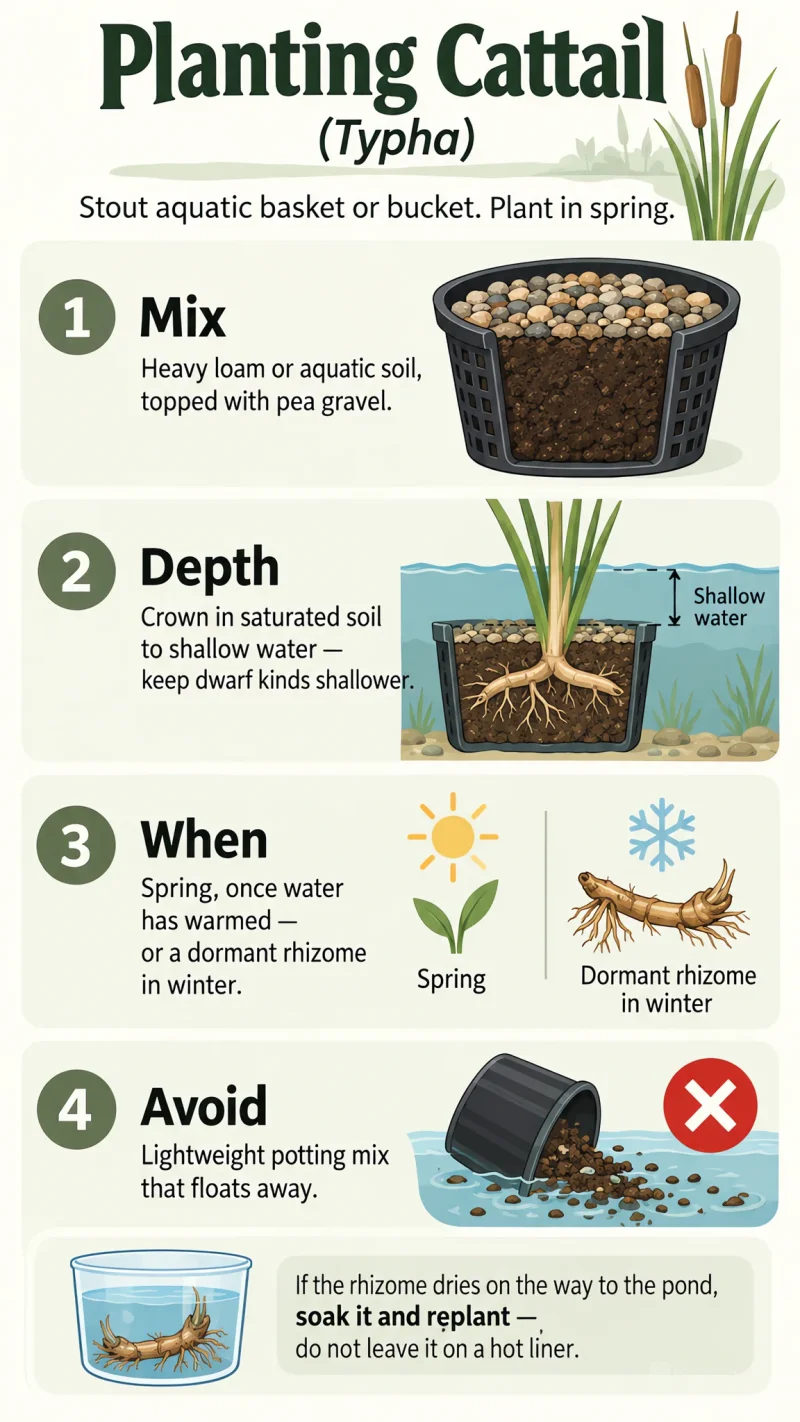
Plant in spring, in a stout basket
| Factor | Recommended | Avoid |
|---|---|---|
| When | Spring, once water has warmed — or a dormant rhizome in winter | Dropping a dry rhizome onto a hot deck |
| Vessel | A stout mesh aquatic basket, or a 5-gallon bucket with drain holes | Open mud in a small lined pond |
| Mix | Heavy loam or aquatic soil, topped with pea gravel | Lightweight potting mix that floats away |
| Depth | Crown in saturated soil to shallow water — keep dwarf kinds shallower | The deep open middle of the pond |
Use a container to control spread on a small water garden, and keep tall broadleaf kinds in shallow to moderate water — you can cover the crown with up to about 30 inches. [1] Set rhizome pieces horizontally, growing points up, about 4 to 6 inches deep in soil that stays saturated. [2] Dormant rhizomes can go in during winter, before new growth starts, next to permanent water. [3]
How deep should I plant cattails?
Keep the crown in saturated soil to shallow water. Tall broadleaf kinds tolerate more depth than dwarf minima, which wants only a few inches. Avoid the deep open zone.
Can I grow cattails in a pot?
Yes — a stout aquatic basket or a 5-gallon bucket is the usual way to keep rhizomes from running. Keep the mix wet. A patio tub works for dwarf minima on a shallow step.
How to plant cattail
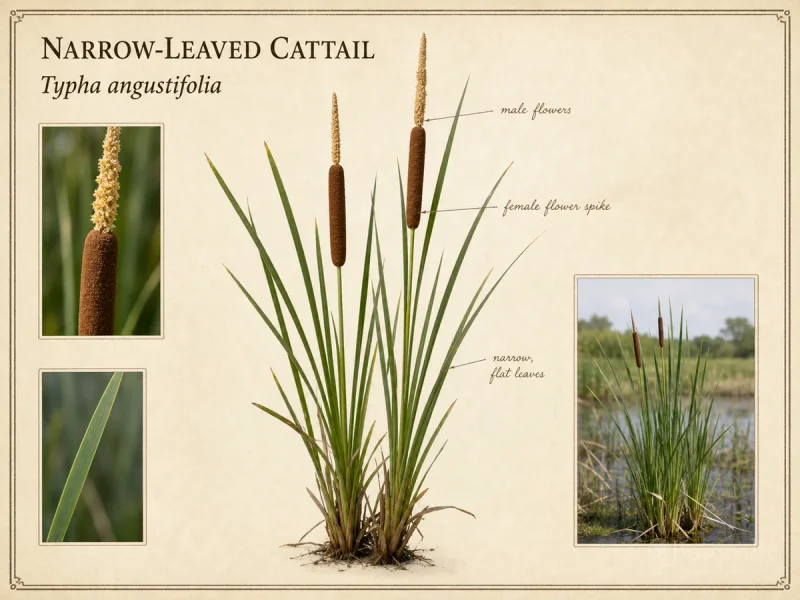
Narrow-leaved kinds are often grown in a 5-gallon bucket under about a foot of water. [4] The same basket method holds for the other kinds we list; only the shelf depth changes.
- Choose a stout mesh basket or a durable bucket. Line wide mesh with burlap so soil does not wash out.
- Fill with heavy loam or aquatic soil. Set the rhizome horizontally, eyes up, and cover with 1 to 2 inches of soil.
- Top with pea gravel so fish and current do not pull the rhizome loose.
- Water the basket until the mix is saturated, then lower it onto the shelf so the crown stays wet. Keep dwarf kinds on the shallow step.
First watering, and what fails a new plant
Keep the mix saturated after plant-out. Rhizomes that dry out fail. Failures are a dry week, a lightweight mix that floated away, water well past the shelf, and open mud in a tiny liner with no basket. Leave walking gaps between baskets if you still want open water.
If the rhizome dries on the way to the pond, soak it and replant — do not leave it on a hot liner.
FAQ
Can I plant into open pond mud?
Only where a large wet edge can absorb a colony. On a small lined pond, a basket or bucket is the plant-out, not an optional extra.
How far apart?
Leave gaps between baskets so you still have open water and a path for a net. Wall-to-wall baskets recreate a monoculture in miniature.
Can I keep one in a patio tub?
Yes for dwarf minima, in a stout pot that stays wet. Tall broadleaf kinds need a much larger vessel and still want a barrier.
Related guides


Recommended plants



References
- [1] NC State Extension Gardener -
https://plants.ces.ncsu.edu/plants/typha-latifolia/ - [2] University of Washington -
https://depts.washington.edu/propplnt/Plants/typha.htm - [3] Texas A&M AgriLife AquaPlant -
https://aquaplant.tamu.edu/management-options/cattail/ - [4] NC State Extension Gardener -
https://plants.ces.ncsu.edu/plants/typha-angustifolia/
This note is part of Typha Guides.
More planting notes by plant are gathered in Planting Guides.
Updated: Reviewed by Bosquelle Editors