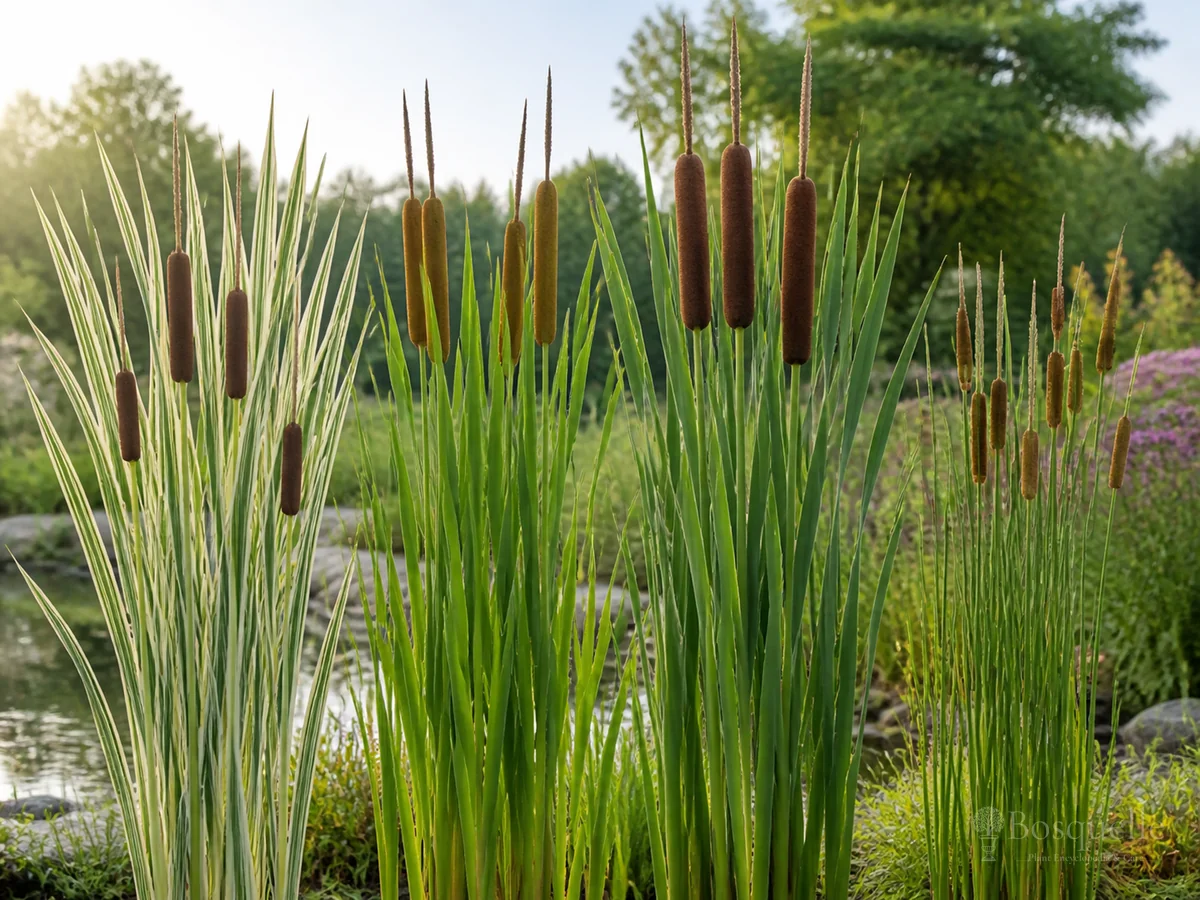
Grow cattail in full sun and shallow water, inside a stout basket or barrier. Cat-o’-nine-tails is the same plant — not a dry-border grass.

Full sun, shallow water, and a rhizome basket
| Factor | Recommended | Avoid |
|---|---|---|
| Light | Full sun; light shade is tolerated | Deep shade that thins stands and spikes |
| Water | Saturated soil to shallow standing water over the crown | A dry border, or the deep open middle of the pond |
| Containment | A stout aquatic basket, bucket, or edge barrier on a small lined pond | Open mud in a tiny ornamental pool |
| Winter | Leave the clump in the pond; it is a hardy emergent | Lifting and storing it like a tender bulb |
Give cattail full sun, wet soil or a shallow shelf, and a plan for the rhizomes. Grow it in containers to keep a small pond from filling in, and you can cover the crown with up to about 30 inches of water on tall broadleaf kinds. [1] Rhizomes creep sideways along the shallows, so a large container and a yearly check for stray runners are the practical control on an ornamental shelf. [2] In a pond much smaller than a half acre, expect to manage spread. [3] Rhizomes can work into liner seams on a small feature, which is why a basket with heavy loam and a gravel cap is the plant-out, not open mud in a corner.
Will cattails take over my pond?
They can on a small lined pond without a basket or barrier. Use a stout aquatic basket, thin runners every year, or plant only where a large wet edge can absorb the colony.
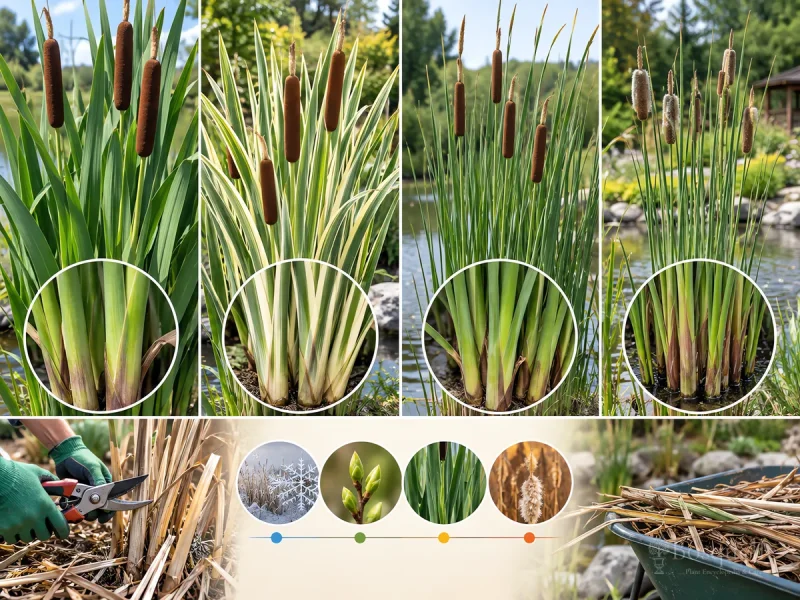
Thin runners, and cut old stems in late winter
Pull or dig rhizomes that escape the basket while they are still small. In late winter or early spring, cut dead stems before new shoots push. [4] If a stand has already closed the open water, cutting the tops above the waterline will not kill it. Cut stems below the waterline, keep the stubs flooded, and remove the cut material so it does not rot in the pond. On a tiny ornamental shelf, cut the brown spikes before they turn to fluff if you want fewer seedlings in the gravel.
- Each growing season, lift stray runners along the liner and return them to the basket or compost them off-site.
- In late winter, cut old brown stems before new growth. Leave a few standing if you want winter cover for birds.
- On an overrun shelf, cut stems below the waterline and keep those stubs submerged. Repeat through the season; one pass is not a kill.
Plant a rhizome, divide a clump, or sow seed
- Set a rhizome in a stout basket on a shallow shelf — Planting Cattail.
- Split an established clump in spring — Propagating Cattail.
- Sow on moist mud if you want a restoration start — Growing Cattail from Seed.
If the stand is already a carpet, cut stems below the waterline and keep the stubs flooded — do not add another rhizome to open mud.
FAQ
Are cattails invasive if they are native?
Broadleaf cattail is native across much of North America and still forms a monoculture in a small, nutrient-rich pond. Native and well-behaved in a lined pool are different questions.
Are cattails edible?
Young shoots and other parts are edible when gathered from clean water at the right stage. This guide is pond culture — not a forage key. Containment still comes first.
Do cattails need full sun?
Yes for the strongest stands and spikes. Light shade is tolerated. Deep shade thins both.
Do cattails need fertilizer?
Usually no in rich muck. Extra feed often pushes algae more than a better stand. A light aquatic tablet is optional in a new, barren basket.
What else can I plant on the same wet shelf?
Other emergents that share standing water — pickerelweed, iris for wet feet, or marsh marigold. Do not pair cattail with a dry prairie perennial on one hose zone.
What pests hit cattail?
Aphids can hide in leaf sheaths. See the aphids hub. Brown, stunted plants are often a dry crown or water that is too deep, not a mystery disease.
Related guides



Recommended plants



References
- [1] NC State Extension Gardener -
https://plants.ces.ncsu.edu/plants/typha-latifolia/ - [2] Mississippi State University Extension -
https://extension.msstate.edu/publications/cattail-typha-spp - [3] PlantNative -
https://plantnative.org/native-plants/cattail-typha-latifolia.htm - [4] Washington Native Plant Society -
https://www.wnps.org/native-plant-directory/42-typha-latifolia
This note is part of Typha Guides.
More first-season notes by plant are gathered in How to Grow Guides.
Updated: Reviewed by Bosquelle Editors