
Grow white correa in sun on ground that drains, and water a new shrub until the roots take. White correa is Correa alba, also sold as Australian fuchsia or Cape Barren tea. If a search for fuchsia sent you to hanging-basket fuchsia, California fuchsia, or Cape fuchsia, those are different plants.
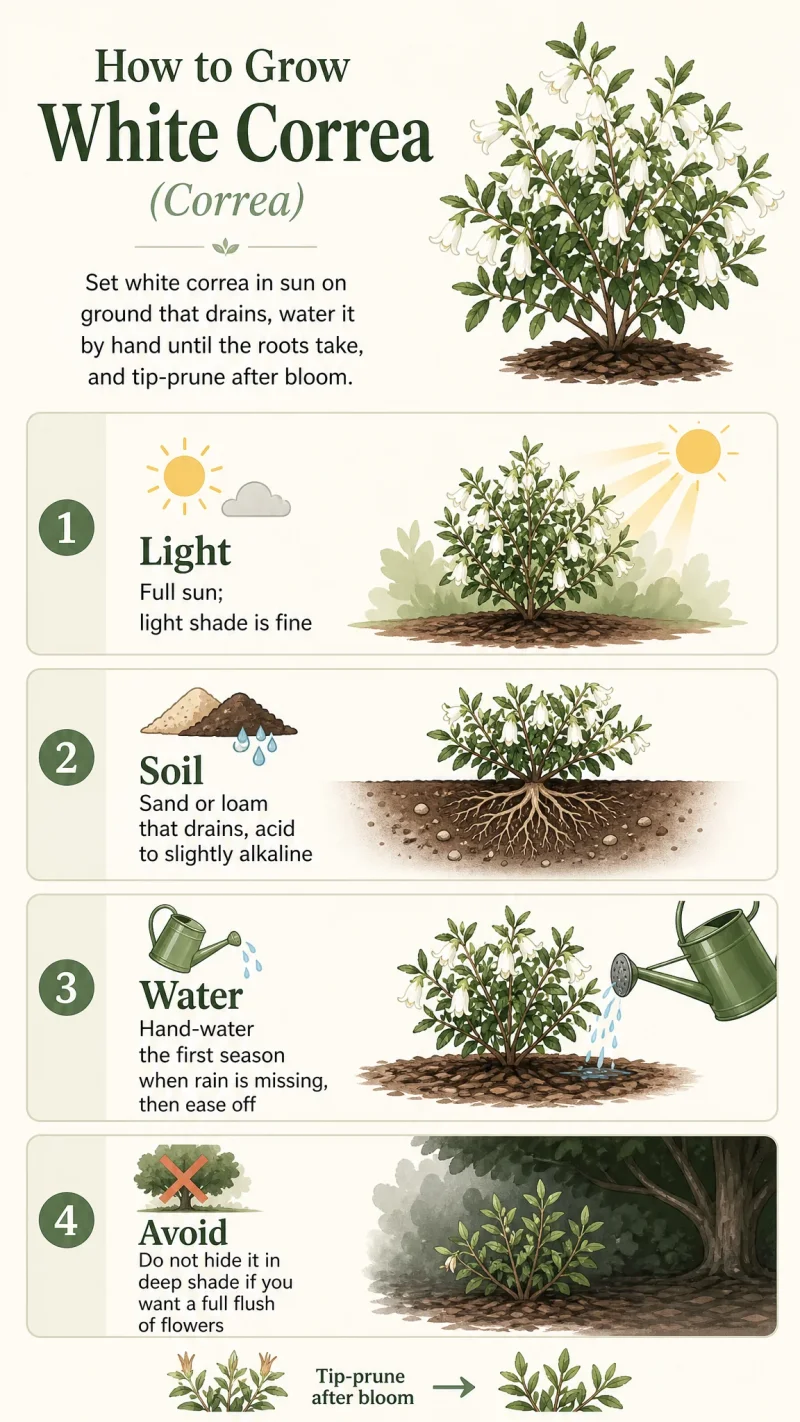
Plant it in sun on ground that drains, then ease off the water
| Factor | Recommended | Avoid |
|---|---|---|
| Light | Full sun; light shade is fine | Do not hide it in deep shade if you want a full flush of flowers |
| Water | Hand-water the first season when rain is missing, then ease off | Do not keep the crown in standing water |
| Soil | Sand or loam that drains, acid to slightly alkaline | Do not plant into a wet clay hole |
| Frost | Plant after frost in a marginal spot | Do not count on it through a hard freeze |
| Room | A rounded shrub about 3 to 6 feet tall and wide | Do not buy it as hanging-basket fuchsia for a porch pot |
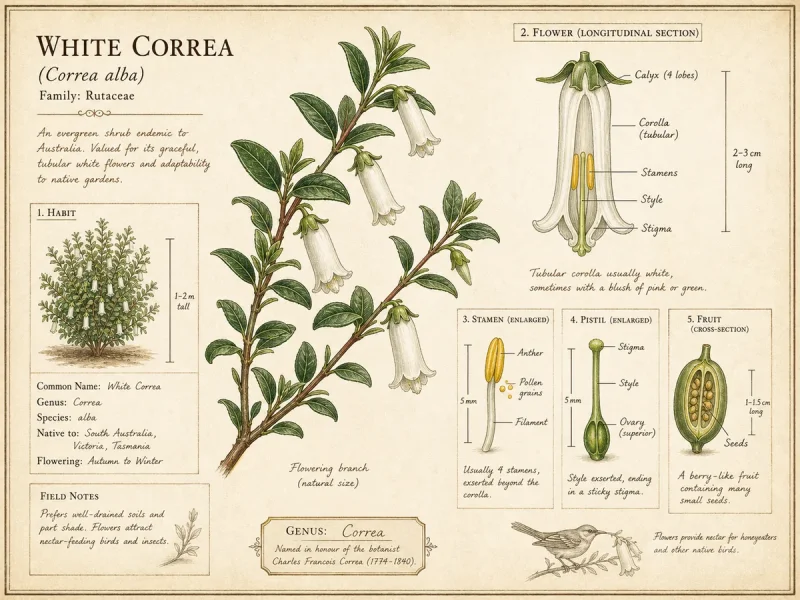
White correa wants a bright site and ground that does not stay wet. Full sun keeps the gray-green leaves dense and the white stars coming. Shade makes the shrub open and cuts the bloom. Water a new plant by hand whenever rain is missing through the first season. After that, skip the regular sprinkler except in a long dry spell. Coastal salt spray is fine. A freeze near 20 to 25°F marks the tips. [1] White Correa is an evergreen Australian shrub in the citrus family, with oval leaves that are hairy underneath and star-shaped white flowers in autumn and winter. The four petals spread open instead of staying fused as a hanging tube. [2] Heavy wet clay around the roots is the usual cause of rot. Once the roots take, the shrub can go through a dry spell. Do not feed a rich lawn dose. [3]
How big does white correa get?
A mature shrub is about 3 to 6 feet tall and wide. Give it that room, not a tight box hedge from day one.
Plant a nursery shrub in spring, or in fall on a mild coast
Plant while you can water by hand and a hard freeze is not due. Spring is the usual window. Fall is fine on a mild coast. Set the root ball even with the surrounding soil. Leave about 3 feet between plants if you want them to meet as a low hedge.
- Plant in sun, after frost, on ground that drains after rain.
- Slide the plant out of the pot and loosen circling roots so they can grow out.
- Set the crown even with the soil. Space plants about 3 feet apart for a low hedge, or farther for a single mound. [4]
- Water after you plant, then by hand through the first season whenever rain is missing.
When should I plant white correa?
Plant in spring, when you can water by hand and a hard freeze is not due. Fall is fine in a mild coastal garden.
Tip-prune after bloom — do not cut into old wood
Flowers sit on the new growth. After the main autumn and winter flush fades, tip the stems back a few inches if you want a denser mound. The shrub looks better, and flowers more, if you skip a hard shear. Do not cut into thick brown wood with no green, because those stubs rarely sprout.
- Wait until the main flush of flowers fades.
- Tip each stem back a few inches, just above a leaf.
- Cut out dead or crossing twigs at their base.
- Do not shear into old wood, and do not cut a tall plant to a stump in one day.
Can I cut white correa back hard?
No. Tip it after bloom. Old wood without green leaves usually stays bare. If you need a smaller plant, buy a compact form rather than cutting this one to the ground.
Not a hanging-basket fuchsia — and not tea tree
White correa has star-shaped white flowers on a woody coastal shrub. Hanging-basket fuchsia is Fuchsia, a tender plant grown for dangling tubes — see How to Grow Fuchsias. California fuchsia is Epilobium, a dry-bank perennial with scarlet tubes — see How to Grow California Fuchsia. Cape fuchsia is Phygelius, a South African shrub with moist-sun trumpets — see How to Grow Cape Fuchsia. Tea tree is Leptospermum; Cape Barren tea is only an old name for this Correa, not that care — see How to Grow Tea Tree. Native fuchsia on a tag often means Correa reflexa, which has hanging bells, or Epacris longiflora. If the tag says Correa alba and the flowers open as white stars, you have white correa.
Is Australian fuchsia the same as hanging-basket fuchsia?
No. Australian fuchsia on a tag is usually this Correa. Hanging-basket fuchsia is a different plant with dangling tubes.
What is the common name for Correa alba?
White correa, also sold as Australian fuchsia or Cape Barren tea. The white stars are this shrub, not a hanging bell.
How to start a new plant from a cutting
A tip cutting is the way to keep the plant you bought. Take the cutting from this year's growth that is not in heavy flower, in late summer or early autumn if you can.
- Take a tip about 2 to 3 inches long, cut just below a node.
- Strip the lower third of the leaves. Keep the upper leaves.
- Dip the base in rooting hormone. Stand the stem in mix that drains.
- Keep the pot bright and barely moist until roots hold the mix, then move it into more sun before you plant it out.
Seed is slower than a cutting
Seed can grow a plant, but it is slower and harder to start than a cutting. Sow fresh seed if you have it, keep the tray barely moist in good light, and wait. Cuttings from this year's growth are the usual home method.
How can I start a new plant?
Take a tip cutting in late summer or early autumn, stand it in mix that drains, and wait until roots hold. Seed is slower, and it is harder to start.
Set white correa in sun on ground that drains, water it by hand until the roots take, and tip-prune after bloom.
FAQ
Can I grow white correa in a pot or indoors?
A large patio pot with a drainage hole can hold a plant if the mix drains and the pot sits in sun. Move it to shelter if a hard freeze is due. It is not a houseplant.
Do you list native fuchsia or Dusky Bells as a separate plant?
This catalog holds White Correa, Correa alba. Native fuchsia often means Correa reflexa, which has hanging bells. Dusky Bells is a hybrid we do not list as a separate plant. They still want soil that drains.
Is Cape Barren tea a tea I should brew?
Cape Barren tea is an old name for the leaves of this shrub. Grow it for the white stars and the coastal hedge, not as a kitchen tea.
Recommended plants
References
- [1] Australian Native Plants Society -
https://anpsa.org.au/plant_profiles/correa-alba/ - [2] San Marcos Growers -
https://www.smgrowers.com/info/Correa.asp - [3] San Marcos Growers -
https://www.smgrowers.com/products/plants/plantdisplay.asp?plant_id=2746 - [4] Australian Plants Society NSW -
https://resources.austplants.com.au/plant/correa-alba/
More first-season notes by plant are gathered in How to Grow Guides.
Updated: Reviewed by Bosquelle Editors