
Grow water hawthorn in cool pond water and sun or part sun. Aponogeton is also sold as Cape pondweed. It is not a hawthorn tree.

Keep it in cool pond water, and give it sun or part sun
| Factor | Recommended | Avoid |
|---|---|---|
| Light | Full sun or part sun | Do not plant it in dry shade on a bed |
| Water | Cool pond water. Once the leaves are up, keep about 6 to 24 inches of water over the tuber | Do not let the tuber dry on a patio |
| Soil | Heavy loam or clay in a pond basket | Do not use a light mix that floats away |
| Summer | Leave the tuber in the pond when the leaves yellow | Do not throw the pot out |
| Winter | Drop the basket so ice does not freeze the tuber | Do not leave the tuber in ice at the surface |
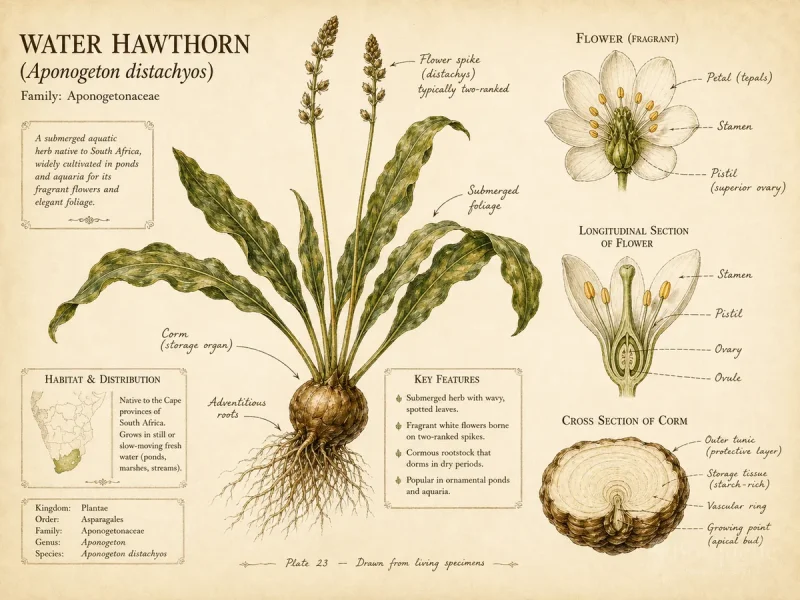
Water hawthorn wants cool pond water. Full sun or part sun is the usual pond home, and the oblong leaves float while a forked white flower spike stands just above the surface. [1] Water hawthorn rests when the water warms, then grows again when the pond cools. The flowers open in cool months, often while summer water-lily pads are still quiet. It is not a dry-bed shrub and not a windowsill houseplant.
How much sun does water hawthorn need?
Give it full sun or part sun. Dry shade on a bed is the wrong home. The leaves need to reach pond light.
Why did my water hawthorn disappear in summer?
That rest is normal when the water warms. Leave the tuber in the pond. New leaves return when the pond cools.
Plant the tuber in a pond basket, then lower it as the leaves grow
Plant from a tuber or a potted plant. Set the tuber in heavy loam in a mesh pond basket, pointed side up, under about an inch of soil. Start that basket in shallow water so the new leaves can reach the surface, then lower it as the leaf stalks lengthen. Once it is growing, about 6 to 24 inches of water over the tuber is enough. [2] Do not drop a new tuber off a deep shelf where the leaves cannot reach the air.
- Plant in cool weather from a tuber or a potted plant, once the pond is filled.
- Set the tuber in heavy loam in a mesh pond basket, pointed side up, under about an inch of soil.
- Start the basket in shallow water so new leaves can reach the surface, then lower it as the leaf stalks lengthen. Once it is growing, about 6 to 24 inches of water over the tuber is enough.
- Cap the basket with a little gravel if the mix floats, and keep extras in the pot.
- Bag extras. Do not toss them into a lake, ditch, or storm drain. This shop plant can seed into wild water.
How do I plant water hawthorn?
Set the tuber in heavy loam in a mesh pond basket, pointed side up, under about an inch of soil. Start it in shallow water, then lower the basket as the leaves grow.
Split a crowded clump of tubers
Most gardeners start a new patch from a tuber, not from seed. Lift a crowded clump while the plant is at rest, keep a growing point on each piece, and replant at once in a fresh basket of heavy loam.
- Lift a crowded clump while the leaves are yellow or gone, so you can see the tubers.
- Pull or cut a piece that has a growing point.
- Replant at once in a fresh basket of heavy loam, start it in shallow water, and keep the tuber wet while it takes.
Let it rest in summer heat, and drop the pot below the ice in winter
When the water warms, the floating leaves yellow and the flowers stop. That rest is normal. Stop fertilizer until new leaves return, and leave the tuber in the pond. Label the pot so you do not throw a resting plant out with dead foliage. After frost, drop the basket to the deepest part of the pond so ice does not freeze the tuber. [3] Pull yellow leaves so they do not rot in the water. If the pond freezes to the bottom, move the basket to a wet, frost-free tub. Do not lift the tuber into a dry pot.
- When the leaves yellow in heat, stop fertilizer and leave the tuber in the pond.
- Label the pot so you do not throw it out while it is at rest.
- After frost, drop the basket to the deepest part of the pond so ice does not freeze the tuber.
- Pull yellow leaves so they do not rot in the water.
- If the pond freezes to the bottom, move the basket to a wet, frost-free tub. Do not store the tuber dry.
Do I throw the pot out when the leaves yellow?
No. Summer rest is normal. Leave the tuber in the pond, and drop the basket so ice does not freeze it in winter.
Not a water lily — and not a hawthorn tree, Indian hawthorn, or water hyacinth
A tag that says hawthorn is often a thorny tree, not this pond plant. Water hawthorn has oblong floating leaves and a forked white flower spike in cool water. A water lily has round pads and flowers in summer heat — see How to Grow Water Lily.
Hawthorn tree is Crataegus, a woody plant for garden soil that drains — see How to Grow Hawthorn. Indian hawthorn is Rhaphiolepis, a dry-soil shrub — see How to Grow Indian Hawthorn. A tag that says water hyacinth is Eichhornia, a floating pest plant, not this tuber. [4]
Is this a water lily?
No. Water lily has round pads and summer flowers. Water hawthorn has oblong floating leaves and flowers in cool water.
Is this a hawthorn tree?
No. Hawthorn tree is Crataegus, a woody plant for garden soil. Water hawthorn is a pond tuber with floating leaves.
Set water hawthorn in cool pond water, plant the tuber in a basket, and leave the tuber in the pond when the leaves yellow in summer heat.
FAQ
Is Madagascar lace plant the same plant?
No. Madagascar lace plant is usually Aponogeton madagascariensis, a submerged aquarium plant with netted leaves. This shop card is water hawthorn, a cool-water pond plant with solid floating leaves.
Can I grow water hawthorn in a dry pot?
No. A mix that dries in a day dries the tuber out, and it does not return. A pond basket works when the soil stays under water. It is not a dry patio plant.
Can I grow it from seed?
You can, but most gardeners plant a tuber. Ripe seed germinates on the water surface if it stays wet. The baskets still have to stay in the pond.
Can I eat the flowers?
Do not eat this plant from the pond. In South Africa the flowers are used in a stew, but a garden pond is not a food crop. Grow it for the cool-water flowers, not as food.
Is it toxic to fish or pets?
It is not known as a toxic pond plant. Keep extras in the basket, and do not toss pieces into a lake.
Recommended plants
References
- [1] In the Country Garden & Gifts -
https://www.inthecountrygardenandgifts.com/articles/plants/pond_plant_water_hawthorn.php - [2] Pond Informer -
https://pondinformer.com/water-hawthorn-aponogeton-distachyos/ - [3] SANBI PlantZAfrica -
https://pza.sanbi.org/aponogeton-distachyos - [4] Royal Horticultural Society -
https://www.rhs.org.uk/plants/1386/aponogeton-distachyos/details
More first-season notes by plant are gathered in How to Grow Guides.
Updated: Reviewed by Bosquelle Editors