
Grow Turk's-cap cactus in bright light, in a mix that drains, and water it when that mix is dry. Keep the cephalium, the woolly cap at the top, dry. The plant is Melocactus, a small melon-shaped cactus. It is not the shrub sold as Turk's cap, and it is not a grafted moon cactus.

Give it bright light, a gritty mix, and water that drains
| Factor | Recommended | Avoid |
|---|---|---|
| Light | Bright sun, with afternoon shade in the hottest weeks | Do not keep it on a dim sill if you want a cephalium and flowers |
| Water | Soak the mix when it is dry, then empty the saucer. Water at the soil, not on the cephalium | Do not leave the pot sitting in a wet saucer |
| Soil | Gritty cactus mix with extra pumice or coarse grit | Do not use packed potting soil that stays wet |
| Warmth | A warm, frost-free room; bring the pot in before nights drop near 50°F | Do not leave a wet pot in frost or a cold garage |
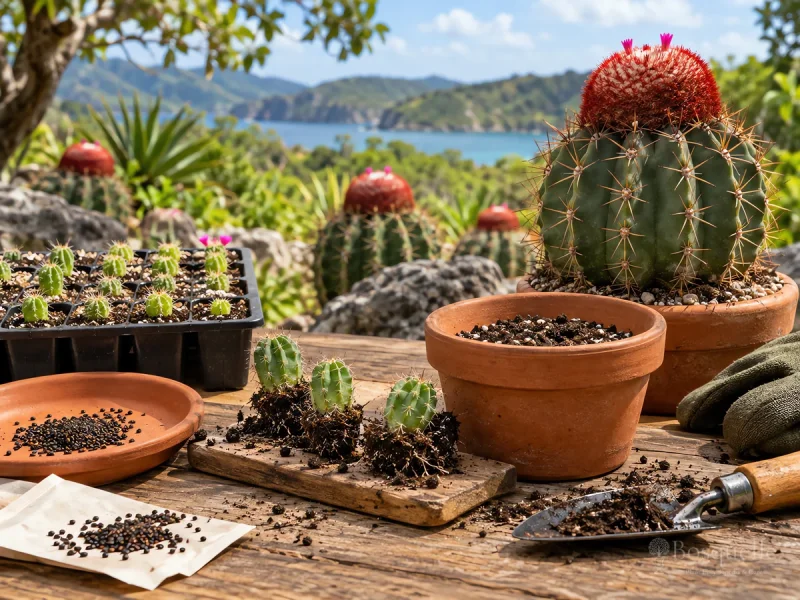
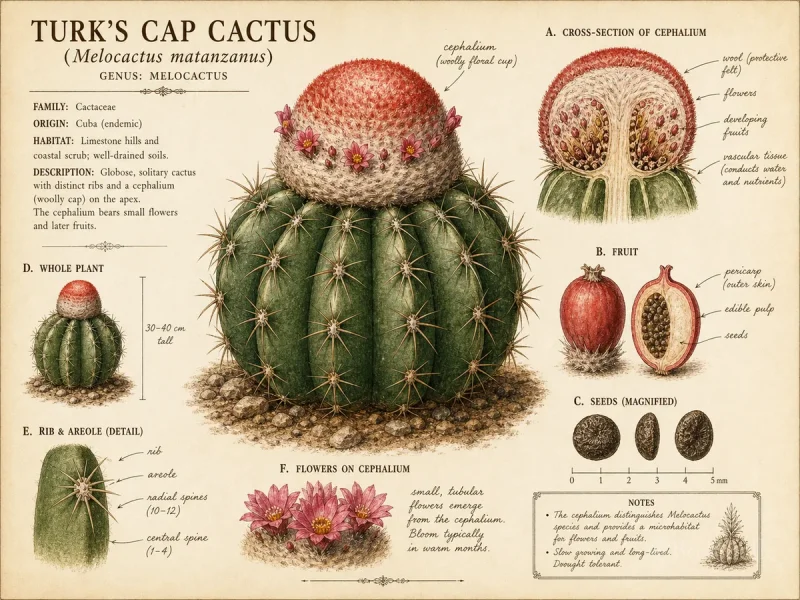
Turk's-cap cactus is Melocactus matanzanus, a Cuban globe about 3 to 4 inches across. At maturity it grows a cephalium, a woolly, bristly pad at the top, and that is where the small pink or magenta flowers open. [1] Give it full light and a cactus mix that sheds water. Soak the mix when it is dry, then let the pot drain. Water at soil level so the cephalium stays dry. In a mix that drains, the fibrous roots still need that soak. In a packed mix they rot. Take seed on How to Propagate Turk's Cap Cactus.
How much sun does Turk's-cap cactus need?
Bright sun, with afternoon shade in the hottest weeks. A dim sill slows the body and often delays the cephalium.
How often should I water Turk's-cap cactus?
Soak the mix when it is dry, then empty the saucer. Water at the soil, not on the cephalium. A wet saucer rots faster than a missed watering.
When does Turk's-cap cactus bloom?
Small pink or magenta flowers open from the cephalium in the warm season, often overnight, once the plant is mature.
Keep it warm in winter, and do not leave the pot wet
This cactus is tropical. If the air drops below about 50°F, the body can scar or collapse in a few hours, especially when the mix is wet. [2] In a cold garden, bring the pot to a sunny windowsill and keep the room around 60 to 70°F. Let the top of the mix dry between waterings, and empty the saucer every time. After the cephalium forms, keep that winter room on the warm side of that range. A dry chill may not kill a young plant. A wet pot in the cold often does.
Does Turk's-cap cactus come back after a freeze?
A brief dry chill may not kill a young plant. A freeze on a wet pot often does. Bring it inside before nights drop near 50°F, and keep the mix from sitting wet.
Grow it in a small pot, and leave the roots alone after the cap forms
This plant lives in a patio pot more often than in open ground. The roots are fibrous and easy to tear, so a small container with a hole in the bottom is enough. After the cephalium forms, the green body stops putting on new growth, and the plant is slow to make new roots if you disturb it. Leave a mature plant in the pot it already fills, or slide it into a slightly larger pot without teasing the root ball. [3] Empty the saucer after you water.
- Choose a small pot with a drainage hole, only a little wider than the body.
- Fill it with cactus mix plus extra pumice or coarse grit. Set the plant at the same depth it was growing, with the green body above the mix.
- Water once to settle the grit, then wait until the mix is dry before you water again.
- Once the woolly cap has formed, skip routine repotting. If you must move it, slide the root ball out intact and do not pick at the roots.
Can I grow Turk's-cap cactus in a pot?
Yes. Use a small pot with a hole in the bottom and a gritty cactus mix. After the cephalium forms, leave the roots alone and empty the saucer after you water.
Not the shrub called Turk's cap — and not a grafted moon cactus
The shrub sold as Turk's cap is Malvaviscus, a woody plant with red flowers that never fully open. Grow that plant on How to Grow Turk's Cap. The woolly pad on this cactus is a cephalium, the adult flowering shoot of the same plant, not a second cactus grafted on top. [4] A colorful moon cactus is a graft: a chlorophyll-poor Gymnocalycium top on a green stock. Grow that plant on How to Grow Moon Cactus. Discocactus also makes an apical cephalium; it is a different South American genus, and we do not hold it. A barrel cactus is Ferocactus; grow that on How to Grow Barrel Cactus. Chin cactus is green Gymnocalycium on its own roots; grow that on How to Grow Chin Cactus. Pincushion cactus is Mammillaria; grow that on How to Grow Pincushion Cactus. Turk's head cactus on a U.S. tag is often Echinocactus horizonthalonius, a different globe with no cephalium.
Is Turk's-cap cactus the same as the shrub Turk's cap?
No. The shrub is Malvaviscus, with closed red flowers on woody stems. Turk's-cap cactus is Melocactus, a spiny globe with a woolly cephalium.
If the body turns soft or the cephalium darkens, empty the saucer, move the pot into more sun and warmth, and wait until the mix is dry before you water again.
FAQ
Do you list all the species?
The shop plant is Melocactus matanzanus, sold as Turk's-cap cactus or melon cactus. The genus holds many named forms. Read the tag for the Latin name, then keep the same sun, grit, and watering that leaves the cephalium dry.
Do I need to prune it?
No regular prune is required. Do not cut or brush the cephalium. Pull a spent flower or a ripe fruit from the wool if you want, and leave the cap in place.
Can I eat the pink fruit?
The small pink fruits are edible in small amounts, with a mild sweet taste. Grow the plant as an ornamental. Do not cook from it, and do not use the pulp as medicine.
Is it poisonous?
Grow it as an ornamental. The spines puncture skin. Keep pets and children from chewing the plant, and handle it with gloves or folded paper.
Related guides
Recommended plants
References
- [1] Henry Shaw Cactus and Succulent Society -
https://hscactus.org/resources/plants-of-the-month/melocactus-2017/ - [2] Henry Shaw Cactus and Succulent Society -
https://hscactus.org/resources/plants-of-the-month/melocactus-2005/ - [3] Il Fiore Tra Le Spine -
https://www.ilfioretralespine.it/en/cultivate-melocactus-cephalium/ - [4] University of Texas -
https://web.biosci.utexas.edu/mauseth/researchoncacti/Cephalia.htm
This note is part of Melocactus Guides.
More first-season notes by plant are gathered in How to Grow Guides.
Updated: Reviewed by Bosquelle Editors