
Grow spotted wintergreen in dry, acidic shade under oak or pine. Spotted wintergreen is Chimaphila maculata. If you crush a leaf and it smells like mint, or you see red berries, that is teaberry wintergreen, not this plant.
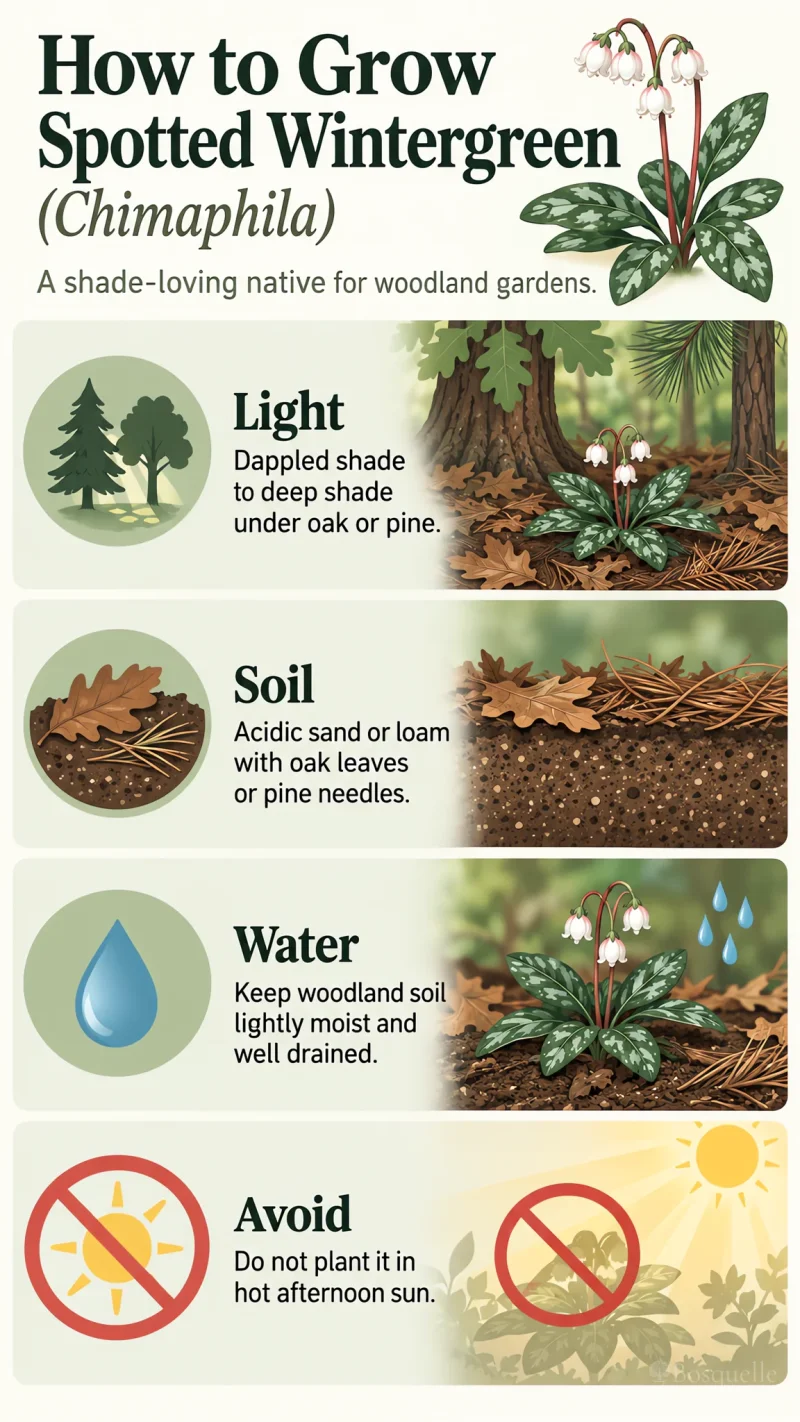
Keep it in dry, acidic shade under oak or pine
| Factor | Recommended | Avoid |
|---|---|---|
| Light | Dappled shade to deep shade under oak or pine | Do not plant it in hot afternoon sun |
| Water | Keep woodland soil lightly moist and well drained | Do not let the roots sit in soggy clay |
| Soil | Acidic sand or loam with oak leaves or pine needles | Do not add lime, or plant it in a wet bog |
| Room | Leave about 4 to 12 inches of height and 6 to 9 inches of spread | Do not treat it as a weed-smothering carpet |
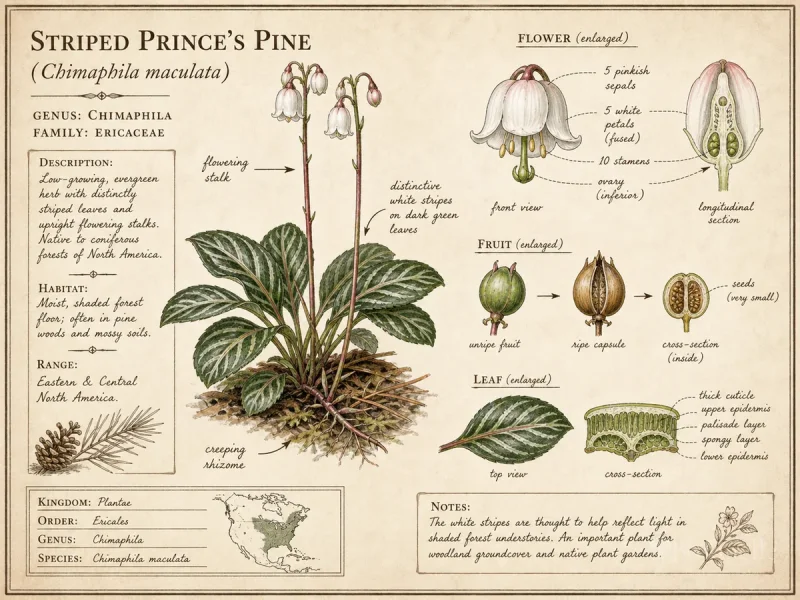
Spotted wintergreen wants dry woods, not a bog. Acidic sand or loam with a mulch of oak leaves or pine needles is the right home, and a lime bed or a soggy hole will rot the roots. [1] Give it dappled shade through a tree canopy, or deeper shade. Hot sun scorches the striped leaves. [2] spotted wintergreen is an evergreen woodland subshrub with dark leathery leaves, a white stripe along the midrib, and nodding white or pink flowers in summer. Crush a leaf: this plant has no mint scent. Do not add lime. Do not fertilize a plant that already lives in woodland litter.
How much sun does spotted wintergreen need?
Dappled shade to deep shade under oak or pine. Hot afternoon sun scorches the striped leaves.
Should the soil stay wet?
No. Keep woodland soil lightly moist and well drained. A soggy clay hole rots the roots, and a wet bog is the wrong home.
Does it need acidic soil?
Yes. Acidic sand or loam with leaf litter or pine needles. Lime and a wet bog are the usual reasons it fails.
Plant a nursery pot without tearing the roots
Buy a nursery plant. Do not dig a wild patch. Set the root ball even with the surrounding leaf litter. Do not tease the fibrous roots apart, because they depend on fungi in that woodland soil, and a torn clump often dies. [3]
- Buy a nursery plant. Do not dig spotted wintergreen from the woods.
- Plant in spring, while the soil is workable, into dry, acidic shade.
- Slip the root ball out and set it even with the surrounding leaf litter. Do not bury the crown, and do not tease the roots apart.
- Water once to settle the soil, then keep the bed lightly moist and well drained. Leave the leaf litter in place.
When should I plant spotted wintergreen?
Spring, while the soil is workable. Set a nursery pot in a spot that is already dry, acidic shade, not a wet hollow you hope to drain later.
Can I dig it from the woods?
No. Wild patches fail when the roots are torn, and the plant is rare or protected in parts of its range. Buy a nursery plant.
Not the mint-scented wintergreen — and not a boxwood
If you bought wintergreen and the leaves smell like mint and set red berries, that is How to Grow Wintergreen. Wintergreen boxwood is How to Grow Boxwood. Winterberry holly is How to Grow Holly. Rattlesnake plantain is a striped woodland orchid, not this subshrub. Pipsissewa without white stripes is Chimaphila umbellata, a relative with shiny green leaves. If the tag says Chimaphila maculata and the leaves have a white midrib and no mint scent, you have spotted wintergreen.
Is spotted wintergreen the same as teaberry?
No. Teaberry wintergreen has a mint scent and red berries. This plant has a white stripe on the leaf and no mint scent.
How to start a new plant from a clump or a cutting
A careful spring division is the usual home start, and it often fails if you tear the roots. A June softwood cutting can root in moist acid peat mixed with a little soil from around an established plant. Fresh seed on moist peat is unreliable. [4]
- In spring, as new growth starts, lift a rooted piece of an established clump. Keep woodland soil on the roots.
- Reset it at the same depth in dry, acidic shade. Do not shake the soil off.
- Or in June, take a softwood cutting, strip the lower leaves, and stick it in moist acid peat out of hot sun. Mix in a little soil from around a healthy plant if you can.
- Sow fresh seed on the surface of moist peat. Keep it shaded and barely moist. Expect many batches to fail.
Can I start it from a cutting?
Yes, in June. Take a softwood cutting and keep it in moist acid peat until a gentle tug meets resistance. A spring division that keeps woodland soil on the roots is the easier start.
Set a nursery pot of spotted wintergreen in dry, acidic shade under oak or pine, even with the leaf litter, and leave the roots intact.
FAQ
Can I grow spotted wintergreen in a pot?
A pot with a drainage hole can hold a small plant if the mix stays acidic and well drained in shade. The usual plant is in the ground, in dry woods, where rhizomes can spread slowly.
Do I need to prune spotted wintergreen?
No. Snip only a brown or broken leaf. A hard cut back to the crown recovers slowly, and this plant does not need a yearly trim.
Is pipsissewa a different plant?
Pipsissewa is an old name for this genus. The unstriped plant sold as pipsissewa is often Chimaphila umbellata, with shiny green leaves and no white midrib. It still wants dry, acidic shade.
Can I eat the leaves or make a tea?
Do not eat the leaves, and do not make a tea or an oil from this plant. Crush a leaf: it has no mint scent, and it is not the wintergreen used for flavoring.
Is spotted wintergreen rare?
It is common in much of the East and rare or protected toward the northern edge of its range. Buy a nursery plant. Do not dig a wild patch.
What does it look like in winter?
The striped leaves stay on. That white midrib is easier to see once the canopy drops. Do not wrap the plant, and do not rake the leaf litter off the crown.
What else likes that dry acidic shade?
Oak sedge, Christmas fern, blueberry, and the oaks or pines that already cast the shade. Leave the leaf litter. Do not pair it with lime-loving shrubs.
Is the plant toxic if eaten?
The foliage is toxic to sheep. Do not let livestock browse it, and keep pets from chewing the leaves. Do not make a tea from this plant.
Recommended plants
References
- [1] NC State Extension -
https://plants.ces.ncsu.edu/plants/chimaphila-maculata/ - [2] Lady Bird Johnson Wildflower Center -
https://www.wildflower.org/plants/result.php?id_plant=chma3 - [3] Illinois Wildflowers -
https://www.illinoiswildflowers.info/woodland/plants/str_wintergreen.html - [4] Plants For A Future -
https://pfaf.org/user/Plant.aspx?LatinName=Chimaphila+maculata
More first-season notes by plant are gathered in How to Grow Guides.
Updated: Reviewed by Bosquelle Editors