
Grow spotted laurel in part to deep shade, in soil that stays moist and drains. Spotted laurel is Aucuba japonica, also sold as gold dust plant.
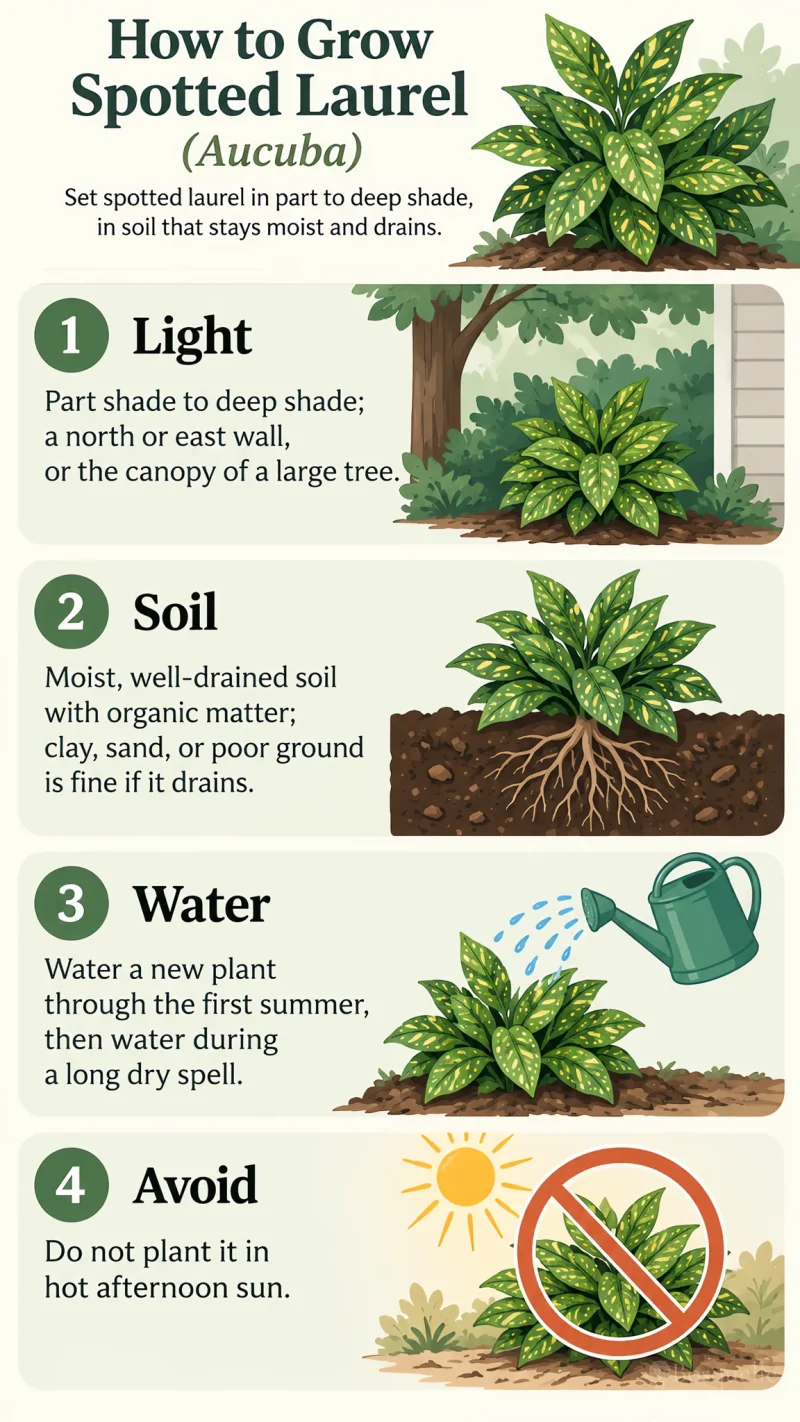
Give it part to deep shade and moist, well-drained soil
| Factor | Recommended | Avoid |
|---|---|---|
| Light | Part shade to deep shade; a north or east wall, or the canopy of a large tree | Do not plant it in hot afternoon sun |
| Soil | Moist, well-drained soil with organic matter; clay, sand, or poor ground is fine if it drains | Do not plant it in a hole that stays soggy |
| Water | Water a new plant through the first summer, then water during a long dry spell | Do not wet the leaves on a daily overhead spray |
| Wind | A sheltered corner, out of a drying wind | Do not site it on an open, windy edge |
| Feed | Little fertilizer once the shrub is in moist ground | Do not dump nitrogen that pushes soft growth |
Spotted laurel wants shade. Afternoon sun blackens young leaves, and a drying wind scorches the same leathery foliage. Give it moist, well-drained ground and water a new plant through the first summer; an established shrub then takes a dry spell better than a wet hole. [1] A north or east foundation, or the shade under trees, is the usual home. [2] It must have that shade. Full sun turns the leaves crunchy and black, so keep it on the dark side of the house in summer. [3] spotted laurel uses that same moist shade garden. [4]
- Choose part shade to deep shade. A dark corner on the north or east side of a house is better than a west wall that bakes in the afternoon.
- Set it in soil that stays moist and still drains. Clay is fine if water does not stand around the roots.
- Water through the first summer so the roots take. After that, water during a long dry spell rather than on a weekly calendar.
- Keep it out of a drying wind. Windburn marks the leaves the same way sun does.
Does spotted laurel need sun?
No. It wants part shade to deep shade. Hot afternoon sun blackens young leaves, especially the yellow markings.
How often should I water spotted laurel?
Water a new plant through the first summer. After that, water during a long dry spell, and do not leave the roots in standing water.
Not a gold-dust croton — and not cherry laurel or mountain laurel
Gold dust plant on an Aucuba tag is this shade shrub. Gold dust on a croton tag is Codiaeum, a tropical houseplant that wants bright light and shows red, orange, and yellow on thinner leaves, not a six-foot evergreen for deep shade. Gold dust on a Dracaena tag is a cane houseplant — see How to Grow Dracaena.
Cherry laurel and English laurel are Prunus, usually grown as a faster hedge that takes more sun — see How to Grow Prunus. Mountain laurel is Kalmia, an acid-soil native with showy flower clusters — see How to Grow Mountain Laurel. Bay laurel is the culinary Laurus, a sun shrub with kitchen leaves, not this spotted shade plant. If the tag says gold dust and the leaves are thick, opposite, and toothed only on the upper half, you still have Aucuba.
Is gold dust plant the same as croton?
No. This gold dust plant is Aucuba, a shade shrub. Croton is Codiaeum, a tropical plant for bright light.
Is this cherry laurel?
No. Cherry laurel is Prunus. Spotted laurel is Aucuba, grown for gold-marked leaves in shade.
Set spotted laurel in part to deep shade, in soil that stays moist and drains.
FAQ
Are the berries safe to eat?
No. Do not eat the berries or the leaves. Keep pets and children from chewing them. Birds may take the fruit; people should not.
Is Picturata a different plant?
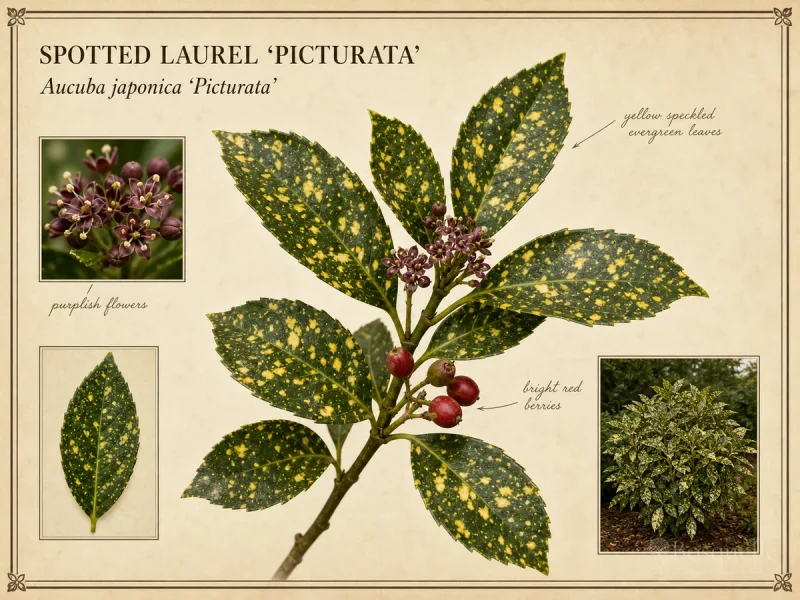
No. Picturata is spotted laurel with a yellow blotch in the leaf. Use the same shade and moisture. Tags do not always agree on whether a given plant is male or female, so read the pot label if you want berries.
Is Japanese laurel the same shrub?
Yes. Japanese laurel, Japanese aucuba, and gold-leaf plant are shop names for spotted laurel. It is not mountain laurel and not bay laurel.
Related guides


Recommended plants

References
- [1] NC State Extension Gardener -
https://plants.ces.ncsu.edu/plants/aucuba-japonica/ - [2] Clemson Cooperative Extension -
https://hgic.clemson.edu/factsheet/aucuba/ - [3] University of Arkansas Division of Agriculture -
https://www.uaex.uada.edu/yard-garden/resource-library/plant-week/Aucuba-japonica-variegata-gold-dust-plant-01-15-2016.aspx - [4] Better Homes & Gardens -
https://www.bhg.com/gardening/plant-dictionary/shrub/gold-dust-plant/
This note is part of Aucuba Guides.
More first-season notes by plant are gathered in How to Grow Guides.
Updated: Reviewed by Bosquelle Editors