
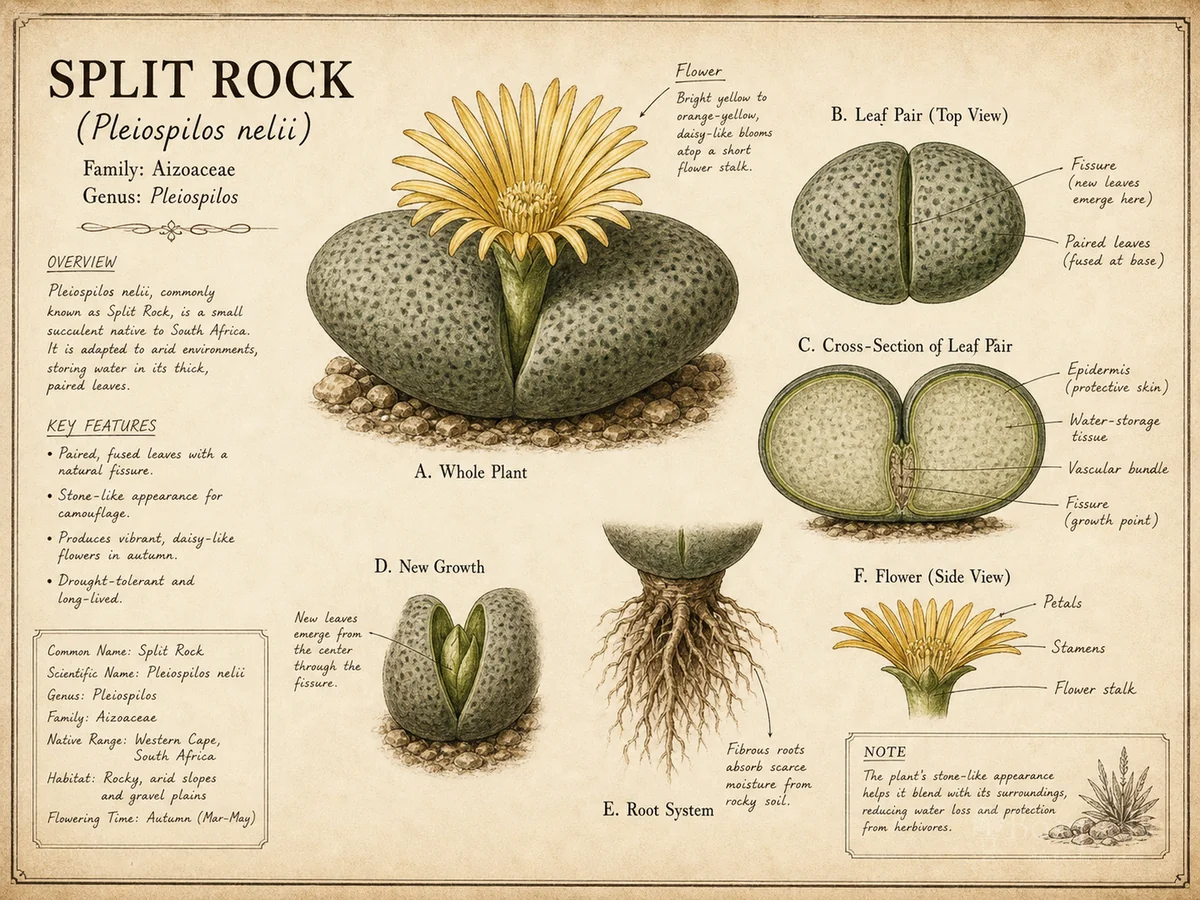
Grow split rock in bright sun, in a mix that drains, and water it only when the leaves soften. Keep the mix dry while a new pair of leaves forms inside the old pair. The plant is Pleiospilos nelii, a small succulent that looks like a cracked stone. It is not living stones, and it is not hardy ice plant.

Give it bright sun, a gritty mix, and water only when the leaves soften
| Factor | Recommended | Avoid |
|---|---|---|
| Light | Bright sun, with morning light and some afternoon shade in the hottest weeks | Do not keep it on a dim sill if you want the stone pattern and flowers |
| Water | Soak the mix when the leaves feel slightly soft, then let it dry for two to three weeks | Do not water while a new pair is forming inside the old leaves |
| Soil | Gritty cactus mix with extra pumice or coarse sand | Do not use packed potting soil that stays wet |
| Warmth | A bright, frost-free sill; cooler and dry while it rests in summer heat | Do not leave a wet pot outdoors in frost |
split rock is Pleiospilos nelii, a southern African succulent with one or two pairs of thick, spotted leaves joined at the base. The body sits above the grit, and a deep fissure runs down the middle. [1] Give it full light and a cactus mix that sheds water. Soak well when the leaves feel slightly soft, then wait two to three weeks before you water again. [2] One or two pairs is normal. If extra pairs stack and the old leaves still look plump in summer, the mix has stayed wet. Take seed on How to Propagate Split Rock.
How much sun does split rock need?
Bright sun, with morning light and some afternoon shade in the hottest weeks. A dim sill stretches the body and the plant often skips bloom.
How often should I water split rock?
Soak the mix when the leaves feel slightly soft, then let the pot drain and wait two to three weeks. While a new pair is forming, keep the mix dry. A wet rest rots faster than a missed watering.
When does split rock bloom?
Yellow to salmon daisy-like flowers, often with a coconut scent, open from the fissure in cool-season growth when the plant gets enough sun and a little water in winter.
Keep it dry while a new pair forms, and through the summer rest
Each year a new pair of leaves forms in the fissure and draws water from the old pair, so those outer leaves shrink. Do not water until the new pair has taken over. Watering too soon keeps the old pair swollen, and the plant can rot. [3] In the hottest weeks many plants rest. Leave the mix dry then. On a frost-free winter sill, a light soak now and then helps this species bloom. If you set the pot outdoors for summer, bring it back inside before a hard frost. A dry chill may not kill it. A wet pot in frost often does.
Does split rock come back after a freeze?
A brief dry chill may not kill it. A freeze on a wet pot often does. In a cold garden, keep a pot bright, cool, and dry until the new pair has formed.
Grow it in a deep small pot, sitting above the mix
This plant lives in a patio pot more often than in open ground. The taproot runs deeper than the stone top suggests, so a small container about 4 inches deep with a hole in the bottom is enough. Set the body on the mix, not buried to the neck, then add a thin gravel dressing so the fissure stays dry. [4] Empty the saucer after you water.
- Choose a small pot about 4 inches deep, with a drainage hole.
- Fill it with cactus mix plus extra pumice or coarse sand. Set the taproot in the mix. Keep the spotted body sitting above the grit.
- Water once to settle the grit, then wait until the mix is dry, and only if the leaves feel slightly soft.
- Move the pot to a bright sill. If nights turn to frost, bring it indoors.
Can I grow split rock in a pot?
Yes. Use a small pot about 4 inches deep with a hole in the bottom and a gritty cactus mix. Keep the body above the grit, and empty the saucer after you water.
Not living stones — and not hardy ice plant
Living stones on a U.S. tag are usually Lithops, a smaller pebble succulent that sits almost flush with the grit and keeps one pair of leaves at a time. Grow that plant on How to Grow Living Stones. Ice plant is Delosperma, a spreading groundcover with many daisy flowers, not a cracked-stone pair of leaves. Grow that plant on How to Grow Ice Plant. A tag that only says stone plant is often living stones, not this succulent. Liver plant on a tag may be Pleiospilos simulans, a different mesemb, or woodland liverleaf (Hepatica); grow that on How to Grow Hepatica. Button plants in the same family are Conophytum. Fairy elephant's feet is club-shaped Frithia with magenta flowers; grow that on How to Grow Fairy Elephant's Feet. Tiger jaws are toothed Faucaria; grow that on How to Grow Tiger Jaws.
Is split rock the same as living stones?
No. Living stones are Lithops, a smaller pebble succulent with one pair of leaves. Split rock is Pleiospilos nelii, a larger mesemb that often keeps two pairs and sits above the mix.
If the body turns soft or splits open sideways, empty the saucer, move the pot into more sun, and stop watering until the new pair has formed.
FAQ
Do you list all the species?
The shop plant is sold as split rock, or Pleiospilos nelii. The genus holds a few named forms, including a purple Royal Flush. Read the tag for the Latin name, then keep the same sun, grit, and soak-and-dry watering.
Do I need to prune it?
No regular prune is required. Do not peel the old leaves while they still have thickness. Let them shrink as the new pair forms, then lift a husk that falls away.
Is split rock poisonous?
Grow it as an ornamental. Do not eat the leaves or flowers. Keep pets from chewing the plant.
Can I eat it?
No. It is a garden succulent. Do not treat it as a kitchen crop.
Should I collect it from the wild?
No. Buy a nursery plant. Wild stands in southern Africa are sparse, and dug plants often die after the move.
Related guides

Recommended plants
References
- [1] PlantZAfrica -
https://pza.sanbi.org/pleiospilos-nelii - [2] Royal Horticultural Society -
https://www.rhs.org.uk/plants/131621/pleiospilos-nelii/details - [3] Llifle -
https://www.llifle.com/Encyclopedia/SUCCULENTS/Family/Aizoaceae/14724/Pleiospilos_nelii - [4] Nurseries Online -
https://www.nurseriesonline.com/cactus-and-succulents/pleiospilos-nelii/
This note is part of Pleiospilos Guides.
More first-season notes by plant are gathered in How to Grow Guides.
Updated: Reviewed by Bosquelle Editors