
Grow living stones in bright sun, in a mix that drains, and water them only while they are in growth. Keep the mix dry while a new pair of leaves forms inside the old pair. The plant is Lithops, a small succulent that looks like a pebble. It is not hardy ice plant, and it is not a Livingstone daisy.
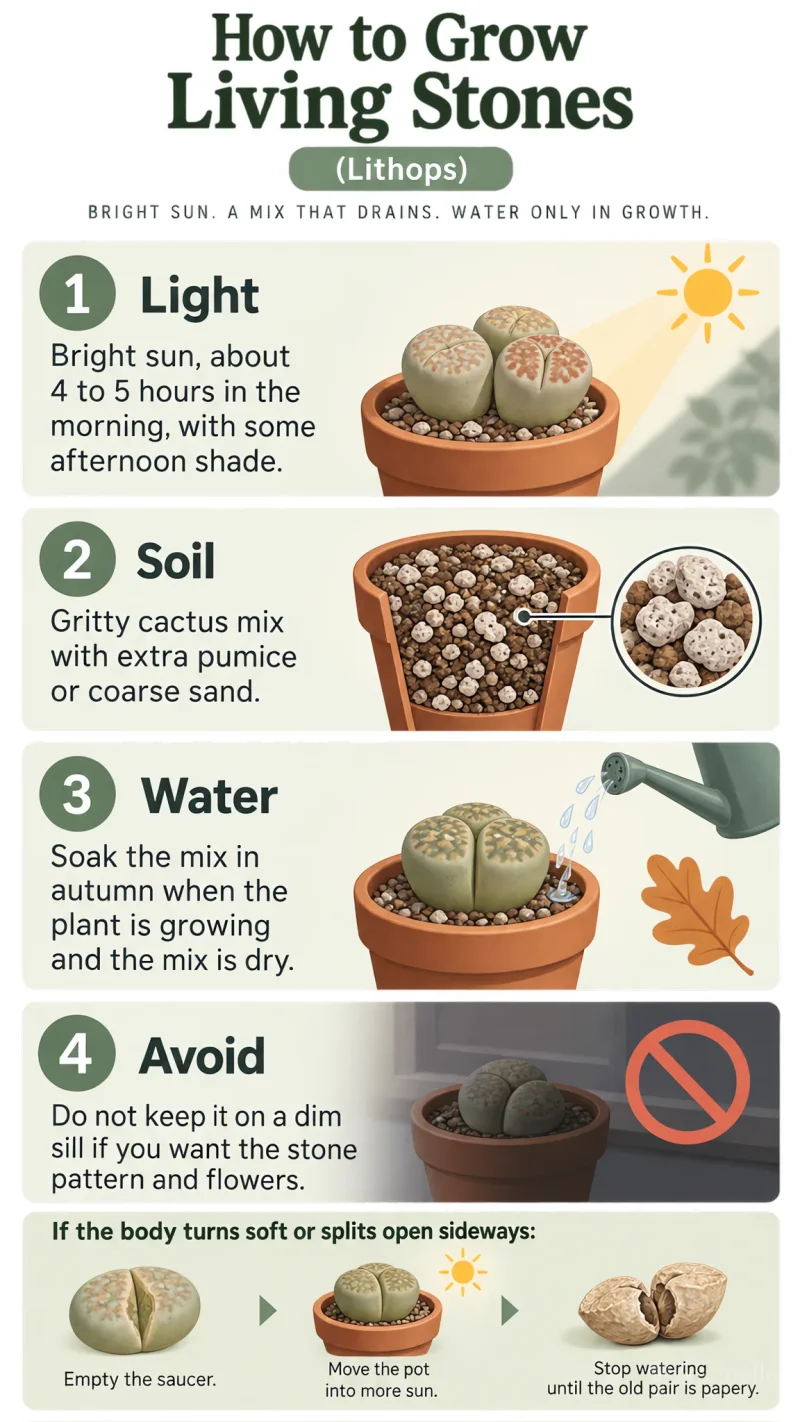
Give it bright sun, a gritty mix, and water only while it grows
| Factor | Recommended | Avoid |
|---|---|---|
| Light | Bright sun, about 4 to 5 hours in the morning, with some afternoon shade | Do not keep it on a dim sill if you want the stone pattern and flowers |
| Water | Soak the mix in autumn when the plant is growing and the mix is dry | Do not water while a new pair is forming inside the old leaves |
| Soil | Gritty cactus mix with extra pumice or coarse sand | Do not use packed potting soil that stays wet |
| Warmth | A bright, frost-free sill; cooler and dry while it rests | Do not leave a wet pot outdoors in frost |
living stones is Lithops, a southern African succulent with two fused leaves and a flat, windowed top. Light reaches the green tissue through those windows even when grit covers most of the body. [1] Give it full light and a cactus mix that sheds water. Water well while it is in growth, then stop once a new pair starts to form inside the old pair. In a U.S. room that growth usually lands in autumn, with yellow or white daisy-like flowers from the fissure. [2] Take seed on How to Propagate Living Stones.
How much sun do living stones need?
Bright sun, about 4 to 5 hours in the morning, with some afternoon shade in the hottest weeks. A dim sill stretches the body and the plant often skips bloom.
How often should I water living stones?
In autumn growth, soak the mix when it is dry, then let the pot drain. While a new pair is forming, keep the mix dry. A wet rest rots faster than a missed watering.
When do living stones bloom?
Yellow, white, or pale orange daisy-like flowers open from the fissure in fall and early winter when the plant is in growth and gets enough sun.
Keep it dry while it splits, and through the summer rest
Each year a new pair of leaves forms inside the old pair and draws water from those leaves, so the outer pair shrivels to a papery husk. Do not water until those old leaves are dry and thin. Watering too soon keeps the old pair swollen, and the new pair cannot push through. [3] In the hottest weeks many plants rest. If the body wrinkles hard then, wet only the top of the mix. If you set the pot outdoors for summer, bring it back inside before a hard frost. A dry chill may not kill it. A wet pot in frost often does.
Do living stones come back after a freeze?
A brief dry chill may not kill it. A freeze on a wet pot often does. In a cold garden, keep a pot bright, cool, and dry until the old pair is papery.
Grow it in a deep small pot, with the top just above the mix
This plant lives in a patio pot more often than in open ground. The roots run deeper than the pebble top suggests, so a small container about 3 to 5 inches deep with a hole in the bottom is enough. Set the top of the body just above the mix, then add a thin gravel dressing so the neck stays dry. [4] Empty the saucer after you water.
- Choose a small pot about 3 to 5 inches deep, with a drainage hole.
- Fill it with cactus mix plus extra pumice or coarse sand. Set the taproot in the mix. Keep the windowed top just above the grit.
- Water once to settle the grit, then wait until the mix is dry, and only if the plant is in growth.
- Move the pot to a bright sill. If nights turn to frost, bring it indoors.
Can I grow living stones in a pot?
Yes. Use a small pot 3 to 5 inches deep with a hole in the bottom and a gritty cactus mix. Keep the top just above the grit, and empty the saucer after you water.
Not hardy ice plant — and not a Livingstone daisy
Ice plant on a U.S. tag is usually Delosperma, a spreading groundcover with many daisy flowers, not a pebble-shaped pair of leaves. Grow that plant on How to Grow Ice Plant. Livingstone daisy is Cleretum bellidiforme, a low annual with bright bedding flowers, not this windowsill succulent. Split rock is Pleiospilos, a larger mesemb that often keeps more than one leaf pair. Button plants in the same family are Conophytum. Fairy elephant's feet is club-shaped Frithia with magenta flowers; grow that on How to Grow Fairy Elephant's Feet. Tiger jaws are toothed Faucaria; grow that on How to Grow Tiger Jaws. A search for the living stone can also be a Bible verse or a film title, not this plant.
Are living stones the same as ice plant?
No. Hardy ice plant is usually Delosperma, a spreading groundcover. Living stones are Lithops, a pebble succulent with two fused leaves and a strict watering calendar.
If the body turns soft or splits open sideways, empty the saucer, move the pot into more sun, and stop watering until the old pair is papery.
FAQ
Do you list all the species?
The shop plant is sold as Lithops, or living stones. The genus holds many named forms. Read the tag for the Latin name, then keep the same sun, grit, and growth-season watering.
Do I need to prune it?
No regular prune is required. Do not peel the old leaves while they still have thickness. Let them dry to a papery husk, then lift a husk that falls away.
Are living stones poisonous?
Grow it as an ornamental. Lists often treat it as non-toxic for cats and dogs. Still keep pets from chewing the plant, and do not eat the leaves or flowers.
Can I eat it?
No. It is a garden succulent. Do not treat it as a kitchen crop.
Should I collect it from the wild?
No. Buy a nursery plant. Wild stands in southern Africa are sparse, and dug plants often die after the move.
Related guides

Recommended plants

References
This note is part of Lithops Guides.
More first-season notes by plant are gathered in How to Grow Guides.
Updated: Reviewed by Bosquelle Editors