
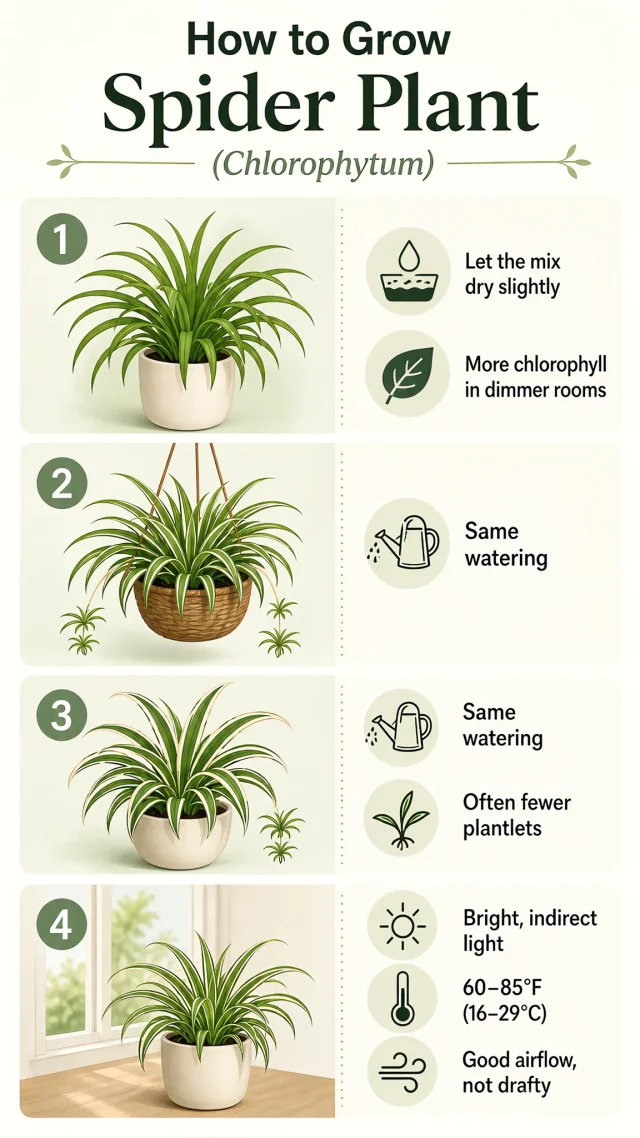
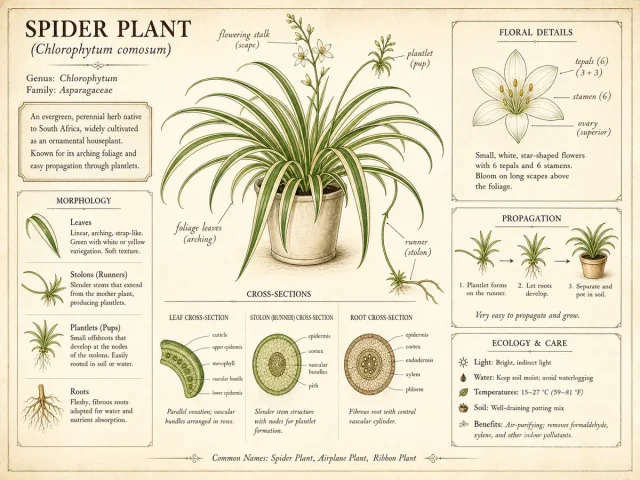
Keep a spider plant in bright indirect light and water when the top of the mix is just dry. Brown leaf tips usually come from fluoride, chlorine, or fertilizer salts — not from a plant that needed more water in an already wet pot.
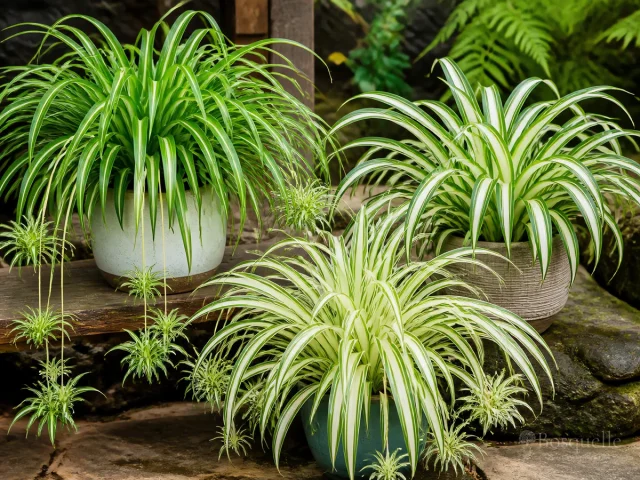
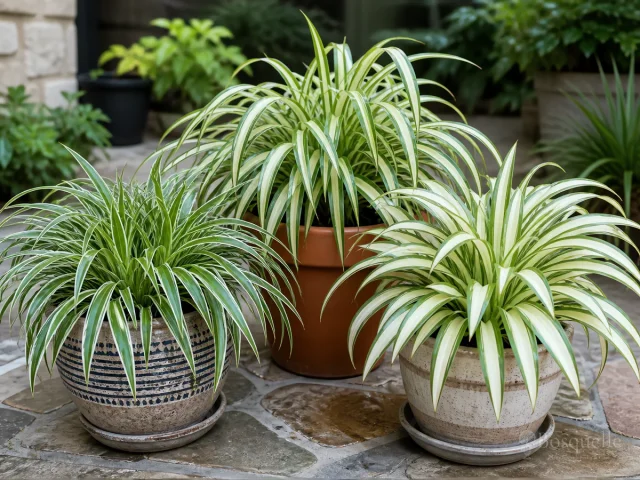
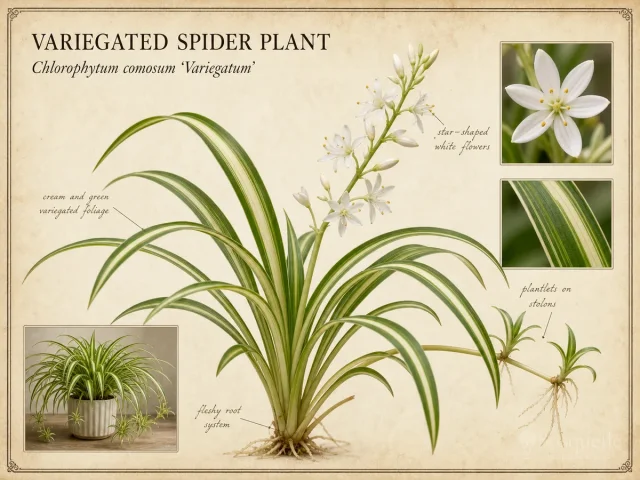
spider plant is the all-green clump. Spider Plant ‘Vittatum’ has a white center stripe. Spider Plant ‘Variegatum’ has white edges. Airplane plant and ribbon plant are names for the same species. Stripe ID, plantlets, and a cracked pot live on the child pages.
Bright indirect light, and a mix that dries slightly
| Factor | Recommended | Avoid |
|---|---|---|
| Light | Bright indirect; morning sun is fine | Hot midday glass that bleaches stripes |
| Water | Top of the mix just dry, then water and drain | A saucer of standing water |
| Mix | Indoor potting mix with drainage holes | Garden soil packed into a sealed dish |
| Site | Hanging basket or shelf with a drain | A squat bowl that never empties |
North Carolina Extension wants bright light without a long spell of direct sun, and a mix that dries a little between waterings. Dim rooms keep a green plant alive and fade the stripes on variegated kinds. Thick tuberous roots store water, so a missed week is kinder than a wet saucer.
Bright indirect is an east window, a south or west window with a sheer, or a spot a few feet back from hot glass. Morning sun is fine. Midday sun bleaches stripes and cooks the crown. A dark stairwell keeps the clump alive and turns variegated leaves muddy.
Dry slightly means the top of the mix is just dry to a finger, or the hanging basket feels light when you lift the hook. Then water until it runs, and empty the saucer. In winter the room is cooler and the pot stays wet longer, so water less often. Ice cubes do not belong in this mix.
How often should I water a spider plant?
When the top of the mix is just dry. Water thoroughly, then empty the saucer. Do not keep the pot wet because the tips look brown.
If the saucer refills overnight, empty it again. A sealed cachepot with no inner drain is the same failure as a wet saucer. Lift the grower pot after you water.
Brown tips versus a wet pot
Brown tips are the usual complaint. Clemson Extension points to extra fertilizer, water high in soluble salts, low humidity, or a mix that went too dry — and tap water with fluoride or chlorine can burn the same tips. Distilled water or rain is kinder if the tips keep browning on tap.
Do not answer brown tips by watering a pot that is already wet. That is rot. Dry the surface. Empty the saucer. A brown tip from salts is a trim, not a flood.
Why are the leaf tips brown?
Often salts, fluoride, or chlorine in tap water, or extra feed. Distilled water or rain can help. Do not flood a wet pot. Soft, sour mix at the crown is rot, not a cue for more water.
Trim the brown with clean scissors. Follow the dead tissue. Leave the green. A brown tip that stays firm is chemistry. A crown that smells sour, with leaves that pull out wet, is rot. That plant needed a drain yesterday, not more water today.
Low humidity can crisp the same tips in winter heat. A tray of pebbles is optional. It is not a reason to keep the mix wet. Extra feed in a small pot salts the mix fast. Skip winter feed.
Flush once with plenty of water if the crust on the surface is white, then go back to dry-slightly.
- Brown plus wet mix: empty the saucer. Let the mix dry before the next watering. Do not flood.
- Brown plus a light, dry pot: the mix went too far. Soak, drain, then let it dry slightly again.
- Brown plus heavy feed: cut the feed. Trim the tip.
- Stripes gone green: brighter indirect light, not a new species.
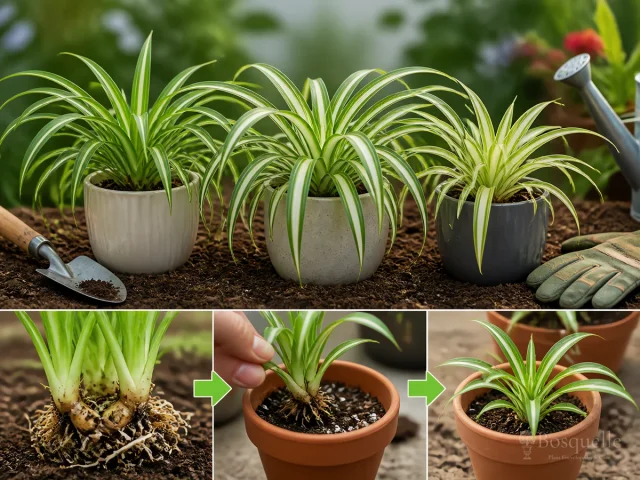
Choose the stripe on Types of Chlorophytum. Clone from plantlets on How to Propagate Spider Plant. Move it before the roots crack the pot on How to Repot Spider Plant.
FAQ
Are spider plants toxic to cats or dogs?
This page is keep-alive, not a poison essay. Hang the basket if they chew the leaves. It is generally treated as a milder houseplant than the aroids, and still not a chew toy.
Why is it called airplane plant or ribbon plant?
Those are common names for the same species, Chlorophytum comosum, along with spider ivy.
Should I buy it because NASA listed it?
No. Air studies are not a watering recipe. The plant still dies in a wet pot.
When will it make plantlets?
Short days help the runners. The full clone job lives on How to Propagate Spider Plant.
Can fertilizer cause brown tips too?
Yes. Light feed in active growth is enough. Skip winter. Never feed a waterlogged pot.
Can I plant it in a Florida yard?
University of Florida Extension no longer recommends it as a landscape plant there. Keep it in a pot.
Hanging basket or a shelf pot?
Either, if it drains. A mature clump is heavy. Check the hook.
What is Chlorophytum?
The genus name. Spider plant is Chlorophytum comosum. Say it once, then water the plant.
What if kids chew the hanging leaves?
Hang the basket out of reach. This page is keep-alive, not a poison essay. Same rule as cats: not a chew toy.
Related guides
Recommended plants

This note is part of Chlorophytum Guides.
More first-season notes by plant are gathered in How to Grow Guides.
Updated: Reviewed by Bosquelle Editors