
Grow silk tassel in sun or afternoon shade, in soil that drains, with shelter from hot wind. Silk tassel is Garrya elliptica, also sold as silk tassel bush.

Give it sun or afternoon shade, soil that drains, and shelter from hot wind
| Factor | Recommended | Avoid |
|---|---|---|
| Light | Full sun on the coast; inland, morning sun and afternoon shade | Do not leave it in a hot, dry wind that scorches the leaves |
| Soil | Soil that drains; clay, loam, or sand is fine if water does not stand | Do not plant it in a hole that stays soggy through winter |
| Water | Water a new plant through the first dry season, then skip extra water once the roots take | Do not water an established shrub on a weekly calendar |
| Shelter | A wall, fence, or nearby screen that breaks hot afternoon wind | Do not count on it in a hot, humid southeastern summer |
| Kind | James Roof for the longest male tassels; wavyleaf silktassel for the species shrub | Do not buy an unlabeled seedling if you wanted foot-long catkins |
| Deer | Deer usually leave the leaves | Do not plant it as a browse crop for hungry deer |
| Salt | Coastal salt spray is fine | Do not plant it in a salty low spot that stays wet |
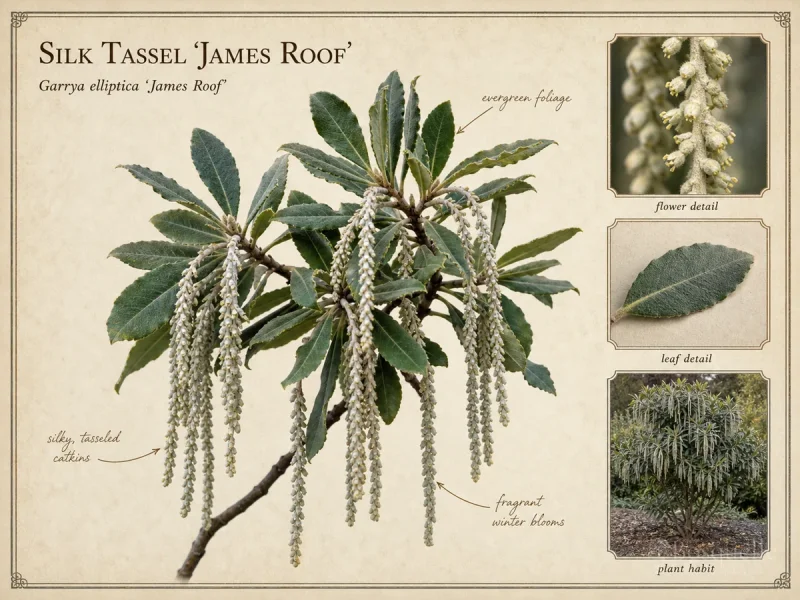
Silk tassel wants sun or light shade and a hole that drains. Water a new plant through the first dry season so the roots take, then skip extra water; an established shrub takes dry weather better than a wet winter hole. Shelter it from hot afternoon wind so the leaves do not scorch, and do not count on it in a hot, humid southeastern summer. [1] wavyleaf silktassel is the species evergreen. James Roof is a named male of the same shrub, grown for tassels about a foot long. [2]
- Choose full sun on the coast. Inland, give it morning sun and afternoon shade.
- Set it in soil that drains. Clay, loam, or sand is fine if water does not stand around the roots.
- Give it a wall, fence, or nearby screen that breaks hot afternoon wind.
- Water through the first dry season. After that, skip extra water unless the shrub wilts in a long drought.
- Match the kind to the display you want. James Roof is the long-tassel male. Wavyleaf silktassel is the species shrub, and an unlabeled plant may be female with shorter catkins.
Does silk tassel need full sun?
On the coast, yes. Inland, morning sun and afternoon shade keep the leaves from scorching. A hot, dry wind browns the foliage.
How often should I water silk tassel?
Water a new plant through the first dry season. After that, skip extra water unless the shrub wilts in a long drought, and do not leave the roots in standing water.
Which silk tassel should I buy?
Buy James Roof if you want the longest male tassels. Buy wavyleaf silktassel for the species evergreen. Both want sun or afternoon shade and soil that drains.
Plant at the same depth as the pot, on a mound if the clay stays wet
Knock the shrub from its pot and set the root ball at the same depth it was already growing. On heavy clay, plant on a low mound so winter rain does not sit around the roots. Leave room for an eight- to twelve-foot shrub. Water after you plant, and water again in dry weather until the roots take. [3]
- Plant in fall or spring while the soil is workable, in sun or afternoon shade that drains.
- Set the root ball even with the surrounding soil. Do not bury the stem deeper than it grew in the pot.
- On heavy clay, plant on a low mound so winter rain runs off. A low spot that stays wet can kill the shrub.
- Leave eight to twelve feet between plants for a screen. Leave more room if you let it become a small tree.
- Water to settle the soil, then keep the first dry season from baking the new roots.
How far apart do I plant it?
Eight to twelve feet for a screen. Leave more room if you let it become a small tree. Set the root ball at the same depth as the nursery pot, on a mound if the clay stays wet.
Prune right after the catkins fade, not in fall
Silk tassel flowers on last year's wood. Prune as the winter catkins fade and before new growth starts, so you do not cut next winter's tassels. A light cut is enough. Hard cutting into old wood makes awkward new shoots, so leave the rounded shape if you have the room. [4]
- Wait until the catkins fade in late winter or early spring, then prune before new growth starts.
- Cut out dead, rubbing, or badly placed stems. Leave the rounded shape if you have the room.
- Do not prune in fall. Fall cuts remove the wood that will carry next winter's tassels.
- Do not shear it like a hedge unless you accept fewer catkins. Hard cutting into old wood makes awkward new shoots.
When should I prune silk tassel?
Right after the catkins fade, before new growth starts. Do not prune in fall, or you cut next winter's tassels.
Fan it on a wall if you want extra shelter
A wall, fence, or nearby screen breaks hot wind and gives the catkins a backdrop. Plant near the wall and tie a few stems as they grow. Prune after the catkins fade, the same way you prune a free-standing shrub.
- Set the shrub near a wall that breaks hot afternoon wind, in soil that drains.
- Tie a few strong stems loosely to wires or nails as they grow, so the catkins can hang free.
- Prune after the catkins fade. Cut stem by stem. Do not run a hedge trimmer over the leaves.
Can I train silk tassel on a wall?
Yes. Set it near a wall that breaks hot wind, tie a few stems as they grow, and prune after the catkins fade. Do not shear it like a hedge.
How to grow silk tassel from a cutting
A named male such as James Roof will not come true from seed, so a cutting is the way to copy the long tassels. Take a semi-ripe stem in late summer, stick it in a mix that drains, and keep it humid until roots form. Rooting can be slow, and not every stick takes, so start more than one.
- In late summer, cut a firm current-year shoot about four to six inches long, just below a node.
- Strip the lower leaves. Leave two leaves at the tip.
- Dip the cut end in rooting hormone if you have it, then insert the stem into a mix that drains, such as potting mix cut with perlite or coarse sand.
- Keep the mix barely moist and the cutting in bright shade with still, humid air until roots form. Do not sit the pot in a saucer of water.
- Grow the rooted plant in a pot for a season before you plant it out, and do not twist the roots when you move it.
How do I take a silk tassel cutting?
Take a four- to six-inch semi-ripe shoot in late summer, strip the lower leaves, and stick it in a mix that drains. Keep it humid and barely moist until roots form.
Not a pussy willow — and not a silk tree or spotted laurel
Silk tassel on a Garrya tag is this evergreen with wavy, leathery leaves and long winter catkins. Pussy willow is Salix, a deciduous shrub with fuzzy early catkins and no evergreen screen — see How to Grow Willow. If the tag says silk tassel and the leaves stay on through winter, you still have Garrya.
Silk tree is Albizia, a ferny summer tree with pink puffs, not winter tassels — see How to Grow Silk Tree. Spotted laurel is Aucuba, a gold-dust shade shrub in the same family, grown for spotted leaves and red berries, not winter catkins — see How to Grow Spotted Laurel. Chenille plant is Acalypha, with hanging red tassels on a tender shrub. Oregon white oak is Quercus, sometimes called Garry oak after the same namesake; it is a deciduous oak, not this evergreen.
Is this a pussy willow?
No. Pussy willow is Salix, a deciduous shrub with fuzzy catkins. Silk tassel is an evergreen with wavy leathery leaves.
Is this a silk tree?
No. Silk tree is Albizia, a ferny summer canopy. Silk tassel is Garrya, an evergreen with winter catkins.
Set silk tassel in sun or afternoon shade, in soil that drains, and skip extra water once the roots take.
FAQ
Can I grow silk tassel in a pot?
Yes, for a few years. Use a pot with a drainage hole and a mix that drains. Keep it outdoors in sun or afternoon shade, water when the mix is dry, and empty the saucer. A large shrub is happier in the ground.
Do I need a male and a female for fruit?
Yes, if you want fruit. Male and female flowers sit on separate bushes. James Roof is a named male, grown for the tassels. Birds eat the dark fruit; people should not treat it as a kitchen crop.
Is James Roof a different species?
No. James Roof is a named male of Garrya elliptica, the same evergreen as wavyleaf silktassel, selected for longer tassels.
Is this Oregon white oak?
No. Oregon white oak is Quercus, sometimes sold as Garry oak. Silk tassel is Garrya, an evergreen shrub with winter catkins.
Is this a chenille plant?
No. Chenille plant is Acalypha, a tender shrub with hanging red tassels. Silk tassel is a hardy evergreen with winter catkins.
Will James Roof come true from seed?
No. James Roof is a named male. Seedlings may be female, or they may have shorter catkins. Take a cutting if you want the same long tassels.
Recommended plants

References
- [1] NC State Extension -
https://plants.ces.ncsu.edu/plants/garrya-elliptica/ - [2] Oregon State University Landscape Plants -
https://landscapeplants.oregonstate.edu/plants/garrya-elliptica-james-roof - [3] UC Master Gardener Program of Sonoma County -
https://ucanr.edu/site/mg-sonoma/garrya-elliptica-silktassel - [4] Gardening Know How -
https://www.gardeningknowhow.com/ornamental/shrubs/silk-tassel-bush/growing-silk-tassel-plants.htm
More first-season notes by plant are gathered in How to Grow Guides.
Updated: Reviewed by Bosquelle Editors