
Grow showy medinilla in bright filtered light, keep the mix evenly moist, and give it humidity of 60 percent or more. Showy medinilla is Medinilla magnifica, also called rose grape — a Philippine epiphytic shrub, not an orchid.
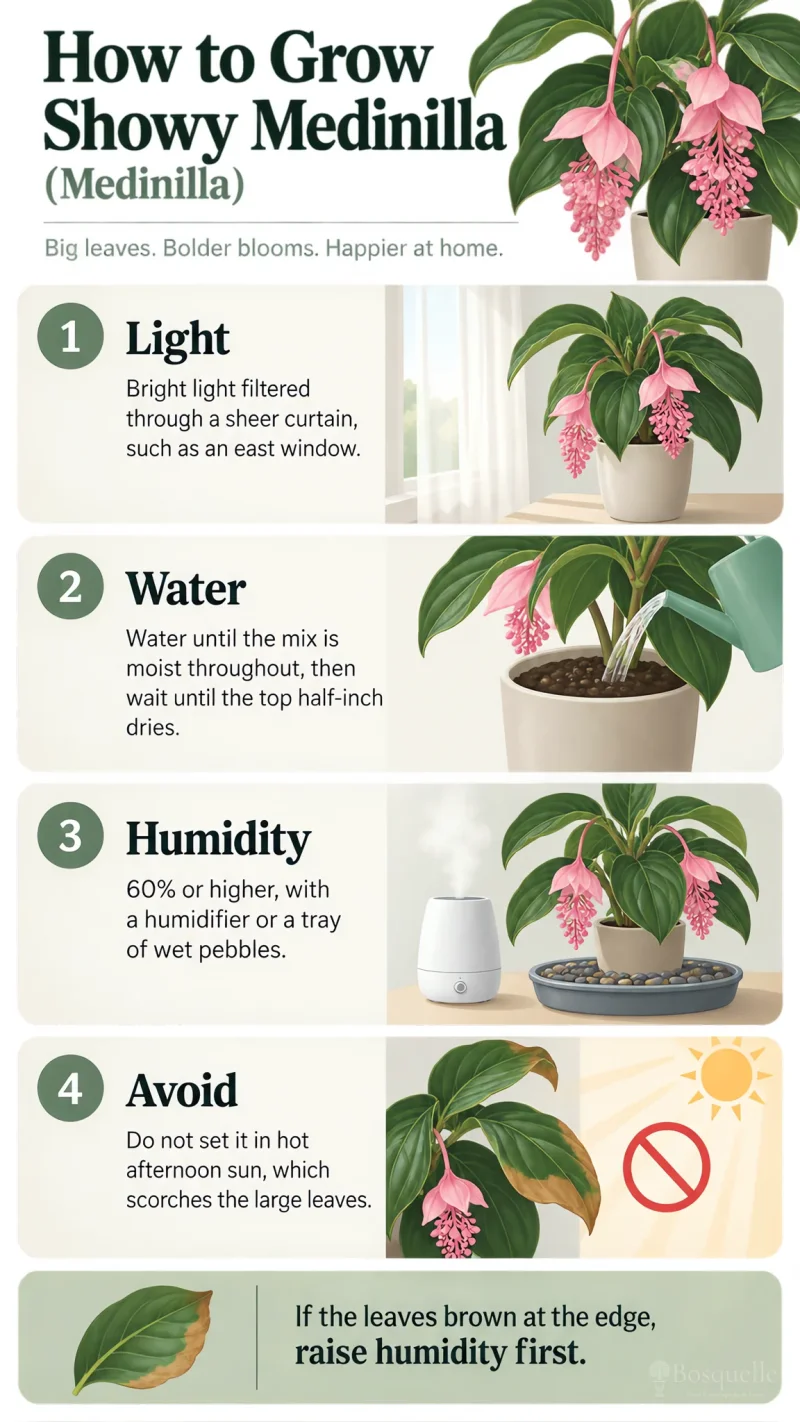
Give it bright filtered light, even moisture, and high humidity
| Factor | Recommended | Avoid |
|---|---|---|
| Light | Bright light filtered through a sheer curtain, such as an east window | Do not set it in hot afternoon sun, which scorches the large leaves |
| Water | Water until the mix is moist throughout, then wait until the top half-inch dries | Do not leave the pot sitting in a saucer of water, and do not let the mix dry out completely in growth |
| Humidity | 60 percent or higher, with a humidifier or a tray of wet pebbles | Do not keep it in dry heated air next to a vent |
| Warmth | A warm room about 65 to 80°F, and keep it above about 59°F | Do not leave it out for a frost |
| Feed | A balanced liquid fertilizer at half strength once a month in spring and summer | Do not feed during the winter rest |
Showy medinilla is Medinilla magnifica, an epiphyte from Philippine rainforest trees. In a pot it usually stays two to four feet tall, with opposite leathery leaves up to a foot long and pale veins. Give it bright light that never turns into hot midday sun, the way a sheer curtain softens an east or south window. [1] Water until it runs out, then empty the saucer. Wait until the top half-inch of mix is dry before you water again. The thick leaves hold some moisture, so a weekly soak with a dry top is safer than a constantly wet pot. [2] Humidity of 60 percent or higher keeps the leaf edges from browning and helps the flower buds stay on. A cool-mist humidifier or a pebble tray does that job in a heated room; a daily mist on warm days is extra, not a substitute. Keep the room above about 59°F. [3] A chunky, open mix that still holds moisture is the vessel job on How to Repot Showy Medinilla. [4]
How often should I water showy medinilla?
Water until it runs out, then wait until the top half-inch of mix is dry. In a warm room that may be about once a week. Empty the saucer.
Why are the leaf edges turning brown?
The air is too dry. Raise humidity to 60 percent or higher with a humidifier or a pebble tray, and keep the plant away from heating vents.
Cool it in winter, water less, and stop feeding until flower stalks show
This plant sets next spring's hanging panicles during a cooler, drier rest. After growth slows in fall, keep it bright but cooler, water only enough that the mix never dries out completely, and stop fertilizer. Resume moderate watering and warmth when new flower stalks show in late winter or early spring, and then leave the pot where it is, because moving it while buds form often drops them.
- After growth slows in fall, keep the plant in a bright, cooler room about 59 to 64°F, never below about 59°F.
- Water only enough that the mix does not dry out completely.
- Stop fertilizer for this rest.
- When new flower stalks show, resume moderate water and warmth, and do not move the pot.
Will it bloom without a winter rest?
Usually not. A cooler, drier, unfed stretch of about eight to twelve weeks is what sets the hanging flower stalks.
It blooms in spring with hanging pink panicles
Given enough light and humidity, long pendulous stalks grow from the branch tips in spring and early summer. Small pink flowers sit under two or three tiers of pink bracts, and the whole cluster can hang a foot and a half or more, which is why shops also call it rose grape or pink lantern. The show lasts weeks if the air stays humid and the pot stays put. If buds form and then drop, check humidity first, then whether the pot was turned or moved.
When does showy medinilla flower?
Usually in spring and early summer, after a cool winter rest. The hanging pink clusters can last for weeks.
After the panicles fade, cut them off and shorten long shoots
Once a cluster has faded, cut that flower stalk off at its base with clean snips. After flowering you can also shorten long shoots by as much as half, cutting just above a leaf, so the plant stays a manageable size and branches. Leave at least one pair of leaves on each stalk you keep, or that stalk dies back.
- Wait until the panicle has faded, then cut the spent flower stalk at its base.
- Shorten long shoots by up to half, cutting just above a leaf.
- Leave at least one pair of leaves on each stalk you keep.
When should I prune showy medinilla?
After the flowers fade. Cut the spent stalk at the base, and shorten long shoots only then, not while it is in bloom.
Not an orchid — and not a grape
Shops often sell this plant as Philippine orchid. It is not an orchid. A moth orchid is Phalaenopsis, with thick leathery leaves and arching sprays; see How to Grow Phalaenopsis if that is the plant you bought. Showy medinilla is Medinilla magnifica in the melastome family, with opposite pale-veined leaves and hanging pink bracts. Rose grape is a nickname for those clusters, not a grape vine; see How to Grow Grapes if you meant Vitis. A hanging tropical with tubular red flowers is lipstick plant; see How to Grow Lipstick Plant.
Is showy medinilla an orchid?
No. Philippine orchid is a shop nickname. This plant is Medinilla magnifica, a melastome shrub. A moth orchid is Phalaenopsis.
If the leaves brown at the edge, raise humidity first. If flower buds drop, stop moving the pot, and give it the cool winter rest before you add fertilizer.
FAQ
Is there more than one kind of showy medinilla?
Medinilla magnifica is the plant here. Shops also sell Malaysian orchid and chandelier tree, which are related shrubs with smaller bracts, not this hanging-panicle plant.
Can I grow it outdoors in the ground?
Only in a frost-free tropical climate with bright shade and high humidity. In most gardens it is a houseplant or a summer patio pot you bring in before nights turn cold.
Is it toxic to cats and dogs?
Extension lists treat it as non-toxic to cats and dogs. Still keep pets from chewing the leaves, because any houseplant can upset a stomach.
Why isn't my plant blooming?
It usually needs brighter filtered light, humidity of 60 percent or higher, and a cooler, drier winter rest. Extra fertilizer will not replace those.
Related guides


Recommended plants

References
- [1] Royal Horticultural Society -
https://www.rhs.org.uk/plants/11004/medinilla-magnifica/details - [2] New York Botanical Garden -
https://libanswers.nybg.org/faq/222620 - [3] NC State Extension -
https://plants.ces.ncsu.edu/plants/medinilla/ - [4] Gardening Know How -
https://www.gardeningknowhow.com/houseplants/medinilla/caring-for-medinilla-plants.htm
This note is part of Medinilla Guides.
More first-season notes by plant are gathered in How to Grow Guides.
Updated: Reviewed by Bosquelle Editors