
Grow lipstick plant in bright indirect light, in mix that drains, and water when the top inch is dry. Lipstick plant here is Aeschynanthus radicans, also sold as lipstick vine or basket vine — not a goldfish plant, and not a lipstick palm.

Give it bright indirect light, mix that drains, and water when the top is dry
| Factor | Recommended | Avoid |
|---|---|---|
| Light | Bright indirect light; a little morning sun is fine | Do not set it in hot afternoon sun, and do not keep it in a dim corner if you want flowers |
| Water | Water when the top inch of mix is dry, then empty the saucer | Do not leave the pot standing in water |
| Mix | African violet mix, or potting mix cut with perlite | Do not use heavy mix that stays wet around the roots |
| Humidity | Around 50 percent, with moving air | Do not keep it in still, wet air |
| Winter | A little cooler and drier; keep the pot above 50°F | Do not let the pot sit below 50°F, and do not keep the mix soaking wet all winter |
| Pot | A hanging basket with a hole; keep it a little snug | Do not move it into a much larger pot just to give it room |
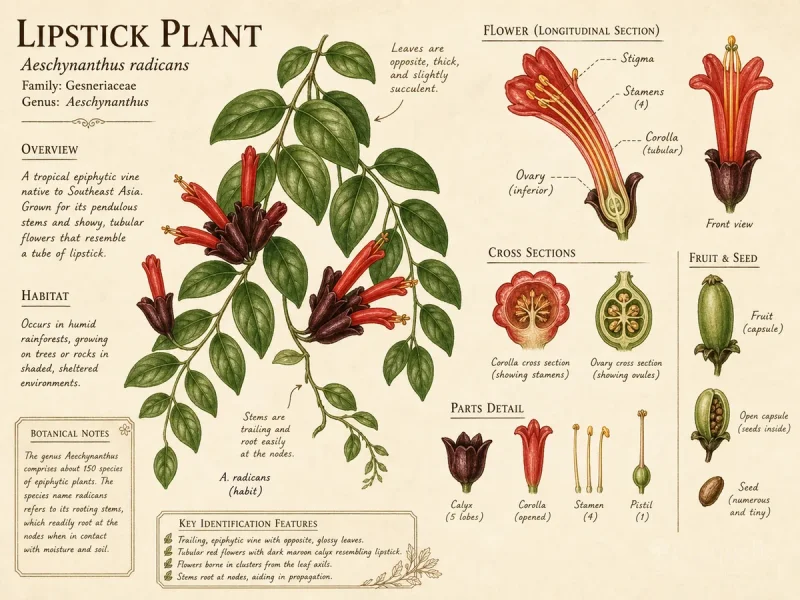
lipstick plant is a trailing epiphyte with thick leaves and tubular flowers that open from a dark calyx, like lipstick from a tube. Give it bright, indirect light and mix that drains. Soggy mix around the roots is the primary cause of root rot, and a dim room is why it never blooms. [1] In winter, keep it a little cooler and a little drier. That rest, plus bright light, is what brings flowers in spring and summer. [2]
- Hang it where it gets bright, indirect light. An east window, or a few feet back from a west window, is the usual home.
- Water when the top inch of mix is dry. Soak until water runs out, then empty the saucer.
- Keep the air around 50 percent humidity, with some movement. Still, wet air invites fungus on the leaves.
- In winter, water less often and keep the pot above 50°F. Bring a patio basket in before nights drop near 60°F.
How much light does lipstick plant need?
Bright indirect light. A little morning sun is fine. Hot afternoon sun scorches the leaves, and a dim corner is why it will not bloom.
How often should I water lipstick plant?
Water when the top inch of mix is dry, then empty the saucer. In winter, wait a little longer between waterings.
Why will it not bloom?
It needs more bright, indirect light, and a cooler, drier stretch in winter. A plant that stays in a dim, warm, wet pot rarely sets buds.
Plant it in a hanging basket with a hole
Knock the plant from its nursery pot and set it no deeper than it was already growing. Fill around it with African violet mix, or with potting mix cut with perlite. A hanging basket with a hole is the usual home, because the stems trail two to three feet.
- Choose a hanging basket or pot with a hole. If you set it in a cachepot, keep the inner pot free to drain, then empty the outer pot after you water.
- Fill with African violet mix, or with potting mix cut with perlite. Do not pack heavy, wet soil around the roots. [3]
- Set the crown at the same depth as the nursery pot. Water once to settle the mix, then wait until the top inch is dry before you water again.
- Stay one pot size up when the roots fill the container. A plant that is a little snug blooms more freely than one in a large, wet mass of mix.
How do I pot it?
Use a hanging basket with a hole and African violet mix. Set it no deeper than it was already growing, water once to settle, then wait until the top inch is dry.
Cut the stems back after they finish blooming
New flowers form near the tips of new stems. After the last cluster fades, cut a long stem just above a leaf so the plant branches instead of trailing as one thin vine. You can cut up to about a third of the plant at one time.
- Wait until a stem has finished blooming, or cut in spring through early summer. [4]
- Cut just above a healthy leaf. Leave that leaf on the stump.
- Do not strip more than about a third of the plant at one time.
- Root the piece you cut, or compost it if it is soft or yellow.
Take a three-node stem cutting
The usual way to make more lipstick plant is a stem cutting. Take a piece with three nodes in spring or summer. Strip all but the top two to four leaves, dip the cut in rooting hormone if you have it, and push it into equal parts vermiculite and perlite. Keep the mix moist. Roots often show in about two weeks.
- Cut a healthy stem just below a node so you have three nodes on the piece. Pull the lower leaves.
- Dip the cut end in rooting hormone if you use it.
- Push the bare nodes into equal parts vermiculite and perlite, or into barely moist African violet mix, in a small pot with a hole.
- Keep it in bright, indirect light. The mix should be moist, not dripping. When a gentle tug meets resistance, pot it like the parent plant.
How do I keep it full?
Cut long stems just above a leaf after they finish blooming. New tips will branch and flower.
How do I start a new plant from a stem?
Take a three-node cutting, strip the lower leaves, and root it in vermiculite and perlite kept moist. Roots often show in about two weeks.
Not a goldfish plant — and not a lipstick palm
Goldfish plant is Columnea or Nematanthus. Its flowers sit along the stem at the leaf axils and look like tiny fish. Lipstick plant holds its flowers in a cluster at the stem tip, opening from a dark tube. Read the Latin if the shop only says hanging gesneriad.
Lipstick palm is Cyrtostachys renda, a red-stemmed tropical palm, not this trailer. A search for lipstick plant often lands on that palm first. Confirm you have a hanging vine with waxy leaves, not a feather-leaf palm in a tub.
Hoya is a wax plant with thicker leaves and star flowers in an umbel — see How to Grow Hoya if that is the plant you bought. Lipstick plant is the gesneriad with the dark calyx.
Is this a goldfish plant?
No. Goldfish plant is Columnea or Nematanthus, with flowers along the stem. Lipstick plant opens tubular flowers from a dark calyx at the stem tip.
Is this a lipstick palm?
No. Lipstick palm is a red-stemmed tropical palm. Lipstick plant is a trailing houseplant for a hanging basket.
Is this a Hoya?
No. Hoya has thicker leaves and star flowers. Lipstick plant is Aeschynanthus, with a dark calyx around each bloom.
Hang the next basket in bright indirect light, water when the top inch is dry, and root extras from a three-node cutting.
FAQ
Are Mona Lisa, Curly, or Rasta a different kind of care?
No. Those are shop forms of the same trailing plant. They use the same bright indirect light, draining mix, and top-dry watering. Twisted or curly leaves are still lipstick plant.
What about Black Pagoda?
Black Pagoda is Aeschynanthus longicaulis, sold for mottled leaves. It still wants bright indirect light and mix that drains. The hanging basket here is the common lipstick plant.
Can I leave it outdoors all winter?
Only where nights stay well above 50°F. Everywhere else, grow it in a hanging basket you can bring in when nights drop near 60°F.
Is lipstick plant toxic to cats or dogs?
Lipstick plant is listed as non-toxic to cats, dogs, and horses. Still keep pets from chewing houseplants, because a chewed leaf can upset a stomach.
Can I grow it from seed?
Seed is a slow, unreliable start, and named shop forms will not come true. A three-node cutting is the usual way.
Do I need to feed it?
A dilute houseplant or orchid feed in spring and summer is enough. Skip fertilizer in winter.
Is it a succulent?
No. The leaves are thick, but it is a tropical trailer. Water when the top inch is dry, not on a cactus calendar.
Do the flowers smell?
Some people find the scent unpleasant. Hang the basket where you like the look more than the smell, or enjoy it from across the room.
Recommended plants
References
- [1] NC State Extension -
https://plants.ces.ncsu.edu/plants/aeschynanthus-radicans/ - [2] Guide-to-houseplants -
https://www.guide-to-houseplants.com/lipstick-plant.html - [3] Gardener's Path -
https://gardenerspath.com/plants/houseplants/grow-lipstick-vine/ - [4] Get Busy Gardening -
https://getbusygardening.com/lipstick-plant-care/
More first-season notes by plant are gathered in How to Grow Guides.
Updated: Reviewed by Bosquelle Editors