
Grow rupturewort in full sun to part shade, in soil that drains. Rupturewort is Herniaria glabra, sold as Green Carpet — a low outdoor mat, not Irish moss.
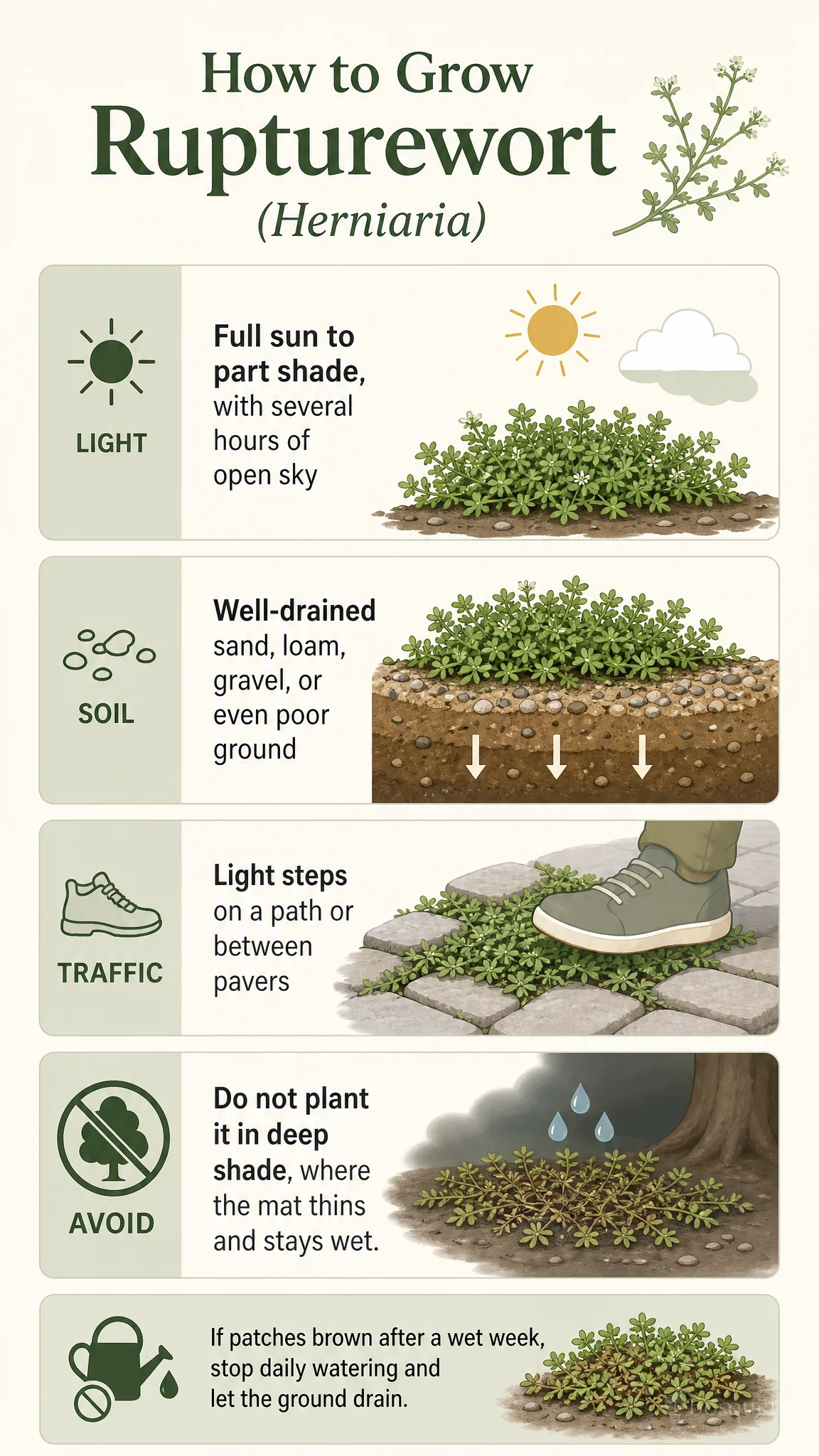
Give it full sun to part shade, soil that drains, and only light foot traffic
| Factor | Recommended | Avoid |
|---|---|---|
| Light | Full sun to part shade, with several hours of open sky | Do not plant it in deep shade, where the mat thins and stays wet |
| Soil | Well-drained sand, loam, gravel, or even poor ground | Do not plant it in a low spot that stays soggy |
| Traffic | Light steps on a path or between pavers | Do not use it as a play lawn that is walked all day |
| Size | About 1 to 3 inches tall and 1 to 2 feet wide | Do not expect a thick turf you can run on |
| Winter | Evergreen. The leaves often turn bronze in cold weather | Do not keep the bed wet through winter, because the roots rot |
| Kind | Tiny bright-green leaves in a tight outdoor carpet | Do not buy a houseplant labeled green carpet, and do not treat it as Irish moss |
rupturewort is a one-to-three-inch evergreen mat. Give it open sun or light shade and ground that sheds water. [1] It fills slowly to about one or two feet across, and it never needs mowing, because it stays that low on its own. [2] Walk on it the way you walk on a path, not as a backyard for running children. The shop name Green Carpet describes this outdoor creeper, not a windowsill plant. [3] Tiny green flowers sit in the leaves in early summer, so small you may not notice them.
How much sun does rupturewort need?
Give it full sun to part shade. Deep shade thins the mat and keeps the soil wet.
Can I walk on rupturewort?
Yes, lightly, on a path or between pavers. It is not a play lawn, and it never needs mowing.
Water until the mat knits, then ease off
Water a new planting often enough that the soil stays barely moist until the plants meet. After that, water only in a long dry spell. Established plants hold moisture in a long taproot, so daily sprinkling is the usual cause of rot, not a missed week of rain. [4] If patches brown after a wet week, stop watering and let the ground drain. Ease off further as fall cools, because cold wet soil is harder on the roots than a dry week.
- Water a new planting so the soil stays barely moist until the plants meet.
- After the mat knits, water only in a long dry spell, then let the soil dry before you water again.
- If patches brown after a wet week, stop daily watering and let the ground drain.
- In late fall, water less, because cold wet soil rots the taproot.
How often do I water rupturewort?
Water regularly until the mat knits, then ease off. Established plants need water only in a long dry spell. Soggy soil browns the patches.
Divide a piece of the mat in spring
The usual home start from a plant you already own is a piece of the mat with roots still attached, not a long leafless stem. Do that in spring, and replant the same day. If you are filling a new path from nursery plugs or seed, see Planting Rupturewort.
- In spring, slice a healthy patch so each piece has green top and roots attached.
- Replant the pieces the same day in soil that drains, and water until they take hold.
- Leave a few inches between pieces so they can knit without sitting wet on top of each other.
- Stay off the new patches until they hold, so footsteps do not tear the roots loose.
Can I divide rupturewort?
Yes. In spring, lift a rooted piece of the mat and replant it the same day. That is how you fill a thin patch from a plant you already have.
Not Irish moss — and not creeping thyme or a houseplant green carpet
Irish moss is Sagina, a flowering plant that looks mossy but is not this carpet. Do not treat a rupturewort tag as Irish moss, and do not expect the same even moisture Sagina wants in a cool, damp joint. Creeping thyme is a fragrant culinary mat with a net of surface roots — see How to Grow Creeping Thyme. Rupturewort has no kitchen smell and holds water in one long taproot. Brass buttons is a ferny paver plant that wants more even moisture — see How to Grow Brass Buttons. A kidney-leaf lawn carpet is Dichondra — see How to Grow Dichondra. A houseplant sold as green carpet is a different job in a pot; this plant belongs outdoors on a path.
Is this Irish moss?
No. Irish moss is Sagina. Rupturewort is Herniaria, a bright-green outdoor mat with a taproot, sold as Green Carpet.
Is this the same as a green carpet houseplant?
No. Green Carpet here is outdoor Herniaria. A houseplant with that nickname wants a pot indoors and is not this path plant.
If patches brown after a wet week, stop daily watering and let the ground drain. Keep the mat in sun or light shade, and walk on it only as a path.
FAQ
Is Green Carpet a different kind?
No. Green Carpet is the shop name for this plant, Herniaria glabra. Read the tag for that name.
What about Sea Foam or hairy rupturewort?
Sea Foam is a cream-edged form of the same species, and hairy rupturewort is Herniaria hirsuta. Neither is on this card. Grow this one as the green mat on the tag.
Can I grow it as a houseplant?
It can spill from an outdoor pot that drains, but it is not a houseplant in a dim room. Keep the mix from staying wet.
Can I make tea from it?
Do not make a tea or medicine from the garden plant. Grow it as a path mat. The old hernia name is history, not a recipe.
Do I need to mow it?
No. It stays about one to three inches tall. In spring you can shear off dead brown tips if winter burned them.
Related guides

Recommended plants
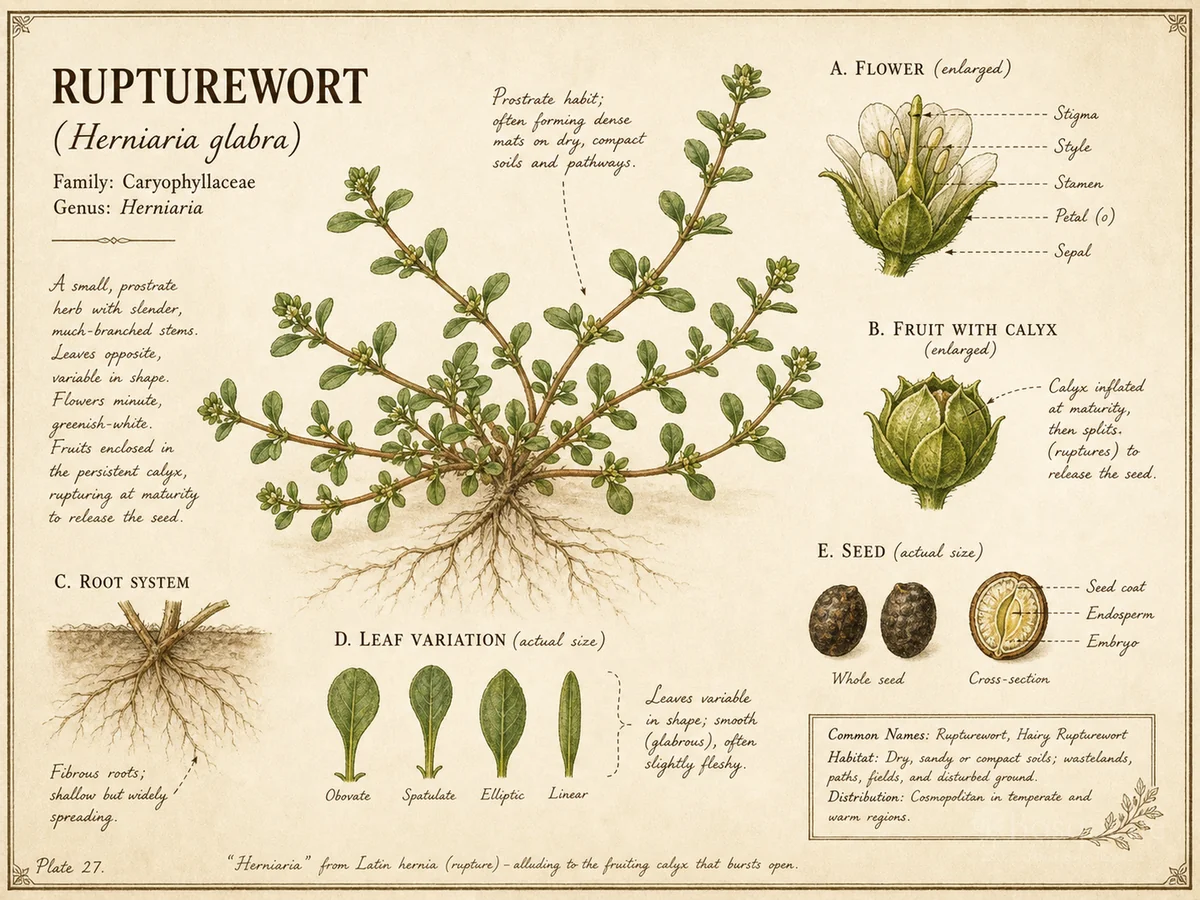
References
- [1] Royal Horticultural Society -
https://www.rhs.org.uk/plants/40501/herniaria-glabra/details - [2] Gardening Know How -
https://www.gardeningknowhow.com/lawn-care/lawn-substitutes/green-carpet-lawn/herniaria-green-carpet.htm - [3] Proven Winners -
https://www.provenwinners.com/plants/herniaria/green-carpet-rupturewort-herniaria-glabra - [4] Perennials.com -
https://www.perennials.com/plants/herniaria-glabra.html
This note is part of Herniaria Guides.
More first-season notes by plant are gathered in How to Grow Guides.
Updated: Reviewed by Bosquelle Editors