
Grow brass buttons as a low ferny mat between pavers, in soil that stays evenly moist. Brass buttons is Leptinella, not a clothing fastener.
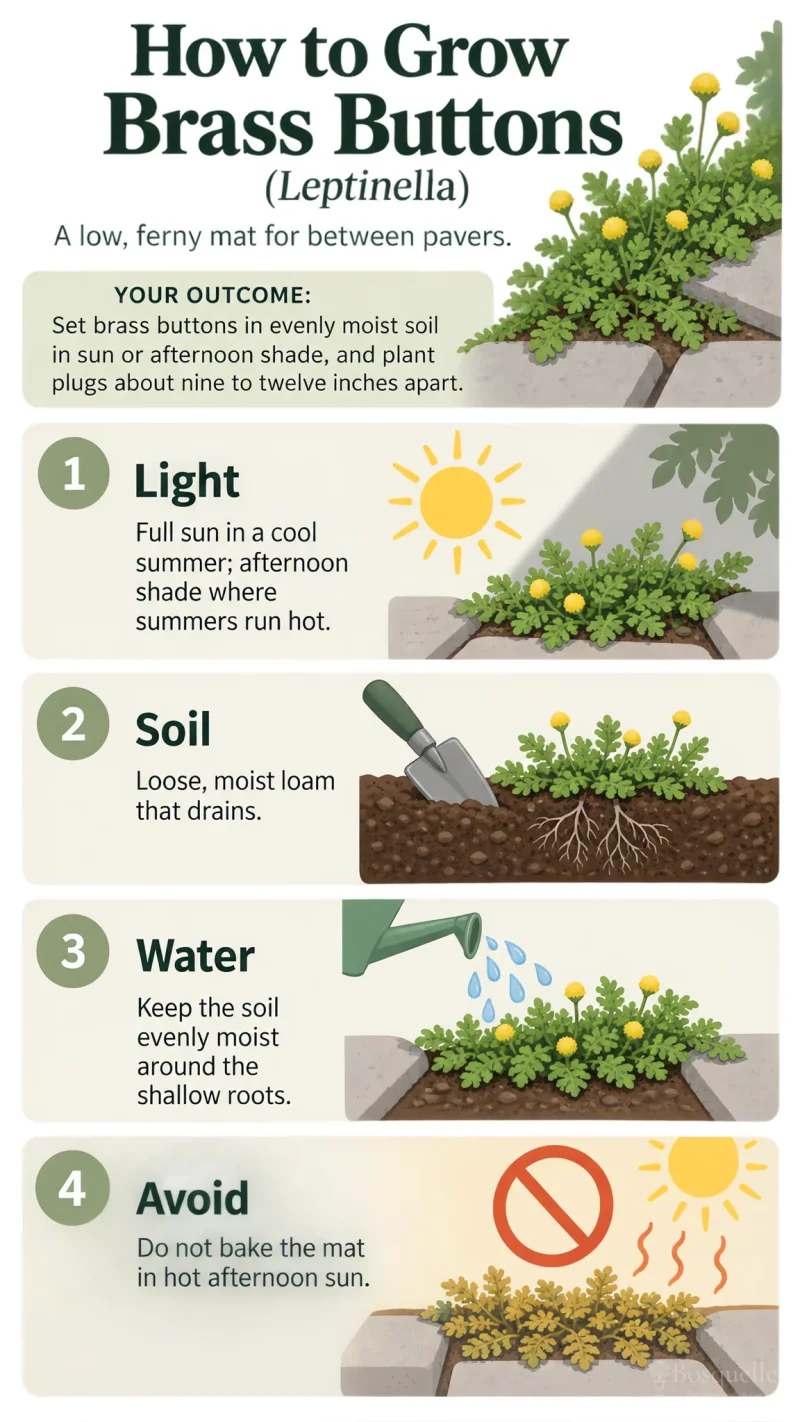
Keep the soil evenly moist, in full sun or afternoon shade in heat
| Factor | Recommended | Avoid |
|---|---|---|
| Light | Full sun in a cool summer; afternoon shade where summers run hot | Do not bake the mat in hot afternoon sun |
| Water | Keep the soil evenly moist around the shallow roots | Do not let the bed dry, and do not leave the crown in standing water |
| Soil | Loose, moist loam that drains | Do not plant into compacted clay and then walk it hard |
| Traffic | Light steps between pavers or along a path edge | Do not use it as a kids' play lawn |
| Feed | A light spring feeding on poor soil | Do not dump nitrogen every week |
Brass buttons wants even moisture in sun, or afternoon shade where the summer runs hot. The roots sit near the surface, so a dry week thins the mat, and compacted clay slows the runners. Give it loose loam that drains, water so the soil stays moist, and the ferny leaves hold instead of going crisp. [1] brass buttons uses that same moist site as a ferny mat about two to three inches tall. verdigris brass buttons uses the same water as a slightly lower pewter-green carpet. [2] Both plants share that moisture. Neither one is a dry thyme lawn or a true moss.
How much sun does brass buttons need?
Give it full sun in a cool summer. In a hot climate, give it afternoon shade so the mat does not bake.
How often do I water brass buttons?
Keep the soil evenly moist. The roots sit near the surface, so a dry week thins the mat. Do not leave the crown in standing water.
Plant plugs 9 to 12 inches apart, with the crown at soil level
Plant in spring or early fall while the soil stays moist and workable. Loosen compacted ground and mix in compost so the shallow runners can move. Set each plug at the same depth it grew in the pot, then space the plants about nine to twelve inches apart so they can knit into a mat.
- Plant in spring or early fall while the soil is moist and workable.
- Loosen compacted soil and mix in compost so the shallow roots can run.
- Set the crown at the same depth it grew in the pot. Do not bury the stems.
- Space plugs about nine to twelve inches apart, then water so the soil stays evenly moist until they knit.
How far apart do I plant brass buttons?
Space plugs about nine to twelve inches apart. The runners fill the gaps if the soil stays moist.
How deep do I plant it?
Set the crown at the same depth it grew in the pot. Burying the stems can rot the mat, and setting it high lets the roots dry.
Split a clump in spring or early fall
The mat spreads by shallow runners just under the soil, so a patch fills a small bed and then keeps going. [3] Most gardeners start a new patch by splitting a clump, not from seed. Lift a piece in spring or early fall while the soil is moist, and reset it at the same depth.
- Lift a clump in spring or early fall while the soil is moist and workable.
- Cut it into pieces that each have roots and leaves.
- Replant at the same depth, about nine to twelve inches apart, and keep the new pieces moist while they take.
When do I divide brass buttons?
Split a clump in spring or early fall while the soil is moist. Keep the new pieces watered until they knit.
Lift runners that leave the path
Runners root wherever they touch moist soil, so a mat that you like between pavers will also leave the joints if you ignore it. Lift what wanders, and replant those pieces or compost them. [4] On a large patch you can mow the spent yellow buttons; a small planting between stones does not need that cut.
- Dig runners that leave the bed or the paver joints.
- Replant those pieces where you want more mat, or compost them.
- On a large patch, mow spent yellow buttons if you want a cleaner look. Most small plantings can skip that cut.
Not Irish moss — and not a clothing brass button
Brass buttons on a sewing card is a metal fastener. This plant is Leptinella, a ferny mat with tiny yellow buttons in spring.
Irish moss is Sagina, a mossy cushion with tiny white flowers, not ferny leaves. Scotch moss is the gold-leaf form of that same cushion. You can plant them next to this mat for contrast, but they are not this plant. Creeping thyme is a drought herb for a hot paver — see How to Grow Creeping Thyme. Baby's tears is Soleirolia, a round-leaf mat that often lives indoors. An old tag that says Cotula squalida is still this plant.
Is this the same as Irish moss?
No. Irish moss is Sagina, a mossy cushion with tiny white flowers. Brass buttons has ferny leaves and tiny yellow buttons.
Is this the metal fastener?
No. Clothing brass buttons are metal. This brass buttons is Leptinella, a low ferny groundcover.
Set brass buttons in evenly moist soil in sun or afternoon shade, and plant plugs about nine to twelve inches apart.
FAQ
Is verdigris brass buttons a different plant?
Verdigris brass buttons is Leptinella potentillina, the pewter-green mat. Use the same even moisture. Brass buttons is Leptinella squalida, the slightly taller ferny carpet.
Is Platt's Black a different species?
Platt's Black is a dark-leaf form of brass buttons, not a second species on this list. Give it the same even moisture as the green mat.
Can I grow brass buttons in a pot?
Yes, as a moist underplanting under a larger plant. Use a mix that stays evenly moist and drains. A mix that dries in a day thins the mat.
Can I grow it from seed?
Seed is possible, but most gardeners split a clump. Keep the new piece moist at the same depth it grew before.
Does brass buttons come back after winter?
In a frost-free winter the leaves can stay green. After a hard freeze the top browns, and new leaves fill in by late spring if the soil stayed moist.
Can I use it as a lawn?
It can stand in for turf in a small, mild-climate patch with light steps. It is not a play lawn, and it still needs even moisture.
Will it take heavy foot traffic?
No. Light steps between pavers are fine. Daily heavy traffic packs the soil and wears the mat thin.
Recommended plants


References
- [1] Wisconsin Horticulture -
https://hort.extension.wisc.edu/articles/brass-buttons-leptinella-squalida/ - [2] New Zealand Plant Conservation Network -
https://www.nzpcn.org.nz/flora/species/leptinella-potentillina/ - [3] Gardening Know How -
https://www.gardeningknowhow.com/ornamental/groundcover/brass-buttons/growing-brass-buttons.htm - [4] Royal Horticultural Society -
https://www.rhs.org.uk/plants/63829/leptinella-potentillina/details
More first-season notes by plant are gathered in How to Grow Guides.
Updated: Reviewed by Bosquelle Editors