
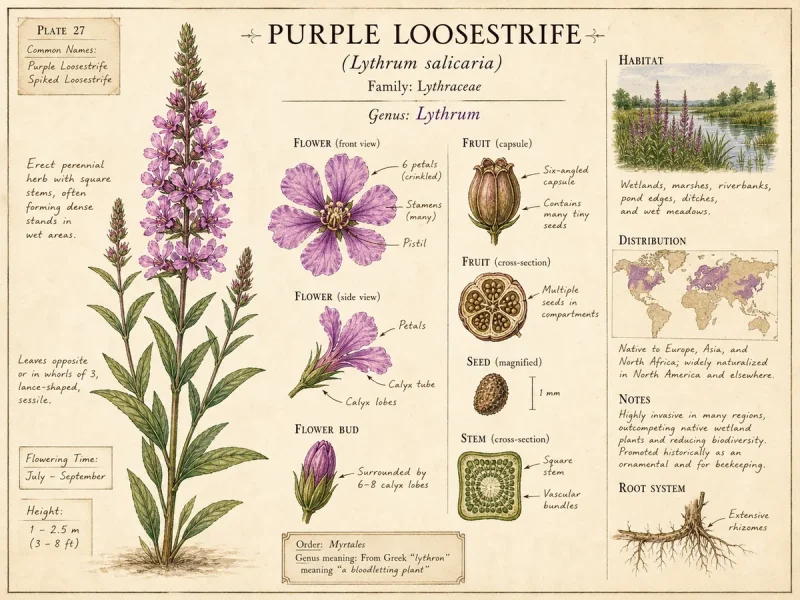
Grow purple loosestrife only if you already have it and can keep every seed and root out of a wetland. Purple loosestrife is Lythrum salicaria, a tall perennial with magenta spikes, also sold as spiked loosestrife.

Give it full sun and soil that stays wet
| Factor | Recommended | Avoid |
|---|---|---|
| Light | Full sun for most of the day | Do not count on deep shade, where the spikes stay thin |
| Soil | Clay or loam that stays moist to wet | Do not let the ground dry out around the crown |
| Water | Keep the soil wet through the growing season | Do not treat it as a dry-border perennial |
| Feed | Ordinary wet ground is enough | Do not fertilize a pond margin, because extra feed grows algae |
| Deer | Deer rarely browse it | Do not count on it as a deer-proof hedge |
purple loosestrife is a wetland perennial, usually 2 to 6 feet tall, with stiff square stems, stalkless lance leaves in opposite pairs or whorls, and dense magenta-pink spikes in summer. Give it open sun and ground that does not dry, the same wet ditch and pond edge it occupies once it naturalizes. [1] It will take poorly drained clay better than a dry ridge. That is also why it crowds native wetland plants once seed or a root piece reaches water. [2]
Many U.S. states make it illegal to sell or plant, including North Carolina, because named cultivars once sold as sterile still cross and set viable seed. Do not buy it for a rain garden. For a legal wet-sun spike, plant swamp milkweed, blazing star, Joe-Pye, ironweed, lobelia, or vervain instead — see How to Grow Milkweed, How to Grow Blazing Star, and How to Grow Joe-Pye Weed.
Does purple loosestrife need full sun?
Yes. Full sun is the usual site. It will flower in a little shade, but the spikes stay thinner.
Will deer eat it?
Deer rarely browse purple loosestrife. That does not make it a hedge you can ignore, and it does not make it safe to plant.
Do not plant it in a wetland — keep a sold plant in a pot
Do not set purple loosestrife in a pond, a ditch, a rain garden, or any wet ground that drains to a marsh. If a nursery already sold you a plant, keep it in a solid pot so seed and root pieces cannot wash away.
- Do not plant it in open ground, a pond shelf, or a mesh basket that sits in a waterway.
- If you already have a pot, keep the mix wet through the growing season, and stand the pot in a saucer you empty onto lawn, not into a drain that reaches a wetland.
- Never dump spent mix, seed heads, or root pieces into a compost pile that could wash toward water.
- Bag every stem you cut. Cut stems re-root if they lie on wet soil.
Can I grow it as a houseplant?
No. It is a hardy outdoor perennial. A patio pot is only a way to keep seed and roots from reaching a wetland.
Cut the spikes before they seed, and dig every root if it has run
Purple loosestrife blooms from late June into September in crowded magenta spikes. Flowers open from the bottom of the spike upward, and the lower capsules can dump seed while the top is still in flower. One mature plant can make about two million seeds, and those seeds can sit in the ground for years. Cut the spikes before they brown, and if a clump has already run, dig the woody taproot instead of mowing.
- When the lower flowers fade, cut the whole spike before the tan capsules open, and bag it. [3]
- Cut the dead stems in late winter or early spring, before new shoots rise, and bag those stems too.
- For a young plant, dig or pull it while the soil is wet, and lift the woody taproot and every side root. A tug that snaps the crown leaves the plant in place.
- Watch the same ground for several seasons. Seedlings will keep coming from the seed bank. Do not mow a patch, because cut stems re-root and seed rides on the blades. [4]
Will cutting it to the ground kill it?
No. Clipped plants grow back, and cut stems re-root on wet soil. Dig the taproot, and keep cutting spikes so new seed does not land.
Not fireweed — and not blazing star or garden loosestrife
Fireweed is Chamaenerion, a native with four egg-shaped petals, alternate leaves, and a round reddish stem. Purple loosestrife has five to seven narrow petals, a square stem, and opposite or whorled leaves. See How to Grow Fireweed if the stem is round and each flower has four petals.
Blazing star is Liatris, with tufted flower heads and grasslike leaves, not a square-stemmed loosestrife. See How to Grow Blazing Star. Garden loosestrife is Lysimachia — gooseneck and creeping jenny share the English name loosestrife, but they are a different genus. Confirm the tag says Lysimachia. See How to Grow Lysimachia.
Native winged loosestrife is Lythrum alatum, a smaller plant with winged square stems and single flowers spaced in the leaf axils, not a dense terminal spike. Swamp loosestrife is Decodon verticillatus, which arches from a shoreline with flowers in separated leaf axils, not an erect candelabra.
Is purple loosestrife the same as fireweed?
No. Fireweed has four petals and a round stem. Purple loosestrife has five to seven petals and a square stem.
Is it the same as creeping jenny or gooseneck?
No. Those are Lysimachia. Confirm the genus on the tag. A purple-loosestrife tag with no Latin is the wetland weed.
If a new shoot comes up outside the pot, lift it with the woody taproot and bag it before the first spike opens. The next patch starts from that stray piece.
FAQ
Is there more than one kind of purple loosestrife?
Lythrum salicaria is the plant here. Tags that say Morden Pink, Dropmore Purple, or wand loosestrife are still this genus, and they can set seed. Native winged loosestrife is a different species, not a sterile form of this one.
Will it come back after winter?
The stems die. New shoots come from the woody taproot in spring. Dead stems can stand through winter; cut them before new growth, and bag them.
Can I divide it or grow it from seed?
Do not. Division, cuttings, and seed are how it leaves a garden. Keep the plant you already have, and do not share pieces.
Can I cut stems for a vase?
You can cut a spike for a small bunch, but bag the spent stems. Do not dump cut pieces in a wet ditch. This is not a florist crop.
Should I spray it, or release beetles?
For a small garden clump, dig the taproot and bag every piece. Large wetland stands belong with your state invasive-species office. Do not mix a home herbicide over water.
Recommended plants
References
- [1] NC State Extension Gardener -
https://plants.ces.ncsu.edu/plants/lythrum-salicaria/ - [2] Royal Horticultural Society -
https://www.rhs.org.uk/plants/10645/lythrum-salicaria/details - [3] BBC Gardeners' World -
https://www.gardenersworld.com/how-to/grow-plants/how-to-grow-purple-loosestrife/ - [4] SDSU Extension -
https://extension.sdstate.edu/plant-look-alikes-whats-difference-between-fireweed-and-purple-loosestrife
More first-season notes by plant are gathered in How to Grow Guides.
Updated: Reviewed by Bosquelle Editors