
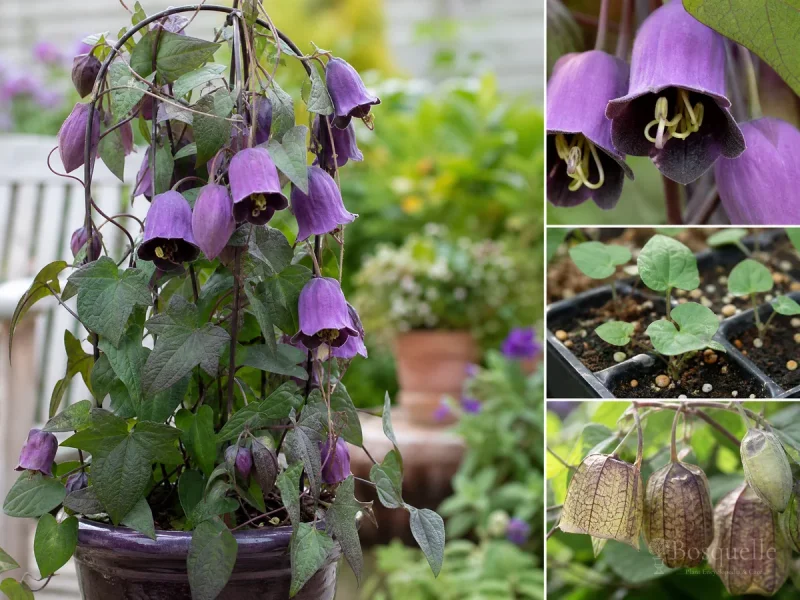
Grow purple bell vine in full sun, in moist soil that drains, and on a trellis the leaf stalks can twine. Purple bell vine is Rhodochiton. Shops also say purple bells. It is not a Campanula bellflower.

Give it full sun, moist soil that drains, and a trellis the leaf stalks can twine
| Factor | Recommended | Avoid |
|---|---|---|
| Light | Full sun, at least six hours; a little afternoon shade in a very hot summer | Do not plant it in deep shade if you want bloom |
| Water | Keep the soil evenly moist; about 1 inch a week, more in heat | Do not let the mix go bone-dry, and do not leave the pot standing in water |
| Soil | Moist soil that drains, with compost mixed in; chalk, loam, or sand | Do not plant it in a soggy low spot |
| Support | A trellis, strings, or mesh the leaf stalks can wrap | Do not leave the vine on the ground |
| Frost | Grow it as a summer annual, or bring a pot in when nights hit the low 40s | Do not leave it out for a freeze |
purple bell vine is Rhodochiton atrosanguineus, a plantain-family climber whose leaf stalks twist around string or mesh. Give it full sun and soil that stays moist but drains, because shade cuts bloom and wet feet rot the roots. [1] A little afternoon shade in a hot summer keeps the leaves from scorching. Compost at planting is enough food until growth is strong; then a balanced liquid feed once a month is plenty. The vine does not grab with tendrils. The leaf stalks wrap a thin support, so string, netting, or a light trellis works better than a smooth thick post. [2] Keep watering even in a container. About an inch a week is a starting point, then more when heat dries the mix. Do not water with softened or salty water. [3]
How do I care for purple bell vine?
Give it full sun, keep the soil moist but draining, and put a trellis or strings where the leaf stalks can wrap.
Does it like sun or shade?
Full sun for bloom. A little afternoon shade helps in a very hot summer. Deep shade makes leaf and little flower.
Treat it as an annual, or bring a pot in before nights hit the low 40s
Most U.S. gardeners grow purple bell vine as a summer annual and let frost end it. If you started it in a pot, bring that pot into a bright, cool room before nights drop into the low 40s, and water less once growth slows. [4] It is a tender perennial only where winter stays frost-free outdoors. Keep the mix just moist in winter, not soggy. It is not a houseplant for a dim windowsill.
Is purple bell vine an annual or a perennial?
Grow it as a summer annual unless winter stays frost-free. A pot can come indoors before nights hit the low 40s.
Grow it in a hanging basket, or in a pot with a hole
A hanging basket shows the dangling bells, and a patio pot next to a string trellis lets you move the plant when nights turn cold. The mix still has to stay moist and drain.
- Use a pot with a drainage hole and a mix that holds moisture but does not stay soggy.
- Water more often than in the ground, because a basket dries out faster in sun and wind.
- Hang it so the stems can trail, or stand the pot next to strings if you want it to climb.
- Do not try to keep it as a year-round houseplant in low light.
Can I grow it in a hanging basket?
Yes. Use a pot with a hole, keep the mix moist, and hang it in morning sun. It is not a dim-room houseplant.
Root a cutting in spring if you already have a vine
Seed is the usual start — see Growing Purple Bell Vine from Seed. A cutting in spring copies a vine you already have, which helps if you want the same plant next year without waiting on a tray.
- Cut a non-flowering shoot with several leaves, just below a node, and strip the lower leaves.
- Tuck the bare nodes into moist mix that drains, or into a half-sand, half-perlite mix, and keep the pot warm and barely moist until the cutting resists a gentle tug.
- Pot it up, give it a stick, and grow it on like a young plant until frost is gone.
Can I take cuttings?
Yes, in spring from a non-flowering shoot. Seed is still the usual start for a new plant.
Not a purple bellflower — and not chocolate cosmos
Purple bellflower is Campanula, an upright bed plant that does not climb — see How to Grow Bellflowers. Chocolate cosmos is Cosmos atrosanguineus, a tuberous daisy with chocolate-scented blooms, not a vine — see How to Grow Chocolate Cosmos. Heart-shaped leaves can look like morning glory; that plant is Ipomoea, a twining annual with funnel flowers — see How to Grow Morning Glory. Cup and saucer vine is Cobaea, a tendril climber with a green calyx — see How to Grow Cup and Saucer Vine. Chocolate vine is Akebia, a five-leaflet woody climber — see How to Grow Chocolate Vine. Packet tags that say Lophospermum atrosanguineum are this same plant, not creeping gloxinia.
Is this a purple bellflower?
No. Purple bellflower is Campanula, which stands in a bed. Purple bell vine is Rhodochiton, a twining climber.
Is it chocolate cosmos?
No. Chocolate cosmos is a tuberous daisy. This plant is a Mexican vine with a pink calyx and a dark purple tube.
If the vine sprawls on the ground, add string or a light trellis the leaf stalks can wrap. If nights will drop into the low 40s and you are not treating it as an annual, move the pot inside.
FAQ
Is purple bell vine invasive?
It is not treated as invasive in the U.S. Frost kills it in most gardens, so treat it as a summer annual and give it a structure it cannot leave.
Do the flowers make good cuts?
Cut stems wilt fast once they leave the vine, so they are a poor bouquet. Enjoy the bells on the plant.
Is there more than one kind of purple bell vine?
Shops sell this one Mexican vine. Other Rhodochiton species are not U.S. garden cards. Grow the plant you bought in the same sun, moist soil, and trellis.
Is Purple Showers this plant?
No. Purple Showers is a Mexican petunia, Ruellia, an upright bed plant — see How to Grow Mexican Petunia.
Is purple bell vine poisonous to pets?
This plant is not on the usual pet-toxin list. Still keep dogs and cats from chewing any garden vine.
Do whiteflies show up on an indoor plant?
Whiteflies and spider mites show up when a pot sits indoors in dry air. Hose the foliage and keep the mix from going bone-dry.
Related guides
Recommended plants

References
- [1] NC State Extension -
https://plants.ces.ncsu.edu/plants/rhodochiton-atrosanguineus/ - [2] Royal Horticultural Society -
https://www.rhs.org.uk/plants/63240/rhodochiton-atrosanguineus/details - [3] Select Seeds -
https://www.selectseeds.com/products/purple-bell-vine-seeds - [4] Epic Gardening -
https://www.epicgardening.com/purple-bell-vine/
This note is part of Rhodochiton Guides.
More first-season notes by plant are gathered in How to Grow Guides.
Updated: Reviewed by Bosquelle Editors