
Grow chocolate vine in sun or part shade, in soil that drains, on a sturdy support you can reach. Chocolate vine here is Akebia quinata, also sold as five-leaf akebia or raisin vine — not wisteria, and not a chocolate-scented cosmos.

Give it sun or part shade, soil that drains, and a support you can reach
| Factor | Recommended | Avoid |
|---|---|---|
| Light | Full sun or part shade; more sun brings more flowers | Do not let it climb into a shrub or a small tree you cannot reach |
| Water | Water weekly until it is established, then water in a dry spell | Do not plant it in standing water |
| Soil | Moist soil that drains; ordinary garden soil is fine | Do not set it in a low, wet pocket |
| Support | A sturdy trellis, arbor, or fence it can twine on | Do not count on it to cling the way Virginia creeper does |
| Spread | An isolated trellis, or a mowing strip if you use it as groundcover | Do not plant it next to woods it can reach |
| Winter | It may keep leaves in a mild winter; after a hard freeze it comes back from the wood | Do not treat winter leaf drop as a dead plant |
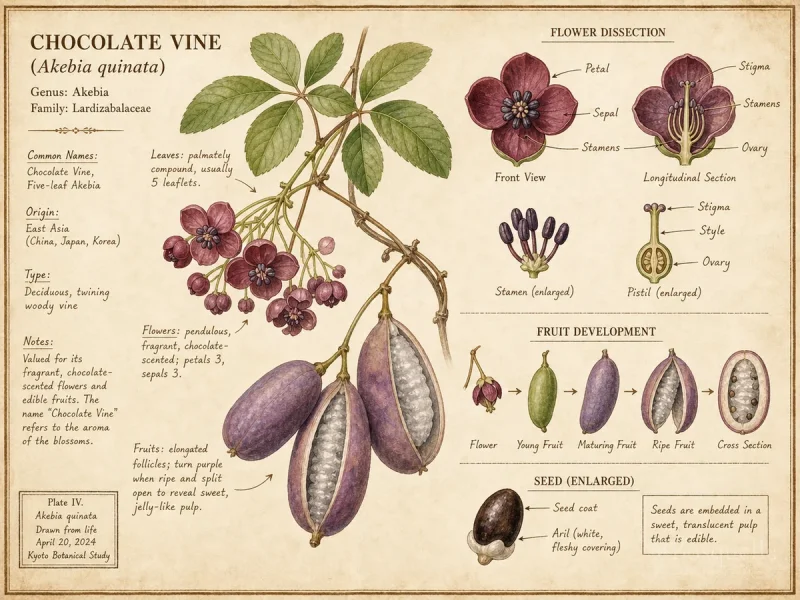
chocolate vine is a woody twiner with a fan of five smooth leaflets. It grows fast — often twenty to forty feet — and it will smother a shrub if you let it. Site it on a trellis or arbor you can reach, in sun or part shade, in soil that drains. Water weekly the first season. After that, water in a dry spell. [1] Several states list it as invasive, so keep it off the fence line that faces woods. An isolated trellis, or a mowing strip around a bank planting, is how you keep the stems from walking. [2]
- Give it full sun or part shade. More sun means more of the chocolate-scented spring flowers.
- Water weekly until the roots take, then water when a dry spell lasts more than a week.
- Keep it on a support you can prune from a ladder or the ground. Do not send it into a tree canopy you cannot reach.
How much sun does chocolate vine need?
Full sun or part shade. It still grows in shade, but it blooms less. Put it where you can reach the stems.
How do I keep it from spreading?
Plant it on an isolated trellis, or keep a mowing strip around a groundcover planting. Snip any stem that runs on the soil before it roots.
Plant it at the same depth, against a sturdy trellis
Put the support in first. Dig a hole twice as wide as the nursery pot and set the top of the root ball even with the soil. Water once to settle. If you grow it as a groundcover on a bank, keep a mowed strip around it so rooted stems cannot walk into the next bed.
- Set the trellis, arbor, or fence before you plant. The vine twines; it does not cling with pads.
- Dig a hole twice as wide as the pot, no deeper than the nursery soil line.
- Set the plant, backfill, and water once to settle the soil.
- If you use it as a groundcover, mow a strip around the planting so new stems cannot root into the next bed.
How do I plant chocolate vine?
Set the support first. Dig a hole twice as wide as the pot, set the plant at the same depth, and water once to settle.
Prune after it flowers, and snip stray stems all summer
Flowers form on last year's wood, so wait until the spring bloom fades, then shorten the long shoots. Through summer, snip any stem that runs on the soil before it roots. You can cut the whole vine to the ground; it comes back, though you may skip a bloom that year. [3]
- After the flowers fade, cut long shoots back to the support.
- Through summer, pull or snip stems that lie on the soil, before they take root.
- If it has swallowed the arbor, cut it to the ground in early spring. It recovers. You may lose that year's flowers.
- Compost the pieces, or bag them. Do not dump live stems where they can root in woods.
Pin a low stem so it roots
A stem that touches moist soil will often root on its own. That is how the vine walks. If you want a second plant, pin a low node in spring, keep that soil moist, and cut the new plant free the next spring. If you do not want more plants, pull those rooted pieces as soon as you see them.
- In spring, bend a low stem to the soil at a node.
- Pin it and keep that spot moist.
- The next spring, cut it free only if you want another plant in a new hole.
- Otherwise, pull every rooted runner so it cannot start a new patch.
When do I prune chocolate vine?
After it finishes blooming in spring, then snip stray stems all summer. Flowers sit on last year's wood, so a hard cut before bloom removes that year's flowers.
How do I start another plant?
Pin a low stem to moist soil in spring. Cut the rooted piece free the next spring, or pull it if you do not want another vine.
Not wisteria — and not Virginia creeper
Wisteria is a pea vine with long hanging flower chains and pinnate leaves. Chocolate vine has small chocolate-scented cups and a fan of five smooth leaflets. See How to Grow Wisteria if that is the plant on your arbor.
Virginia creeper also has five leaflets, but the edges are toothed and the tips are pointed. It climbs with tendrils. Chocolate vine twines, and each leaflet is rounded with a small notch at the tip. [4]
Chocolate mint is a mint — see How to Grow Mint if that is the plant you bought. Chocolate cosmos is a tuber with chocolate-scented daisies — see How to Grow Chocolate Cosmos. Hardy kiwi is Actinidia — see How to Grow Hardy Kiwi if you bought a fruiting kiwi vine. Dutchman's pipe has heart-shaped leaves, not a fan of five leaflets.
Is this wisteria?
No. Wisteria has hanging pea-flower chains and pinnate leaves. Chocolate vine has small maroon cups and five smooth leaflets.
Is this Virginia creeper?
No. Virginia creeper has toothed, pointed leaflets and climbs with tendrils. Chocolate vine twines, and the leaflet tips are rounded with a notch.
Put the next vine on a sturdy trellis you can reach, water it through the first summer, and snip any stem that runs on the soil.
FAQ
Are Alba, Silver Bells, or Variegata a different kind of care?
No. Those are shop forms of the same twining vine. They still want sun or part shade, soil that drains, and a support you can reach. White or pink flowers, or cream-splashed leaves, do not change the job.
What about three-leaf akebia?
Three-leaf akebia is Akebia trifoliata, sold for leaves in threes. It still twines, still wants a support, and still spreads if stems root. The vine here is the five-leaflet chocolate vine.
Will it fruit?
Often not, unless a second, different plant is nearby to pollinate it, and the summer is long and warm. The inner white pulp is edible. Do not expect a crop the way you would from kiwi.
Can I grow it in a pot?
Only in a large, heavy pot with a hole and a sturdy trellis. It is a landscape vine, not a houseplant. Most gardeners plant it in the ground against a fence or arbor.
Can I grow it from seed?
Seed is a slow start, and named shop forms will not come true. Pinning a low stem is the usual way to make another plant.
Is chocolate vine toxic to cats or dogs?
It is not a listed toxic plant in the usual pet lists. Still keep pets from chewing vines, because a chewed stem can upset a stomach.
Do I need to feed it?
A compost mulch in spring is enough. It grows fast without a heavy fertilizer program.
Recommended plants
References
- [1] NC State Extension -
https://plants.ces.ncsu.edu/plants/akebia-quinata/ - [2] University of Arkansas Extension -
https://www.uaex.uada.edu/yard-garden/resource-library/plant-week/akebia-1-9-2015.aspx - [3] Oregon State University -
https://landscapeplants.oregonstate.edu/plants/akebia-quinata - [4] University of Wisconsin -
https://renzweedscience.cals.wisc.edu/wp-content/uploads/sites/177/2025/05/Akebia-quinata-five-leaf-chocolate-vine.pdf
More first-season notes by plant are gathered in How to Grow Guides.
Updated: Reviewed by Bosquelle Editors