
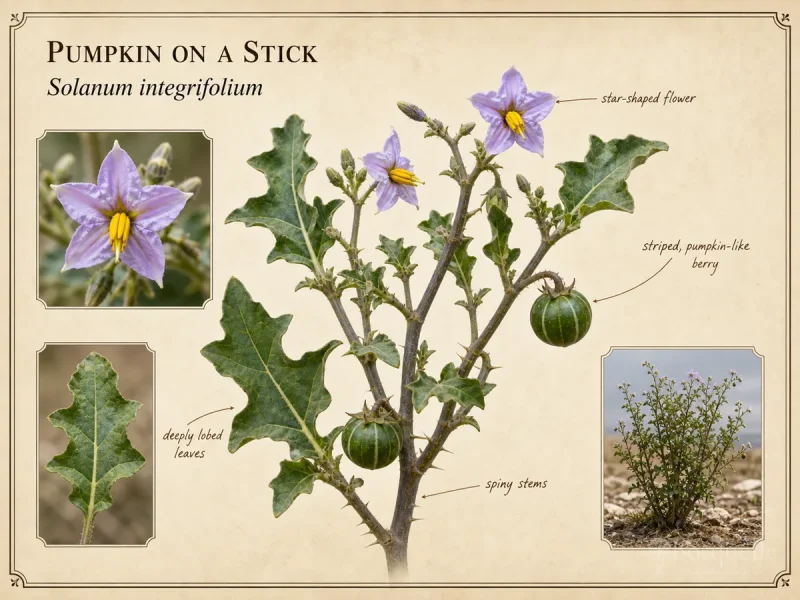
Grow pumpkin on a stick in full sun and heat, with even moisture in dry spells. The plant here is Solanum integrifolium — also sold as ornamental eggplant — not a pumpkin vine and not food eggplant.

Give it full sun, heat, and even water
| Factor | Recommended | Avoid |
|---|---|---|
| Sun | Full sun, at least six hours | Do not site it in deep shade that cuts flowers and fruit |
| Heat | Warm days; a frost-free stretch once plants are outside | Do not leave it out through a frost |
| Water | Even moisture in dry spells; mulch to hold water | Do not let the bed go bone-dry while fruit is swelling |
| Feed | Modest fertility, as you would for tomato or pepper | Do not push heavy nitrogen that makes leaves instead of fruit |
Pumpkin on a stick is a heat crop. It stalls in cool weather and dies in a frost. Give pumpkin on a stick (Solanum integrifolium) full sun and well-drained soil, and water during dry stretches so flowers and fruit keep coming. [1] [2] The stems and leaves carry thorns, so wear gloves when you brush past the plant. Keep it off the drip line of a black walnut. Patio plants want the same sun in a pot, below. Fruiting stems come off the plant on Harvesting Pumpkin on a Stick.
How much sun does pumpkin on a stick need?
Full sun, at least six hours. Shade cuts flowers and the later fruit.
How often should I water pumpkin on a stick?
Keep the soil evenly moist in dry spells. Do not let it crust dry while fruit is swelling.
Grow one plant in a large draining pot
A patio plant still wants full sun and a pot that drains. One plant fills a large container because the bush spreads about two to three feet.
- Choose a pot with a drainage hole, wide enough for a bushy plant about two to three feet across.
- Fill a soilless potting mix. Do not pack garden soil into the pot.
- Set one plant, water until mix runs out the holes, and add a small cage while the plant is still small.
How big a pot does it need?
A large draining pot with one plant. A small pot dries too fast and the plant stays short.
Not a pumpkin — and not a food eggplant
True pumpkins are vine crops on How to Grow Squash. Pumpkin on a stick is an ornamental eggplant relative, grown for ribbed fruit on woody stems, not for a jack-o'-lantern patch. [3] [4] Food eggplant is a different crop on How to Grow Eggplant. Garden peppers are Capsicum on How to Grow Peppers. A grocery-store pumpkin tree is a decorated branch, not this plant.
Is pumpkin on a stick a real pumpkin?
No. It is Solanum integrifolium, an ornamental eggplant. Pumpkins are a squash vine.
If the soil crusts dry while fruit is swelling, water deeper — do not mist the leaves.
FAQ
Does pumpkin on a stick come back next year?
It is a tender plant. In most U.S. gardens frost ends the outdoor crop, so you start again in spring.
Can I grow pumpkin on a stick from cuttings?
Home gardeners start it from seed or a spring transplant. A cutting rarely has enough warm weeks left to fruit.
What is a pumpkin tree at the grocery store?
That is usually a decorated branch sold for fall display. It is not this garden plant.
Is it toxic to pets?
It is a nightshade. Keep dogs, cats, and horses from chewing the leaves or fruit.
What is chewing holes in the leaves?
Flea beetles chew small round holes on young plants. Cover transplants until they are growing strongly.
Do I need a spiny kind or a spineless kind?
Care is the same heat-and-water job. Spiny stems need gloves. Spineless stems are easier to handle.
Related guides


Recommended plants
References
- [1] Nebraska Extension -
https://lancaster.unl.edu/pumpkin-stick/ - [2] NDSU Extension -
https://www.ag.ndsu.edu/news/columns/dakota-gardener/dakota-gardener-a-pumpkin-on-a-stick - [3] Cornell High Tunnels -
https://blogs.cornell.edu/hightunnels/flowers/cut-flowers/cut-flower-crops/pumpkin-on-a-stick/ - [4] University of California ANR -
https://ucanr.edu/blog/under-solano-sun/article/pumpkins-stick
This note is part of Pumpkin_on_a_stick Guides.
More first-season notes by plant are gathered in How to Grow Guides.
Updated: Reviewed by Bosquelle Editors