
Grow pigface in full sun, in sandy soil that drains, and water only in a long dry spell. Pigface is Carpobrotus rossii, also sold as karkalla. A tag that says ice plant is often hardy ice plant or highway ice plant.
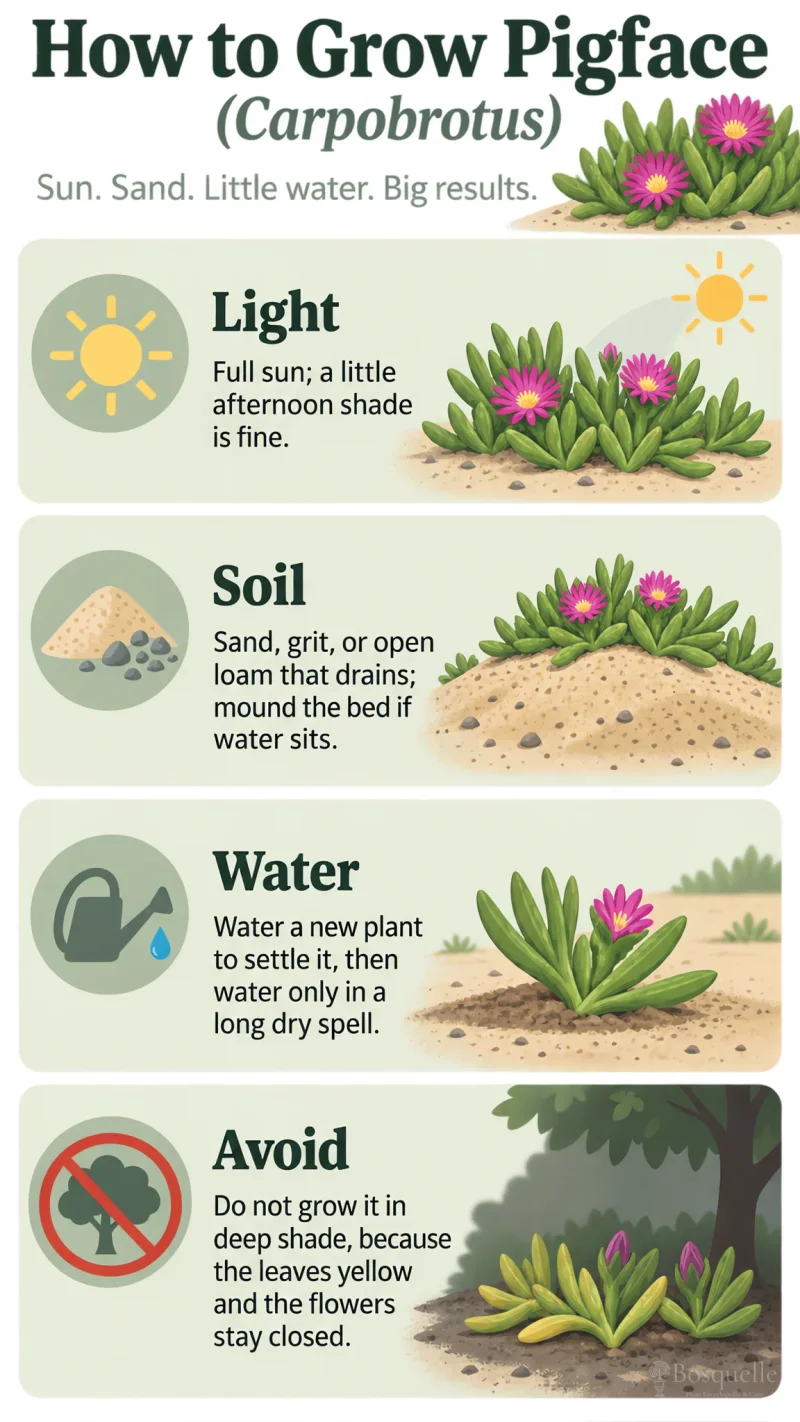
Give it full sun and sandy soil that drains, and water only in a long dry spell
| Factor | Recommended | Avoid |
|---|---|---|
| Light | Full sun; a little afternoon shade is fine | Do not grow it in deep shade, because the leaves yellow and the flowers stay closed |
| Water | Water a new plant to settle it, then water only in a long dry spell | Do not keep the roots wet, and do not water on a calendar while the soil is still moist |
| Soil | Sand, grit, or open loam that drains; mound the bed if water sits | Do not plant it in heavy, wet clay |
| Drought | Skip extra water once the stems have rooted and started to spread | Do not treat a dry week as a reason to soak a soggy bed |
| Salt | Coastal wind and salt spray are fine | Do not treat salt spray as a reason to add extra water |
| Winter | Keep the soil dry through a freeze | Do not leave it wet through a hard frost |
| Kind | Thick three-sided leaves; mauve to purple flowers with a white center | Do not buy needle-leaf hardy ice plant or a yellow-flower highway ice plant and expect this plant |
pigface wants an open, bright bed and sand that dries between waterings. Soggy soil around the roots is the primary cause of root rot. [1] It takes full sun, and it also takes some afternoon shade on a coastal bank. [2] The flowers stay closed on heavy overcast days, so a dim wall is the wrong place if you want bloom.
- Set it in full sun. A little afternoon shade is fine on a hot bank.
- Grow it in sand, grit, or open loam. Mound the bed if water sits after rain.
- Water to settle a new plant, then wait for a long dry spell before you water again.
How much sun does pigface need?
Full sun. A little afternoon shade is fine, but deep shade yellows the leaves and the flowers stay closed.
How often should I water it?
Water a new plant to settle it, then water only in a long dry spell. Once the stems have rooted, skip extra water except in a long heat wave. Keep it dry through a freeze.
Plant it in sand, with room to run
Weed the spot first, because the stems will root wherever they touch. Dig a hole about as deep as the nursery pot and set the crown at the same depth as it was already growing. Leave a few feet between starts, because a plant can run three to ten feet. Water once to settle, then wait until the soil is dry.
- Choose a sunny, sandy spot. Mound the soil if water sits after rain.
- Set the crown at the same depth as the nursery pot.
- Leave a few feet between starts so the stems can run and root.
- Water once to settle the mix, then wait until the soil is dry before you water again.
How do I plant pigface?
Plant it in sand, at the same depth as the nursery pot, with a few feet of room. Water once to settle, then wait until the soil is dry.
Does pigface spread?
Yes. Stems root where they touch, and a plant can run several feet in the first year. Leave room, then pinch a runner when it reaches a path.
Pinch long runners when they reach the path
The stems keep running. When a runner reaches a path, a wall, or a neighbor bed, pinch or cut it there. You can stick a node back into sand if you want another start, or compost the extra piece.
- Follow a long runner to the path, wall, or bed edge.
- Pinch or cut it there.
- Stick a node in sand if you want another plant, or compost the extra piece.
Take a four-inch stem cutting and strip the lower leaves
The usual way to make more pigface is a stem cutting, not seed. In warm weather, pinch a firm tip about four inches long. Strip the two lowest leaves so a node is bare, then push that node into sandy mix in a pot with a hole, or into sand in the bed. [3] Keep it in bright light, not hot midday sun, and barely moist until a gentle tug meets resistance, usually in a few weeks.
- Pinch a firm four-inch tip in warm weather.
- Strip the two lowest leaves so a node is bare.
- Push the node into sandy mix in a pot with a hole, or into sand in the bed.
- Keep it in bright light, not hot midday sun, and barely moist until it resists a tug. Then water as you would the parent plant.
How do I take a cutting?
Pinch a four-inch tip, strip the two lowest leaves, and push the bare node into sandy mix. Keep it barely moist in bright light until it resists a tug.
Can I plant cuttings straight in the ground?
Yes, if the sand drains. Push a bare node into the soil, keep it barely moist until it roots, and skip a soggy clay bed.
Not hardy ice plant — and not the highway ice plant
Hardy ice plant is Delosperma, a low daisy-flower mat with nearly cylindrical leaves. Pigface is a thicker carpet with three-sided leaves and mauve flowers that have a white center. See How to Grow Ice Plant if that is the plant you bought.
Highway ice plant is Carpobrotus edulis, a South African succulent with large yellow flowers. Do not plant it on the California coast, because it smothers native dune plants. [4] A California tag that says sea fig is often Carpobrotus chilensis, not this Australian species. Baby sun rose is Aptenia, with heart-shaped leaves — see How to Grow Baby Sun Rose if that is the tag.
Is pigface the same as ice plant?
No. Hardy ice plant is a low daisy-flower mat. Pigface is Carpobrotus rossii, with thicker three-sided leaves and mauve flowers with a white center.
Is pigface invasive?
Native Australian pigface is not the California highway invader. Do not plant Carpobrotus edulis on the California coast. Pinch this plant when a runner reaches a path.
Set it in full sun and sand, water only in a long dry spell, and root extras from a four-inch stem.
FAQ
Is karkalla a different plant?
Karkalla is another name for this same Australian pigface. Tags also say native pigface or Ross's noonflower. Give it the same sun, sand, and dry-between watering.
Can I grow it in a pot?
You can, in a pot with a hole and sandy mix, and let the stems trail over the rim. It is happier in the ground on a bank or in gravel once nights stay warm.
Can I grow it from seed?
You can, but most gardeners start a stem cutting. Seed is slower. The new plants still need sun and sand that drains.
Can I leave it out all winter?
Only where a hard frost does not sit wet on the bed. Keep the soil dry through a freeze. In a colder winter, root a cutting under cover and plant after frost.
Can I eat the fruit?
The dull-red fruit is edible when it is ripe and pulls off easily. Eat it fresh. Do not copy a jam recipe onto the leaves.
Will pets chew it?
Keep pets from chewing the leaves. A chewed succulent can upset a stomach.
Recommended plants
References
- [1] Nurseriesonline -
https://www.nurseriesonline.com.au/plant-index/australian-native-plants/carpobrotus-rossii-karkalla-or-native-pigface/ - [2] Australian Native Plants Society -
https://anpsa.org.au/plant_profiles/carpobrotus-rossii/ - [3] Everydaywits -
https://www.everydaywits.com/growing-pigface/ - [4] California Department of Fish and Wildlife -
https://wildlife.ca.gov/Conservation/Plants/Dont-Plant-Me/Iceplant
More first-season notes by plant are gathered in How to Grow Guides.
Updated: Reviewed by Bosquelle Editors