
Grow pigeonberry in part shade in moist soil that drains. Pigeonberry is Rivina humilis — rouge plant or baby-peppers on a tag, not the yellow-fruited shrub sold as pigeon berry.
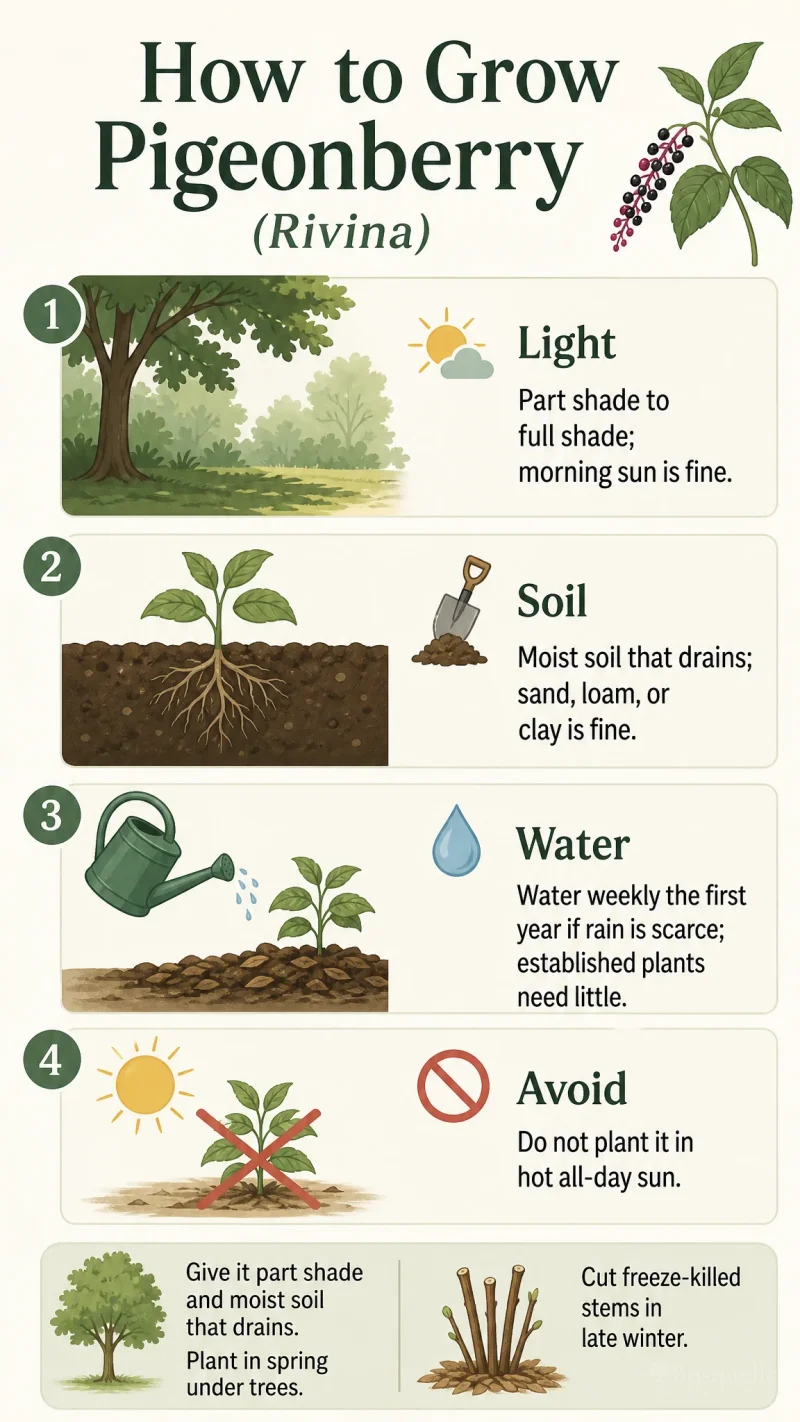
Give it part shade and moist soil that drains
| Factor | Recommended | Avoid |
|---|---|---|
| Light | Part shade to full shade; morning sun is fine | Do not plant it in hot all-day sun |
| Soil | Moist soil that drains; sand, loam, or clay is fine | Do not leave the crown in standing water |
| Water | Water weekly the first year if rain is scarce; established plants need little | Do not keep soaking a dormant clump as if it were dying |
| Drought | Let an established clump go dormant in a dry spell; it leafs out after rain | Do not rip out a leafless crown in August |
| Size | Leave about 1 to 2 feet in a woodland; frost-free hammocks can reach about 5 feet | Do not pack a sun perennial against the crown |
| Pests | Few insect problems on a shady site | Do not pack wet debris against the crown |
pigeonberry is Rivina humilis, a shade perennial in the pokeweed family. It holds alternate leaves with wavy edges and short racemes of small white-to-pink flowers. Shiny red berries form on the same stems while the tips are still blooming. Site it under trees or shrubs, in moist soil that drains. [1]
Water a new planting about once a week the first year if rain is scarce. After that, water only in a long, hot dry spell if you want it to keep leaves and berries. In a hard drought the top can drop and look gone. Leave the crown. It leafs out again when rain returns. A pot that drains can hold a small clump on a shady porch, but this is not an indoor windowsill plant. [2]
Does pigeonberry like sun or shade?
Part shade to full shade. Morning sun is fine. Hot all-day sun scorches the leaves.
What happens in a drought?
An established clump can go dormant and drop its leaves. It leafs out after rain. Do not rip the crown out.
Does pigeon berry spread?
It reseeds nearby in shade, enough to fill a patch without taking the whole yard. Birds move the berries.
Pair it with other shade natives
Plant it with other plants that like dappled shade and ordinary moisture — Turk's cap, American beautyberry, or cedar sage. Those jobs are How to Grow Turk's Cap and How to Grow Beautyberry. [3]
Cut freeze-killed stems in late winter
After a hard freeze the tops blacken and drop. The roots stay. Cut the dead stems in late winter or early spring, before new shoots run. In a frost-free hammock the plant may keep leaves; then you only shorten spindly stems.
- Wait until late winter or early spring, before new shoots run.
- If a freeze killed the tops, cut the dead stems to a few inches above the soil.
- If the plant stayed leafy, shorten spindly stems just above a leaf node, about 6 inches up.
- Do not cut in peak berry season unless a stem is broken.
Do I prune pigeonberry every year?
Cut freeze-killed tops in late winter. If the plant stayed leafy, you may not need a hard cut.
Plant in spring under trees
Plant in spring after frost, in shade or dappled light under trees. Set the crown level with the soil. Space plants about 12 to 18 inches apart if you want a ground cover. Water it in, then follow the first-year watering in the table above.
- Choose shade or dappled light under trees, not a west wall in full sun.
- Dig a hole and set the crown level with the soil. Do not bury the stem, and do not perch it high and dry.
- Space plants about 12 to 18 inches apart if you want the patch to fill.
- Water in. Keep the first season from going bone-dry.
When do I plant pigeonberry?
In spring after frost, in shade under trees. Set the crown level with the soil.
Start more plants from a stem cutting
Seed is the usual start. That job is Growing Pigeonberry From Seed. In warm weather you can also root a stem. Take a healthy shoot with several nodes, strip the lower leaves, and stick the cut end in moist mix that drains. Keep it out of hot sun until new leaves show. [4]
- In warm weather, take a healthy stem with several nodes.
- Strip the lower leaves.
- Stick the cut end in moist mix that drains, and keep it out of hot sun until new leaves show.
Not golden dewdrop — and not pokeweed
The shrub sold as pigeon berry is golden dewdrop, Duranta erecta, a sun plant with yellow-orange fruit. That job is How to Grow Duranta. Pokeweed (Phytolacca) is a much taller plant with purple-black berries; do not treat this small red-berried ground cover as that weed. Safflower also bags rouge plant (How to Grow Safflower). Bloodleaf is How to Grow Bloodleaf. Inkberry is a holly (How to Grow Holly). Partridge berry is How to Grow Partridge Berry. The berries and leaves are toxic if a person or a pet eats them. Leave the fruit for birds.
Is pigeonberry the same as golden dewdrop?
No. Golden dewdrop is Duranta, a sun shrub with yellow-orange fruit. This plant is a small shade perennial with tiny red berries.
Are pigeonberry berries edible?
No. Birds eat them. People and pets should not. The leaves are toxic too.
Give it part shade and moist soil that drains, plant in spring under trees, and cut freeze-killed stems in late winter.
FAQ
What is rouge plant or baby-peppers?
Those are other names for this same plant, Rivina humilis, also sold as bloodberry.
Is there more than one kind of pigeonberry?
The plant is Rivina humilis. Older labels may say Rivina laevis. That is the same species, not a second kind to buy.
Is pigeonberry native to Texas?
Yes. It is native in the southern United States, including Texas, and south through the Caribbean and tropical America.
Can I use the berries as rouge or dye?
People once used the juice as a cosmetic stain. Do not eat the berries, and do not cook with them.
Related guides
Recommended plants

References
- [1] Lady Bird Johnson Wildflower Center -
https://www.wildflower.org/plants/result.php?id_plant=RIHU2 - [2] Central Texas Gardener -
https://www.centraltexasgardener.org/resource/pigeonberry/ - [3] Native Backyards -
https://nativebackyards.com/rivina-humilis-pigeonberry/ - [4] Florida Native Plant Society -
https://www.fnps.org/plant/rivina-humilis
This note is part of Rivina Guides.
More first-season notes by plant are gathered in How to Grow Guides.
Updated: Reviewed by Bosquelle Editors