
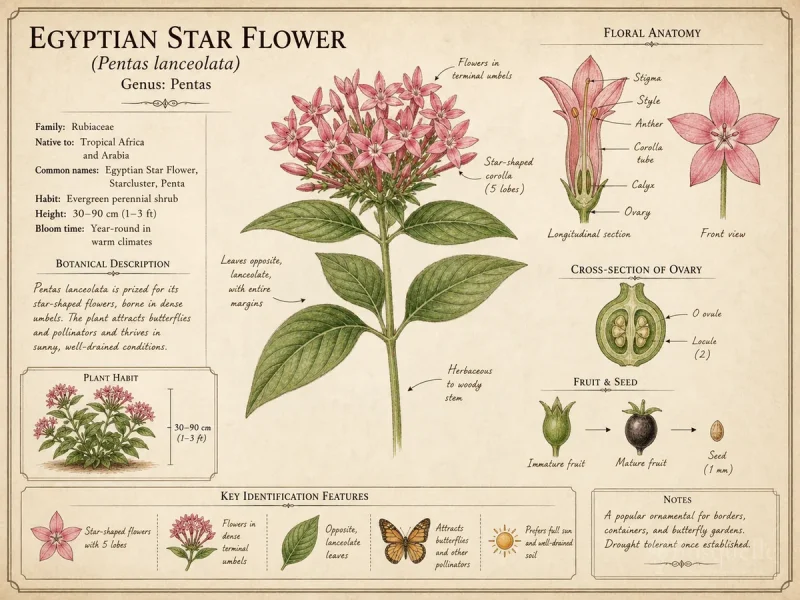
Grow pentas in full sun and summer heat. Garden centers sell it under that Latin name, or as Egyptian star flower — a heat-loving summer plant, not Star of Bethlehem, which is a spring bulb.

Give it full sun, heat, and soil that stays moist but drains
| Factor | Recommended | Avoid |
|---|---|---|
| Sun | Full sun, at least six hours a day. More sun means more bloom | Do not site it in shade — stems stretch and flower heads stay thin |
| Heat | Wait until nights stay warm and the soil has warmed before you expect strong growth | Do not set plants out before the last frost — growth stalls in cold soil |
| Soil | Moist loam or amended sand that drains after rain. Slightly acidic to neutral | Do not plant in a low wet spot — soggy soil around the roots causes rot |
| Water | Keep new plants evenly moist until they root in, then water when the top inch of soil is dry | Do not let a new transplant wilt in the first heat wave, and do not keep established roots soggy |
| Wildlife | Leave the flower heads open — butterflies and hummingbirds work them all season | Do not spray open blooms; that is when pollinators visit |
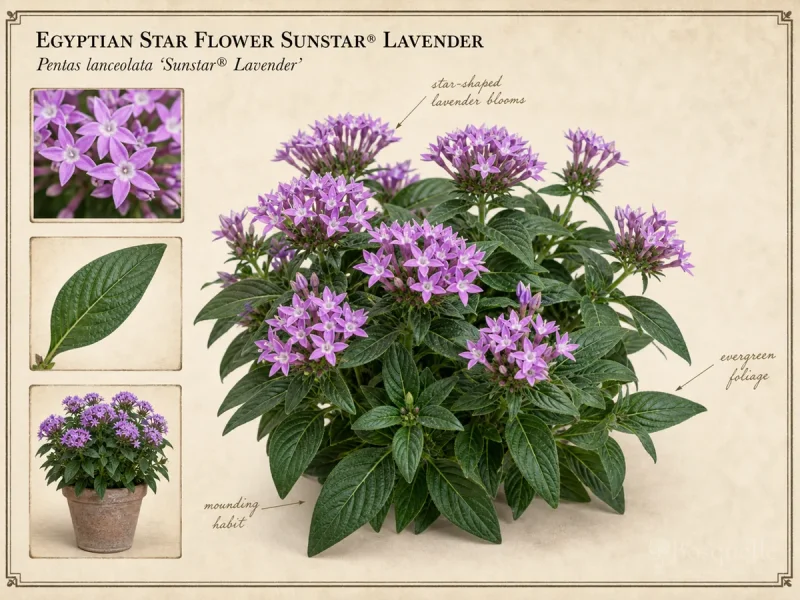
Pentas wants a full day of sun and the same heat that fades cool-season annuals. [1] Growth stalls below about 55 °F, so the plant barely moves until the ground is warm. Water a new plant regularly for the first couple of weeks. After that, water when the top inch is dry. Established plants take a short dry spell, but a wilt that yellows the lower leaves costs weeks of bloom. [2] Butterfly Deep Pink and Sunstar Lavender use that same sun and water. When you are ready to set a transplant, see Planting Pentas. A patio pot is on Pentas in Pots.
Does pentas need full sun?
Yes. Give it at least six hours of direct sun. In shade the stems stretch and bloom drops off. In the hottest inland summers, a little afternoon shade is fine as long as the morning is bright.
How often should I water pentas?
Keep the soil evenly moist for the first two to three weeks. After that, water when the top inch is dry. Plants in containers dry out faster than those in the ground.
Are pentas deer resistant?
This catalog does not list pentas as deer-resistant. If deer pressure is high in your yard, protect new plants. Do not treat them as a deer-proof bedding crop.
Do rabbits eat pentas?
This catalog does not list pentas as rabbit-resistant. Rabbits may browse young plants and flower buds. Protect new transplants if rabbits are active in the bed.
Deadhead spent clusters so it keeps blooming until frost
Pentas is not self-cleaning. Spent heads stay on the plant, and new clusters slow if you leave them. [3] Snip each faded cluster just above a pair of healthy leaves. Do this through the season, about once a week once bloom is heavy, so the plant keeps pushing new heads until frost. Young plants also branch better if you pinch the tips once when they are 4 to 6 inches tall. [4] That delays the first bloom by a week or two and pays off in a bushier plant with more flower stems.
- When a young plant is 4 to 6 inches tall, pinch the growing tips to force side branches. Skip this if the plant is already branching well.
- As clusters fade, cut the spent stem just above a leaf pair or a side shoot. Use clean snips.
- Work around the plant once a week at peak bloom so brown heads do not sit and set seed.
- Water after a heavy round of cutting if the soil is dry.
- Where pentas lives as a perennial, cut the whole plant back after the main flush in late fall or before spring growth, so it does not go woody and sparse.
Does pentas need deadheading?
Yes. It is not self-cleaning. Snip spent clusters above a leaf pair so new heads keep coming until frost. A midseason hard cut is only needed if the plant has gone tall and thin.
Should I pinch pentas?
Pinch once when young plants are 4 to 6 inches tall if you want a denser mound. After that, regular deadheading is the cut that matters.
Sow seed on the surface — do not cover it
Most shop plants, including the Butterfly and Sunstar series we list, are sold as transplants. Seed is the Graffiti and Lucky Star path, not those named cuttings. If you do sow, press the seed onto moist mix and leave it uncovered. Pentas needs light to germinate. Start indoors about seven to ten weeks before the last frost. Seedlings usually appear in two to three weeks in a warm, bright spot, then they need strong light so they do not stretch.
- Fill a tray with a fine, draining seed mix. Moisten it before you sow.
- Press the seed onto the surface. Do not cover it.
- Keep the mix evenly moist and warm until you see seedlings.
- Move them into strong light as soon as they are up. Harden them off, then plant them out after frost on Planting Pentas.
Can I grow pentas from seed?
Yes, if you can find seed. Press it on the surface and do not cover it. Named Butterfly and Sunstar plants in the shop are usually bought as starts, not grown from seed.
Not Star of Bethlehem — Egyptian star flower is a summer plant
Egyptian star flower is a marketing name for pentas. Star of Bethlehem is a different plant: a spring-flowering bulb in the genus Ornithogalum, with grassy leaves and white stars that come up from a bulb, then go dormant. See How to Grow Ornithogalum. Pentas is a tropical subshrub that you plant after frost and that peaks in summer heat. If you bought a bag of bulbs labeled Star of Bethlehem, you have a spring bulb, not pentas. If you bought a six-pack labeled pentas or Egyptian star flower, plant it when the soil is warm and keep it watered through the heat.
Is Egyptian star flower the same as Star of Bethlehem?
No. Egyptian star flower is pentas, a summer bedding plant. Star of Bethlehem is Ornithogalum, a spring bulb. They share a star-shaped bloom and nothing else in the care calendar.
If bloom thins, check sun first, then whether spent clusters are sitting on the plant. A weekly snip keeps new heads coming.
FAQ
Is pentas a perennial or an annual?
In frost-free gardens it can live as a tender perennial and bloom most of the year. Where frost hits, grow it as an annual and replant each spring. A pot you can carry inside is on Pentas in Pots.
Can I take cuttings from a shop plant?
Named Butterfly and Sunstar plants are usually vegetative shop stock, and some series are patented. Check the tag before you root a cutting. Non-patented plants root from softwood tips in a draining mix. Most gardeners north of frost-free zones find it easier to buy new plants in spring.
Are there compact pentas?
Seed series such as Graffiti and Lucky Star stay shorter than the Butterfly and Sunstar plants in this catalog, which are landscape types. Read the tag for height. Care is the same sun, moisture, and deadheading.
Are pentas toxic to pets?
Pentas is not treated as a toxic plant in the sources we opened. Still keep pets from chewing ornamental foliage, and do not confuse the tag with Star of Bethlehem, which is a different genus.
Related guides


Recommended plants


References
- [1] Garden Design -
https://www.gardendesign.com/annuals/pentas.html - [2] NC State Extension Gardener -
https://plants.ces.ncsu.edu/plants/pentas-lanceolata/ - [3] Epic Gardening -
https://www.epicgardening.com/pentas/ - [4] Gardening Know How -
https://www.gardeningknowhow.com/ornamental/flowers/pentas/growing-penta-plants.htm
This note is part of Pentas Guides.
More first-season notes by plant are gathered in How to Grow Guides.
Updated: Reviewed by Bosquelle Editors