
Ornithogalum bulbs rot in wet winter clay and stay leafless in deep shade. Grow them in full sun to light part sun, in soil that drains. Water while leaves and flowers grow. Stop when foliage yellows. All parts are toxic if eaten. This page covers site, water, the spring-star vs summer-hyacinth split, and spread. Star of Bethlehem is the usual spring star — it can fill a lawn. Planting depth lives on Planting Ornithogalum.
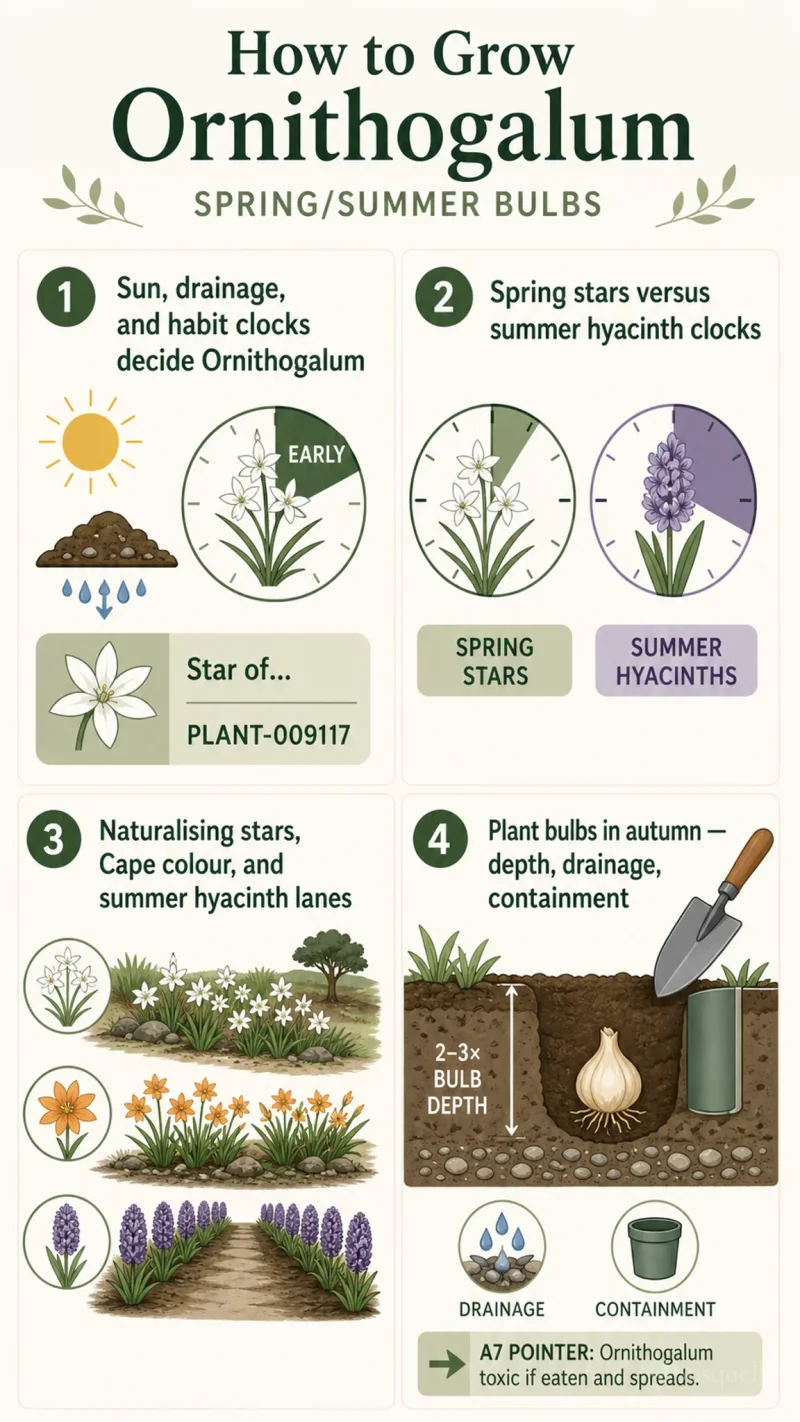
Sun, drainage, and habit clocks decide Ornithogalum
| Factor | Recommended | Avoid |
|---|---|---|
| Light | Full sun to light part sun | Deep shade (lean stems, thin bloom) |
| Soil | Well-drained loam or sandy loam; grit or a raised bed on clay | Waterlogged winter clay |
| Water | Even moisture while in growth; none after foliage yellows | Summer watering on dormant bulbs |
| Spread | A bed edge if you do not want a lawn colony | Open turf for O. umbellatum when spread is unwelcome |
North Carolina Extension: plant in fall, about 10 cm deep, in rich well-drained soil in full sun. Keep the soil evenly moist in growth. The same site rule covers spring stars and summer hyacinth: open light, air at the bulb, no standing water.
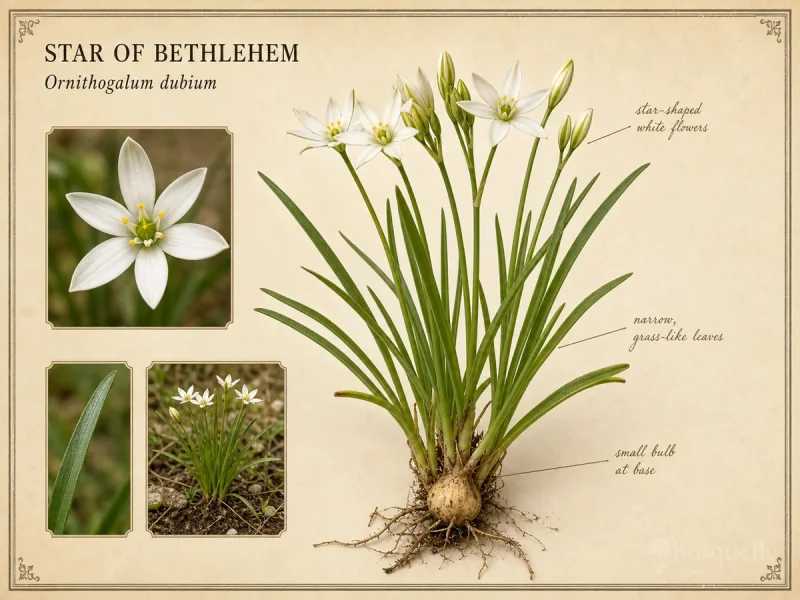
Star of Bethlehem shows why spread is a site choice. It makes white spring stars, then the leaves yellow. Offsets can fill lawns and meadows. Plant it only where you want a drift or can keep an edge. Chincherinchee (Chincherinchee) and summer hyacinth (Summer Hyacinth) need the same drainage. They do not share that lawn-filling habit.
Water to settle new plantings. Keep the soil moist through bloom. When leaves yellow after flowering, withhold water. Leave the foliage until it withers so the bulb can recharge. Do not cut green leaves to tidy the bed. Ice cubes do not belong on these bulbs.
Read the growth clock from the leaves, not from the calendar. Green strap leaves mean the bulb is still charging. Soft yellow collapse means rest has started. Extra water in rest does not force a second bloom. It only sits around the basal plate and invites rot.
If stars have naturalised in grass, delay the first close mow until those leaves yellow. Scalping green foliage starves the bulb for next spring. In a border, you can hide the same dying leaves with a low skirt rather than cutting them early.
Rain on sharp-draining soil is usually fine. The fail is sealed clay plus a summer irrigation valve that never turns off. Group these bulbs with other sun-and-drain spring bulbs, not with bog plants on the same line.
Feed lightly if at all. Compost at planting is enough. Heavy nitrogen on wet soil invites soft growth and rot.
Ornithogalum species are widely listed as toxic to cats, dogs, and livestock if bulbs or foliage are eaten. Store spare bulbs in a closed bag, not in a pet-reachable shed tray. Keep plantings away from grazing and from pets that dig. This is ornamental stock, not forage.
Spring partners and edges: Ornithogalum Companion Plants. Autumn depth and spacing: Planting Ornithogalum.
Spring stars versus summer hyacinth clocks
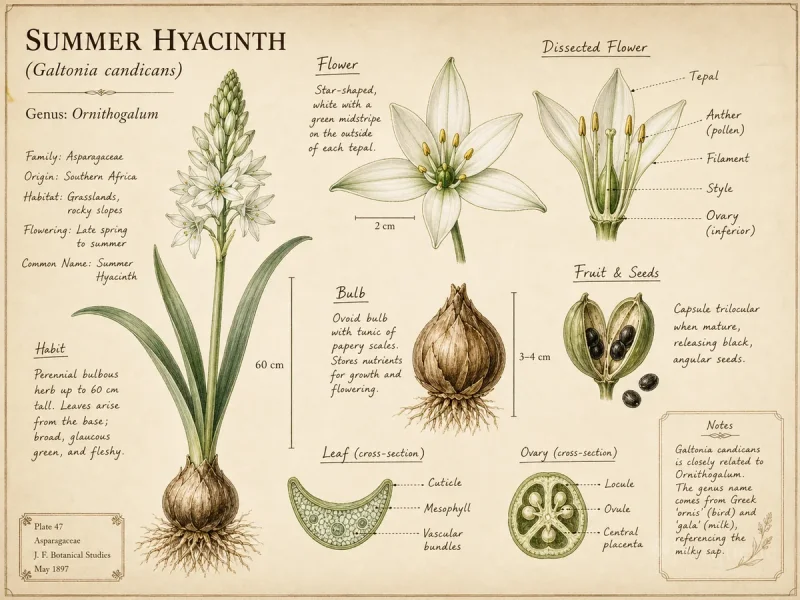
Spring star-of-Bethlehem types bloom early to late spring, then go quiet. Chincherinchee and Cape colour bloom late spring into early summer. Summer hyacinth is a taller white spike in summer — same genus shelf, different calendar. Confirm Latin on the tag. A star-of-Bethlehem label does not tell you which clock you bought.
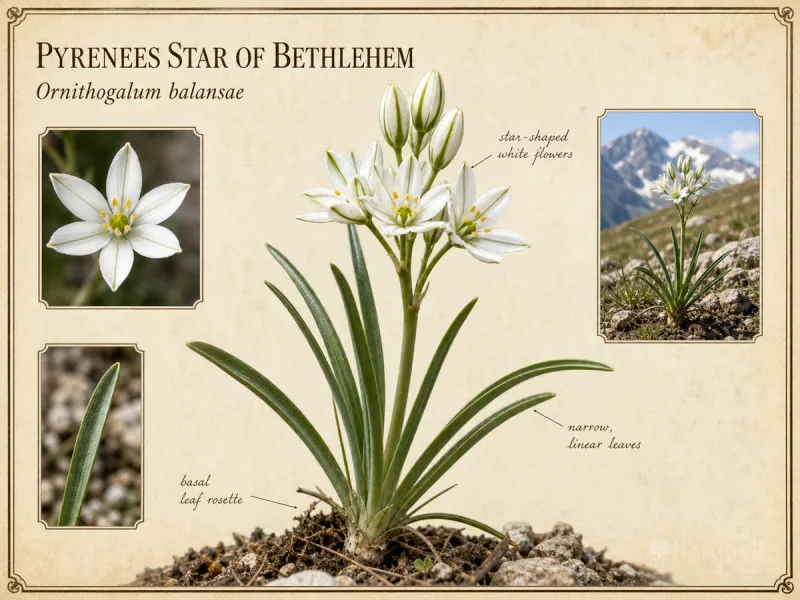
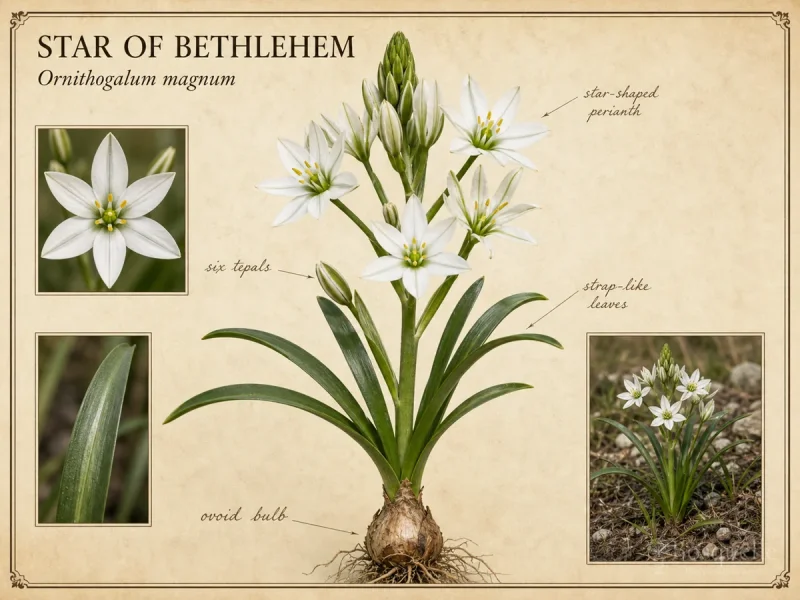
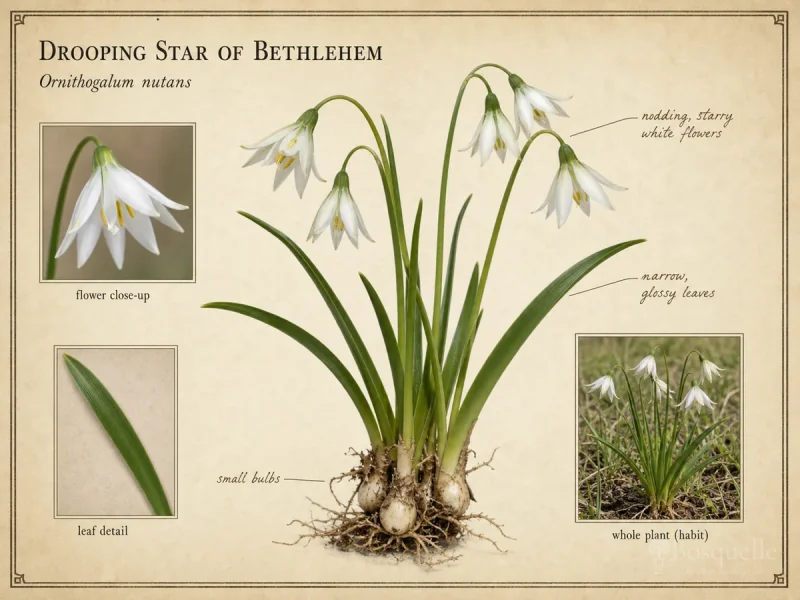
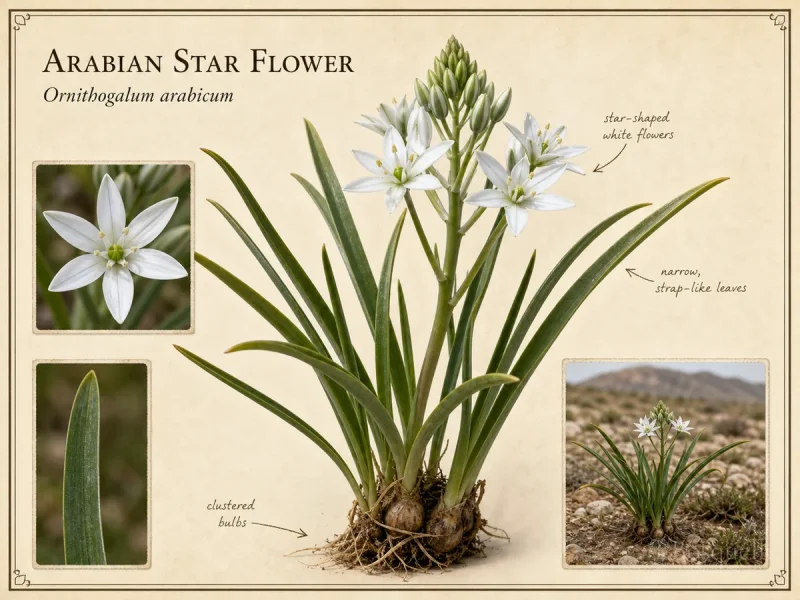
Spring faces include Star of Bethlehem, Drooping Star of Bethlehem, Pyrenees Star of Bethlehem, Ornithogalum magnum, and Arabian Star Flower. Cape cut colour is Chincherinchee and Orange Star Flower. Summer hyacinth is Summer Hyacinth (often sold as Galtonia candicans). All want sun and drainage. Habit band does not change toxicity.
- Sun plus sharp drain — the shared contract.
- Winter wet on sealed clay — rot.
- Umbellatum in a lawn you want clean — weedy spread.
- Pets or livestock that eat bulbs — wrong plant.
Open flowers draw bees. That does not make the bed safe to graze.
Do not expect spring-star foliage to stay through summer. After bloom, the leaves yellow and the pocket looks empty until autumn planting marks or a partner skirt takes over. Summer hyacinth is the face that still occupies height later. Mixing those two calendars in one unmarked bed is how gardeners spear resting bulbs in June.
A first-year planting can bloom lightly even when site and drainage are right. Keep spring moisture even, then honour the rest. Volume often improves once bulbs have a full recharge cycle. That is not a reason to keep watering after the leaves have collapsed.
Naturalising stars, Cape colour, and summer hyacinth lanes
Naturalising spring stars (Star of Bethlehem, Drooping Star of Bethlehem, Pyrenees Star of Bethlehem) own early white or green-backed stars and increase by offsets. Star of Bethlehem has the strongest weedy reputation. Border spring faces (Ornithogalum magnum, Arabian Star Flower) hold mid-height spring stars. Chincherinchee (Chincherinchee) and Orange Star Flower carry cut-flower white and orange-yellow. Summer Hyacinth owns the tall summer spike.
Failure signs: soft bulbs after a wet winter; umbellatum in turf you meant to mow as lawn; pets digging bulbs; empty summer beds with no partner after spring yellowing; shade-lean stems.
Soft, smelly bulbs after a wet winter mean drainage failed, not that you under-watered in April. Lift what is left in a dry spell, discard the mush, and replant firm stock into grit or a raised bed. Do not “rescue” rot with more water.
Lean, pale stems and few stars usually mean shade or a crowded clump, not a missing fertiliser recipe. Move the pocket into open light, or lift and space in autumn. Height still differs by band: dwarf early stars sit far below a 0.6–1.2 m summer spike.
After bloom, leave foliage until it yellows. Cut only when it is soft and spent. Spent flower stems can come off once they brown; green leaf straps stay until they collapse on their own.
Plant bulbs in autumn — depth, drainage, containment
- Buy firm bulbs with Latin on the packet.
- Refuse soft or mouldy stock.
- Choose full sun with sharp drainage.
- Raise or grit heavy clay so winter water can leave.
- Plant 8–15 cm deep, pointy end up, in autumn.
- Space for a drift, not a sealed wet clump.
- Give Star of Bethlehem an edge if lawn spread is unwelcome.
- Water once to settle the soil.
- Mulch lightly, not a wet blanket on the neck.
- Mark the pocket so summer plants do not spear resting bulbs.
First-year bloom can be light until bulbs settle. Dormancy still arrives on schedule. Full depth and spacing: Planting Ornithogalum.
This page only covers the overview plant-out. Depth by bulb size, spacing in centimetres, soil prep, and when to lift live on the planting essay. Do not copy a daffodil recipe (much deeper) onto these smaller bulbs. Pointy end up, 8–15 cm, then water once to settle.
If autumn weather stays wet, wait for a workable day rather than forcing bulbs into mud. A week later in still-open soil beats a wet clay smear that seals the basal plate.
Containers are possible only if the pot drains freely and is deep enough for 8–15 cm of mix over the bulb. A sealed saucer is the same fail as winter clay. This page does not replace a dedicated pots essay; the drainage rule does not change in a pot.
Browse species bands before you buy
Eight catalog faces are enough to choose a habit band — not enough for eight care essays. Skim here; open Types of Ornithogalum for the choose table and band cards.
Naturalising spring: Star of Bethlehem, Drooping Star of Bethlehem, and Pyrenees Star of Bethlehem. Plan containment first for umbellatum.
Border spring: Ornithogalum magnum and Arabian Star Flower — mid-height stars without the same lawn-invasion reputation.
Chincherinchee / Cape and summer hyacinth: Chincherinchee, Orange Star Flower, and Summer Hyacinth. Latin and calendar beat a generic star-of-Bethlehem slogan.
Partners: Ornithogalum Companion Plants. Planting: Planting Ornithogalum. Types: Types of Ornithogalum.
- Naturalising spring stars → umbellatum / nutans / balansae
- Border spring stars → magnum / arabicum
- Chincherinchee / Cape colour → thyrsoides / dubium
- Summer hyacinth → Galtonia / O. candicans
- Livestock-safe forage → skip this genus
What usually works: full sun, sharp drainage, and a containment plan. What usually fails: winter wet, umbellatum in unreclaimed lawn, pets digging bulbs, or partners that keep dormant bulbs wet.
If a bench labels everything “star of Bethlehem” without Latin, ask for Ornithogalum (or Galtonia) and the habit band before you pay. Packet height is a useful check: a 15 cm dwarf star and a metre-class summer spike are not interchangeable even when both packets show white flowers.
Buy for the job you can keep next year, not for a one-week vase photo. Naturalisers need an edge or a meadow you accept. Border stars need a marked pocket. Cape colour and summer hyacinth need the same sun and drain, plus a frost plan where winters freeze hard. Care does not change by paint; calendar and spread do.
FAQ
Is star of Bethlehem the same as Ornithogalum?
Star of Bethlehem is a common name for several Ornithogalum species, especially O. umbellatum. Prefer Latin on the tag. Summer hyacinth is often Galtonia / O. candicans.
Is chincherinchee different from star of Bethlehem?
Chincherinchee usually means Ornithogalum thyrsoides. Star of Bethlehem often points at O. umbellatum. Confirm Latin.
Is Ornithogalum toxic to cats or livestock?
Yes. Bulbs and foliage are toxic if eaten by cats, dogs, or livestock. Keep plantings away from pets that dig and from grazing.
Does Ornithogalum need wet soil?
No. Sharp drainage, even moisture through growth and bloom, then a drier rest after foliage yellows. Winter wet on clay risks rot.
Is star of Bethlehem invasive?
O. umbellatum can naturalise in lawns and open ground in many regions. Other species multiply more slowly. Plan containment by type.
How is summer hyacinth different?
Summer hyacinth (Galtonia / Ornithogalum candicans) is a taller summer white spike, not the early-spring star calendar of classic star of Bethlehem.
When should I plant Ornithogalum bulbs?
In autumn, into full-sun, well-drained ground. Depth and spacing: Planting Ornithogalum.
What grows well next to Ornithogalum?
Spring partners that share sun and drainage, and neighbours that help contain naturalisers without keeping bulbs wet. See Ornithogalum Companion Plants.
Sun or shade for Ornithogalum?
Full sun to light part sun with sharp drainage. Deep shade leans stems and thins stars.
Where do I compare species types?
Types of Ornithogalum sorts naturalising spring stars, border spring, chincherinchee / Cape colour, and summer hyacinth. This page owns sun, drainage, toxicity, and spread.
Related guides


Recommended plants


This note is part of Ornithogalum Guides.
More first-season notes by plant are gathered in How to Grow Guides.
Updated: Reviewed by Bosquelle Editors