
Grow Osage orange in full sun, on soil that drains, and water it through the first seasons. Osage orange is Maclura pomifera, also sold as hedge apple — not a citrus orange.

Give it full sun and soil that drains, and water it through the first seasons
| Factor | Recommended | Avoid |
|---|---|---|
| Light | Full sun, at least six hours a day | Do not hide it in deep shade if you want a dense crown |
| Soil | Soil that drains; clay, loam, sand, and poor ground are fine | Do not leave a young tree in a hole that stays wet |
| Water | Water a new tree through the first seasons, then only in a long dry spell | Do not keep an established tree on a soggy lawn |
| Kind | Buy a male, thornless tree for a yard; use the thorny wild type only for a living fence | Do not plant a fruiting female over a walk, a drive, or a parked car |
| Room | Leave about 30 to 60 feet of height and spread for a shade tree | Do not crowd a shade tree against a house or a power line |
Osage orange is Maclura pomifera, a thorny deciduous tree with shiny simple leaves and milky sap. Full sun and soil that drains are what it needs. Water a new tree through the first seasons, then ease off; an established tree takes a dry spell better than a wet hole. [1] The female tree drops bumpy green fruit the size of a softball, often called a hedge apple. That fruit is inedible, and the milky juice can irritate skin, so a male tree is the better choice over a walk. [2] This is a 30- to 60-foot shade tree, or a shorter living fence if you keep it cut. It is not a citrus orange and not a patio houseplant.
- Choose full sun and soil that drains. Standing water is the main reason a young tree fails.
- Leave about 30 to 60 feet of height and spread for a shade tree. A living fence is planted much closer, then cut back each winter.
- Water through the first seasons, then water again only when a long dry spell hits.
- Keep a mulch ring over the roots, and keep that mulch off the trunk.
How do you grow Osage orange?
Give it full sun and soil that drains, and water it through the first seasons. Buy a male tree for a yard if you do not want hedge apples on the walk.
What kind of soil does Osage orange grow in?
Soil that drains. Clay, loam, sand, and poor ground are fine. Do not leave the roots in a hole that stays wet.
How tall does Osage orange get?
About 30 to 60 feet tall and wide as a shade tree. A living fence stays much shorter if you prune it.
Plant a young tree in spring, with the flare at grade
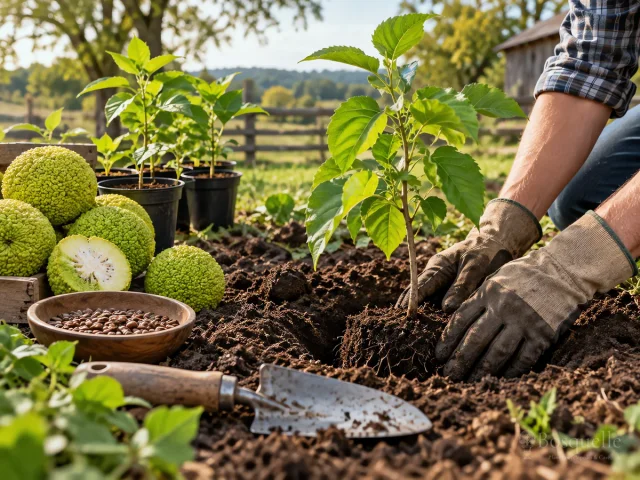
Osage orange takes well when it is still a young nursery tree. Set the root flare at the soil line, in a hole no deeper than the root ball and two to three times as wide. [3] Plant in spring, or in fall while the ground is still workable. Backfill with the native soil. Do not pack a rich compost pocket under a tree that already takes ordinary ground. For a living fence, set the plants a few feet apart along the line; the heading cuts come in late winter.
- Plant in spring, or in fall while the soil is still workable and a hard freeze is not due.
- Dig a hole no deeper than the root ball, and two to three times as wide.
- Set the flare at the soil line. Backfill with the native soil, water to settle it, and mulch off the trunk.
- Leave a shade tree well off a house, a walk, and a power line. For a hedge, space the plants a few feet apart along the row.
When should I plant Osage orange?
Plant in spring, or in fall while the ground is still workable. Set the flare at the soil line.
Prune a hedge in late winter, and wear heavy gloves
Osage orange was planted as a living fence because the thorns and dense shoots stop livestock. Wear heavy gloves, long sleeves, and full-length pants; the thorns are sharp, and the milky sap can irritate skin. [4] Cut in late winter, before new growth starts. A hedge is headed back every year so it stays bushy. A shade tree keeps one strong leader, with side branches spaced along the trunk. Cut new shoots at the base, because this tree suckers freely.
- Put on heavy gloves and long sleeves before you reach into the thorns.
- For a living fence, cut the row back in late winter so it stays dense and shorter than a shade tree.
- For a shade tree, keep one leader and cut competing upright stems. Space the side branches along the trunk.
- Cut dead, broken, or rubbing wood, and take suckers at the base every year.
When do I prune Osage orange?
In late winter, before new growth. Head a hedge so it stays bushy. Keep one leader on a shade tree, and cut suckers at the base.
Not a citrus orange — and not yellowwood
A grocery orange is Citrus, an evergreen fruit tree that is not hardy in a cold yard. Osage orange is a deciduous native with simple leaves, thorns, and bumpy green fruit that nobody eats. If the tag says navel, Valencia, or citrus, read How to Grow Citrus.
Yellowwood is Cladrastis, a pea-family shade tree with hanging white flowers. Some lists print yellowwood on Osage orange; that name belongs to Cladrastis. If the tag says Cladrastis or Kentucky yellowwood, read How to Grow Yellowwood. Mulberry is Morus, in the same family, but it has no stout thorns and the fruit looks like a blackberry — see How to Grow Mulberry. Mock orange is Philadelphus, a spring-flowering shrub, not a hedge apple; see How to Grow Mock Orange. Honey locust is Gleditsia, with tiny ferny leaflets and branched trunk thorns; see How to Grow Honey Locust. If the tag says Maclura pomifera, you have Osage orange.
Is Osage orange a real orange?
No. A grocery orange is Citrus. Osage orange is Maclura, a thorny deciduous tree with inedible hedge apples.
Is Osage orange the same as yellowwood?
No. Yellowwood is Cladrastis, with hanging white pea flowers. Osage orange is Maclura. Some lists reuse the yellowwood name; trust the Latin on the tag.
Plant the young tree this spring, water it through the first seasons, and make the first hedge cuts in late winter.
FAQ
Can I grow Osage orange in a pot?
Only as a nursery start. It is a 30- to 60-foot tree. Move it into the ground while it is still young.
Do you list White Shield or Wichita?
This catalog holds Osage orange. White Shield, Wichita, and Park are extra names, not extra cards here. Read the tag for a male, thornless tree if you want a yard without hedge apples.
Does Osage orange need winter protection?
An established tree drops its leaves and stays in the ground. Do not lift it like a tender pot plant.
Do hedge apples keep spiders out of the house?
No. Whole fruit in a room does not keep spiders or insects out. Leave the fruit on the ground, or pick it up because it is messy, not as a spray.
Related guides
Recommended plants

References
- [1] NC State Extension Gardener -
https://plants.ces.ncsu.edu/plants/maclura-pomifera/ - [2] Iowa State University Extension -
https://yardandgarden.extension.iastate.edu/how-to/all-about-hedge-apples - [3] The Morton Arboretum -
https://mortonarb.org/plant-and-protect/trees-and-plants/osage-orange/ - [4] Gardening Know How -
https://www.gardeningknowhow.com/ornamental/trees/osage-orange/pruning-osage-orange-trees.htm
This note is part of Maclura Guides.
More first-season notes by plant are gathered in How to Grow Guides.
Updated: Reviewed by Bosquelle Editors