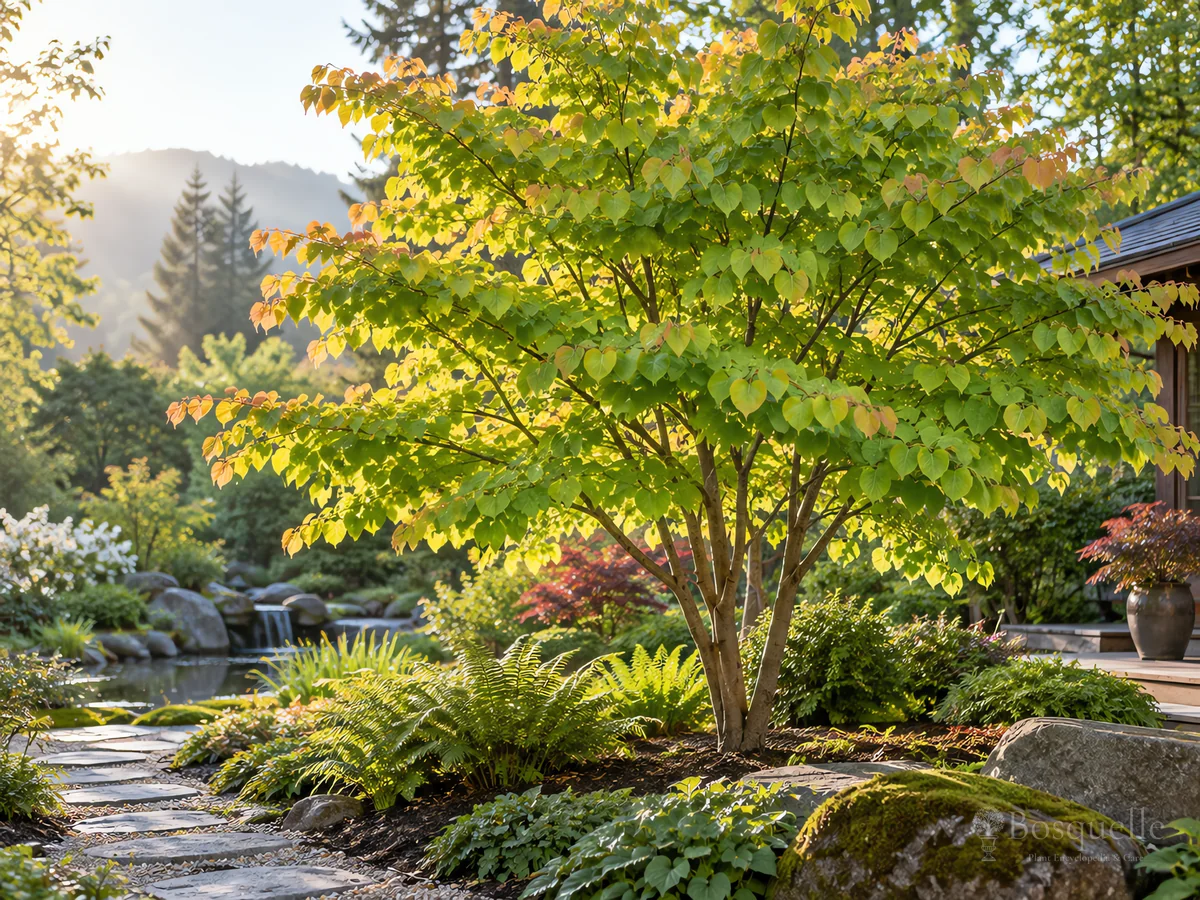
Grow a katsura tree in moist soil that drains, with room for a 40-foot shade tree, and water it through dry spells so the heart-shaped leaves do not scorch. Katsura tree is Cercidiphyllum japonicum.

Give it moist soil that drains, and keep the roots cool
| Factor | Recommended | Avoid |
|---|---|---|
| Light | Full sun, or a little afternoon shade in a hot site | Do not site it in a hot, dry wind |
| Water | Water through dry spells, especially the first years | Do not let the soil stay dry around the shallow roots |
| Soil | Moist soil that drains | Do not plant it where the ground stays dry |
| Size | About 40 to 50 feet tall and 25 to 35 feet wide | Do not crowd it against a walk or a small bed |
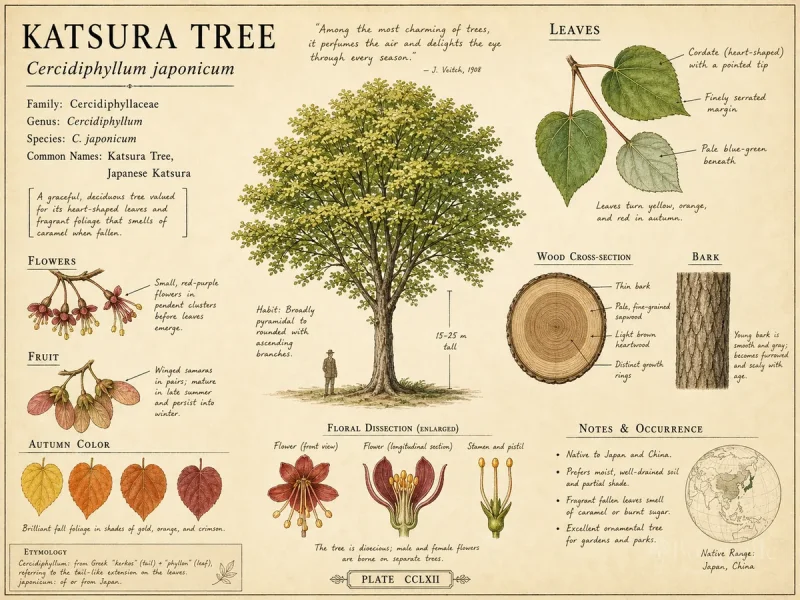
Katsura Tree is a deciduous shade tree about 40 to 50 feet tall and 25 to 35 feet wide. Leaves come out reddish, turn blue-green, then apricot or yellow in fall. Fallen leaves can smell like caramel or burnt sugar. [1] A katsura tree wants even moisture and soil that drains. Give it a weekly soak through the first summers if rain is short, then keep watering in a long dry spell, because dry wind and heat brown the leaf edges. [2] Keep a mulch ring so the shallow roots stay cool. Skip extra fertilizer the first year. [3]
How do you grow a katsura tree?
Give it moist soil that drains, room to reach about 40 feet, and water in dry spells so the leaves do not scorch.
How do you care for a katsura tree?
Keep the soil evenly moist, mulch the roots, and water deeply when a dry spell hits. Brown leaf edges in summer usually mean the roots dried out.
How big does a katsura tree get?
A mature tree is about 40 to 50 feet tall and about 25 to 35 feet wide. Leave that room so the canopy can fill in.
Why do katsura leaves smell like caramel?
The fallen autumn leaves give off a caramel or burnt-sugar scent. That is the fallen foliage, not a kitchen crop.
Why are the leaf edges turning brown?
Dry soil, hot wind, or a harsh afternoon sun scorches the edges. Water deeply and keep mulch over the roots.
Plant it in spring, with the root flare at soil level
Plant a young nursery tree in spring so the roots can grow before summer heat. Set the flare where the trunk widens at soil level, not buried in a deep hole.
- Plant in spring, while the tree can still put on roots before a hot dry spell.
- Dig a hole as deep as the root ball and about twice as wide. Do not bury the flare.
- Set the top of the root ball level with the soil, firm it, and water it in.
- Spread about 2 inches of mulch over the roots, and keep the mulch off the trunk. Water about once a week the first summer unless rain already soaks the soil. [4]
When should a katsura tree be planted?
Plant it in spring. A young tree settles better before summer heat than a large tree moved in midsummer.
Prune in late winter, while the tree is still bare
A katsura needs little pruning once the framework is in. Cut in late winter, while the branches are still easy to see.
- Wait until late winter or early spring, while the tree is still dormant.
- Cut dead, crossing, or rubbing branches back to a collar or a side branch.
- Take off a low limb only if you need clearance under the canopy. Do not shear the tree into a hedge.
Do I need to prune a katsura tree every year?
No. Check it in late winter and cut dead or crossing wood. Skip a yearly shape prune unless a limb hangs in a walk.
How to start a new tree from seed
Nurseries usually start katsura from seed. Collect the small pods from a female tree in fall, then sow the winged seed on moist mix that drains.
- Collect ripe pods in fall from a female tree. Male trees do not set seed.
- Sow the thin, winged seed on the surface of a moist mix that drains, and press it in. Do not bury it deep.
- Keep the mix moist, not soggy, until seedlings show.
- Grow the seedling through a season before you plant it out, and keep watering it the first summers in the ground.
Can I grow a katsura tree from seed?
Yes. Sow the winged seed from a female tree on moist mix that drains, and keep the mix from drying out until it sprouts.
A stem cutting is slower than seed
A stem cutting can work, but seed is the usual start. If you take a cutting, use a short piece of summer wood, stick it in a mix that drains, and keep that mix barely moist until roots hold.
Not a redbud — and not a Japanese maple named Katsura
A redbud is Cercis. The heart-shaped leaves look similar, but redbud leaves sit alternate on the stem, and katsura leaves sit opposite. If the tag says redbud or Judas tree, read How to Grow Redbud.
Japanese maple ‘Katsura’ is an Acer, a smaller colored maple, not this shade tree. If the tag says Japanese maple, read How to Grow Maples. Pieris ‘Katsura’ is an evergreen shrub sold as Japanese andromeda; that keep-alive is How to Grow Japanese Andromeda.
Weeping or dwarf katsura names on a nursery tag are still this genus. They want the same moist soil. They are not a second species in this shop.
What is a katsura tree?
It is Cercidiphyllum japonicum, a deciduous shade tree with opposite heart-shaped leaves. It is not a redbud and not a Japanese maple.
Is a katsura tree the same as a redbud?
No. Redbud is Cercis. Katsura leaves sit opposite on the stem. Redbud leaves sit alternate.
If the leaf edges brown in summer, water deeply and thicken the mulch so the roots stay cool.
FAQ
Can I grow a katsura tree in a pot?
A nursery pot is how a young tree is sold, not a houseplant. Plant it in the ground. A 40-foot shade tree will not stay in a patio pot.
Is weeping katsura a different tree?
Weeping katsura is still Cercidiphyllum japonicum. It wants the same moist soil. It is not a second species here.
Does a katsura tree need winter protection?
An established tree drops its leaves and stays in the ground. Water it in a dry fall. Do not lift it like a tender pot plant.
Are katsura trees poisonous to dogs?
This tree did not show up on the pet-plant lists we opened. Keep pets from chewing landscape plants as a habit.
Recommended plants
References
- [1] NC State Extension -
https://plants.ces.ncsu.edu/plants/cercidiphyllum-japonicum/ - [2] The Morton Arboretum -
https://mortonarb.org/plant-and-protect/trees-and-plants/katsura-tree/ - [3] Oregon State University -
https://landscapeplants.oregonstate.edu/plants/cercidiphyllum-japonicum - [4] White Flower Farm -
https://www.whiteflowerfarm.com/how-to-grow-cercidiphyllum
More first-season notes by plant are gathered in How to Grow Guides.
Updated: Reviewed by Bosquelle Editors