
Grow Joseph's coat as Alternanthera, a frost-tender foliage plant with burgundy or mixed-color leaves. It is not amaranth Joseph's coat, not Acalypha copperleaf, and not Iresine bloodleaf.

Give it full sun, even moisture, and soil that drains
| Factor | Recommended | Avoid |
|---|---|---|
| Light | Full sun for the strongest leaf color; part sun is tolerated | Do not site it in shade if you bought it for purple or burgundy leaves |
| Water | Keep the soil evenly moist through the growing season | Do not let the mix dry out, and do not leave the pot standing in water |
| Soil | Moist soil that drains, in a bed or a pot with a hole | Do not plant it in a bog or in a mix that stays soggy |
| Site | A border front, an edging strip, or a patio pot you can water | Do not treat it as a dry-slope shrub |
| Feed | Skip extra fertilizer unless growth stalls; a little compost is enough | Do not dump nitrogen every week |
Joseph's coat wants full sun and soil that stays moist but still drains. The leaves color up in sun. They fade toward green in shade, so a burgundy plant in a north bed will not look like the tag. [1] Water often enough that the mix never dries out. A wilted plant usually recovers after you water it, but a soggy pot rots the roots. Do not fertilize on a calendar. Extra feed is not what keeps the color. Joseph's coat is grown for those leaves, not for the small white or green flowers tucked in the axils.
How much sun does Joseph's coat need?
Give it full sun for the strongest color. Part sun is tolerated, but purple leaves fade toward green in shade.
How often do I water it?
Water so the soil stays evenly moist. Do not let the mix dry out, and do not leave the pot standing in water.
Plant after frost, or grow it in a pot you can move
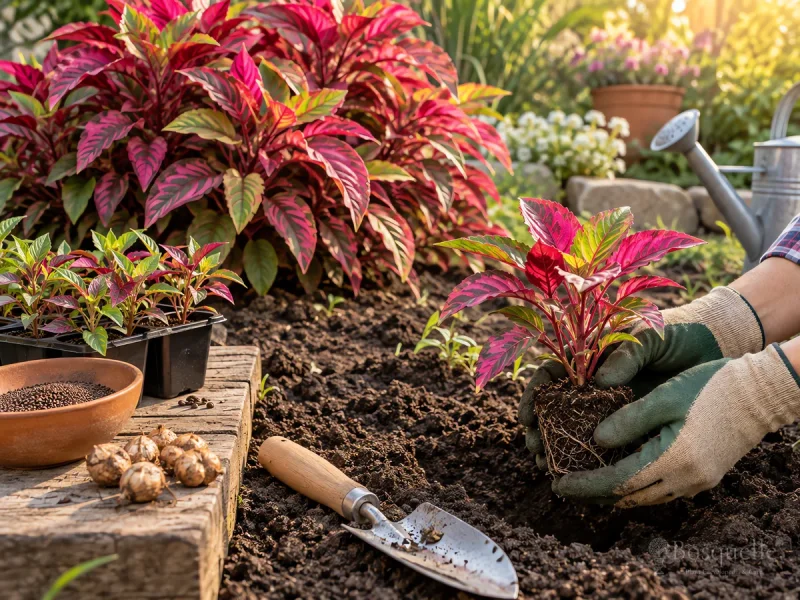
A nursery pot is the usual start. Set the plant out after frost, at the same depth it grew in the pot, and keep the soil moist while it takes. A pot with a drainage hole is the easier way to bring the plant in before a freeze. If you want the same leaf color next year, take a cutting before frost on How to Propagate Joseph's Coat.
- Wait until a couple of weeks after the last frost, when nights stay warm.
- Dig a hole as deep as the pot and a little wider, and loosen the soil around it.
- Set the crown at the same depth it grew in the pot. Space plants about 12 inches apart if you will shear them as one mass, or 18 to 24 inches if each mound should read as its own plant. [2]
- Water to settle the soil, then keep the mix evenly moist. In a pot, use a container with a hole, and move it indoors before a freeze if you want to keep that plant.
When do I plant it outdoors?
Plant after frost, once nights stay warm. Set the crown at the same depth it grew in the pot.
Can I grow it in a pot?
Yes. Use a pot with a drainage hole, keep the mix evenly moist, and move it inside before a freeze if you want to keep it.
Pinch the tips so it stays a mound
Pinch the growing tips as the plant runs, so it branches instead of sprawling open. If you want a neater edge, shear it in summer. Do not wait for flowers. The show is the leaves.
- Pinch the stem tips as soon as the plant starts to stretch. [3]
- Shear the mound if it opens or flops later in the season, then keep watering so new leaves color up in sun.
- Skip a hard cut in cold weather. Frost ends the outdoor plant.
Do I prune Joseph's coat?
Pinch the tips through the season so it stays a mound. Shear it if the plant opens. Do not wait for flowers.
Not amaranth, not copperleaf, and not bloodleaf
Amaranth Joseph's coat is Amaranthus, a taller annual grown from seed, often 2 to 4 feet, with large blotched leaves. This plant is the lower bedding shrublet. See How to Grow Amaranth if the tag is Amaranthus or the seedling is already waist-high. [4] Copperleaf in the shrub aisle is Acalypha — see How to Grow Chenille Plant. Bloodleaf is Iresine, a different foliage annual with red stems; a tag that says bloodleaf on this plant is still Alternanthera only if the leaves match Joseph's coat. The climbing rose named Joseph's Coat is a rose, not this foliage plant. Alligator weed is an invasive wet-site relative — do not plant it, and do not dump trimmings in a ditch. An aquarium parrot-leaf stem is a different species kept underwater, not this garden bed. Bright calico kinds can look like coleus; coleus is a different plant — see How to Grow Coleus.
Is this the same as amaranth Joseph's coat?
No. Amaranth Joseph's coat is a tall annual from seed. This plant is Alternanthera, a lower bedding foliage plant.
Set Joseph's coat in full sun on moist soil that drains, and pinch the tips through the season.
FAQ
Is Little Ruby a different plant?
Little Ruby and Purple Knight are compact or taller burgundy forms of the same species. Party Time and other calico tags are usually the same sun, moisture, and pinch job. Read the tag for the size you bought.
Can I keep it indoors all year?
It can sit in a bright, sunny window if you keep the mix moist. Most gardeners treat it as a summer outdoor plant and start fresh from cuttings each spring.
Will pets get sick if they chew it?
This plant is grown for foliage, not for eating. Keep pets from grazing the bed. Call a veterinarian if a pet eats a lot of any ornamental plant.
Related guides
Recommended plants

References
- [1] NC State Extension -
https://plants.ces.ncsu.edu/plants/alternanthera-dentata/ - [2] University of Georgia Extension -
https://fieldreport.caes.uga.edu/news/josephs-coat-provides-nonstop-landscape-color/ - [3] Illinois Extension -
https://extension.illinois.edu/flowers/alternanthera - [4] Walter Reeves -
https://www.walterreeves.com/landscaping/josephs-coat-identification/
This note is part of Alternanthera Guides.
More first-season notes by plant are gathered in How to Grow Guides.
Updated: Reviewed by Bosquelle Editors