
Grow island marlberry as a native Florida evergreen shrub or small tree. Island marlberry is Ardisia, also sold as marlberry or marbleberry. If the tag says coral ardisia or a houseplant Ardisia, that is a different plant.

Give it part sun to full sun, and soil that drains
| Factor | Recommended | Avoid |
|---|---|---|
| Sun | Part sun to full sun. It still grows in shade, but it flowers more with some sun | Do not expect a full flower show in deep shade |
| Soil | Moist sand, loam, or limestone that drains. Acid to alkaline is fine | Do not plant it where water sits around the roots |
| Water | Water through the first year. Once the roots are down, water only in a long dry spell | Do not skip the first-year water just because the shrub is drought-tolerant later |
| Salt | Salt wind and a light spray are fine | Do not plant it where salt or brackish water floods the roots |
| Room | Twelve to twenty feet of height for a hedge, a screen, or a small tree | Do not treat it as an eight-inch groundcover or a windowsill pot |
island marlberry wants part sun to full sun and soil that drains. It grows twelve to twenty feet, with glossy leaves and white or pink flower clusters. [1] Water a new plant until it is established. After that it holds a dry spell, so long as the soil is not a swamp. [2] Salt wind is fine. Standing salt water is not.
How much sun does island marlberry need?
Part sun to full sun. It still grows in shade, but it flowers more when it gets some sun.
How often do I water a new plant?
Water through the first year. Once the roots are down, water only in a long dry spell. Do not keep the roots in standing water.
Will it take salt spray?
Salt wind and a light spray are fine. Do not plant it where salt or brackish water floods the roots.
Plant at the same depth as the pot, 3 to 5 feet apart for a hedge
Plant a container shrub at the same depth it sat in the pot. For a hedge or screen, space plants three to five feet apart so the canopy can close. If you want a row of small trees, leave about fifteen feet between trunks so you can lift the lower branches later.
- Water the pot, then let it drain. Dig a hole as deep as the root ball and a little wider, on ground that drains.
- Set the top of the root ball even with the soil. If the roots circle the pot, tease them outward so they can grow into the bed.
- For a hedge, space plants 3 to 5 feet apart. For a small tree, leave about 15 feet between trunks.
- Backfill, firm gently, and water well. Mulch around the shrub, not against the stems. Keep the soil moist until new growth shows.
How far apart do I plant a hedge?
Three to five feet apart for a hedge or screen. Leave about fifteen feet if you want a row of small trees.
Prune it as a hedge, or lift the lower branches for a small tree
Clip or shear the shrub to the hedge height you want. It stays dense even in part shade, so a screen holds. To train a small tree, cut off the lower foliage and branches so the trunks show. The wood is weak, so do not train it as a street tree that has to take a hard hit.
- Shear or clip to the hedge size you want. You can do this whenever the shrub is outgrowing the bed.
- To make a small tree, cut the lower branches off close to the trunks so the bark can show.
- Do not leave a heavy limb over a walk. The wood breaks more easily than a live oak.
How do I train a small tree?
Cut the lower branches off close to the trunks so the bark can show. Leave about fifteen feet between trunks if you plant a row.
Not coral ardisia — and not Japanese marlberry
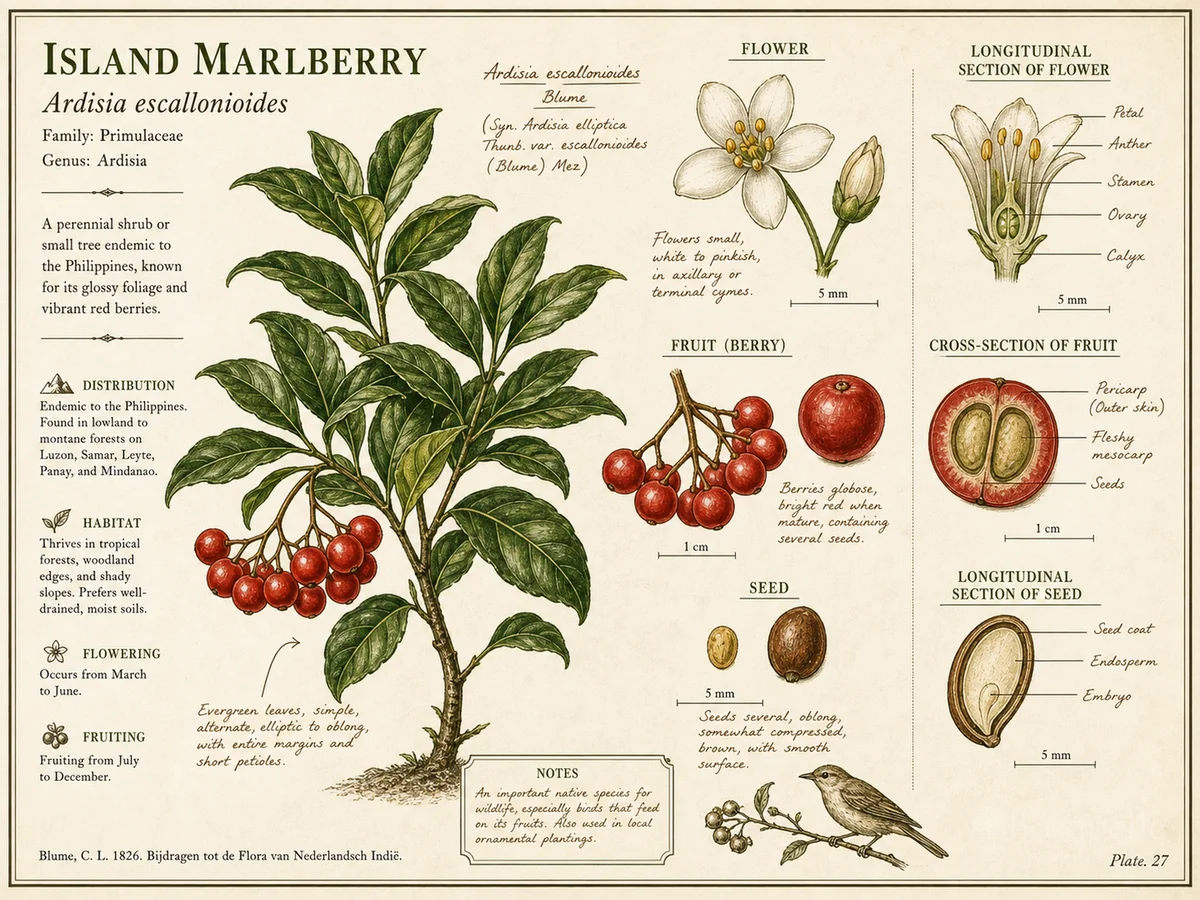
Coral ardisia is a different, invasive shrub with wavy, blunt-toothed leaves and clusters of bright red berries that hang on for months. Island marlberry has smooth entire leaf edges. Its fruit starts green or red and turns shiny black when it is ripe. Shoebutton ardisia is another invasive cousin, with larger pink-purple flowers. Do not plant those two, and pull them if they show up. [3]
Japanese ardisia is also sold as marlberry. That plant is an eight-to-twelve-inch groundcover that spreads by rhizomes in shade. It is not this twelve-to-twenty-foot hammock shrub. [4] Coralberry on a northern tag is often Symphoricarpos, a deciduous snowberry — see How to Grow Snowberry if the fruit is pink-purple on a suckering thicket, not a Florida evergreen.
Is this coral ardisia?
No. Coral ardisia has wavy, blunt-toothed leaves and bright red berries. This native has smooth leaf edges and fruit that ripens black.
Is this Japanese marlberry?
No. Japanese ardisia is an eight-to-twelve-inch groundcover also sold as marlberry. Island marlberry is a native shrub or small tree.
How to grow island marlberry from seed
A new plant starts from a ripe black fruit. Take the fruit from the shrub, not from the ground, and squeeze the pulp off the hard seed. Sow in moist mix in light shade. Some seeds never sprout, so sow more than one and wait.
- Pick ripe, shiny black fruit from the shrub. Fruit that has sat on the ground is often insect-damaged.
- Squeeze the pulp off each hard seed. Do not sow the whole berry.
- Sow in a moist mix in light shade, and keep the mix moist. Wait. Some seeds never sprout.
Can I grow it from seed?
Yes. Take ripe black fruit from the shrub, squeeze the pulp off the seed, and sow in moist mix in light shade. Some seeds never sprout.
Plant it this season in part sun, on ground that drains, water until it takes, and clip it to a hedge or lift the lower branches.
FAQ
Can I grow it as a houseplant?
No. This is a twelve-to-twenty-foot landscape shrub. The houseplant sold as Ardisia is usually coral ardisia, an invasive with red berries.
Can I grow it in a pot?
A large pot can hold a young shrub for a season on a patio, but it wants to become a hedge or a small tree in the ground. Keep the mix draining.
Can I eat the berries?
Ripe black pulp is edible. Eat only fruit you have identified as this native, and do not eat the hard seed. Do not eat coral ardisia's red berries.
When does it bloom?
Fragrant white or pink clusters open at intervals through the year, often more in summer and fall. Fruit follows and ripens black.
Recommended plants
References
- [1] UF/IFAS Extension -
https://ask.ifas.ufl.edu/publication/FP048 - [2] Institute for Regional Conservation -
https://www.regionalconservation.org/beta/nfyn/PD_PFriendly.asp?tx=Ardiesca - [3] Florida Wildflower Foundation -
https://www.flawildflowers.org/flower-friday-ardisia-escallonioides/ - [4] Clemson Home & Garden Information Center -
https://hgic.clemson.edu/factsheet/japanese-ardisia/
More first-season notes by plant are gathered in How to Grow Guides.
Updated: Reviewed by Bosquelle Editors