
Grow Indian warrior in sun to light shade, in soil that drains, among living woody hosts such as manzanita. The plant in this catalog is Pedicularis densiflora — also called warrior's plume. It is not the big-bluestem cultivar of the same name, and it is not Indian paintbrush.
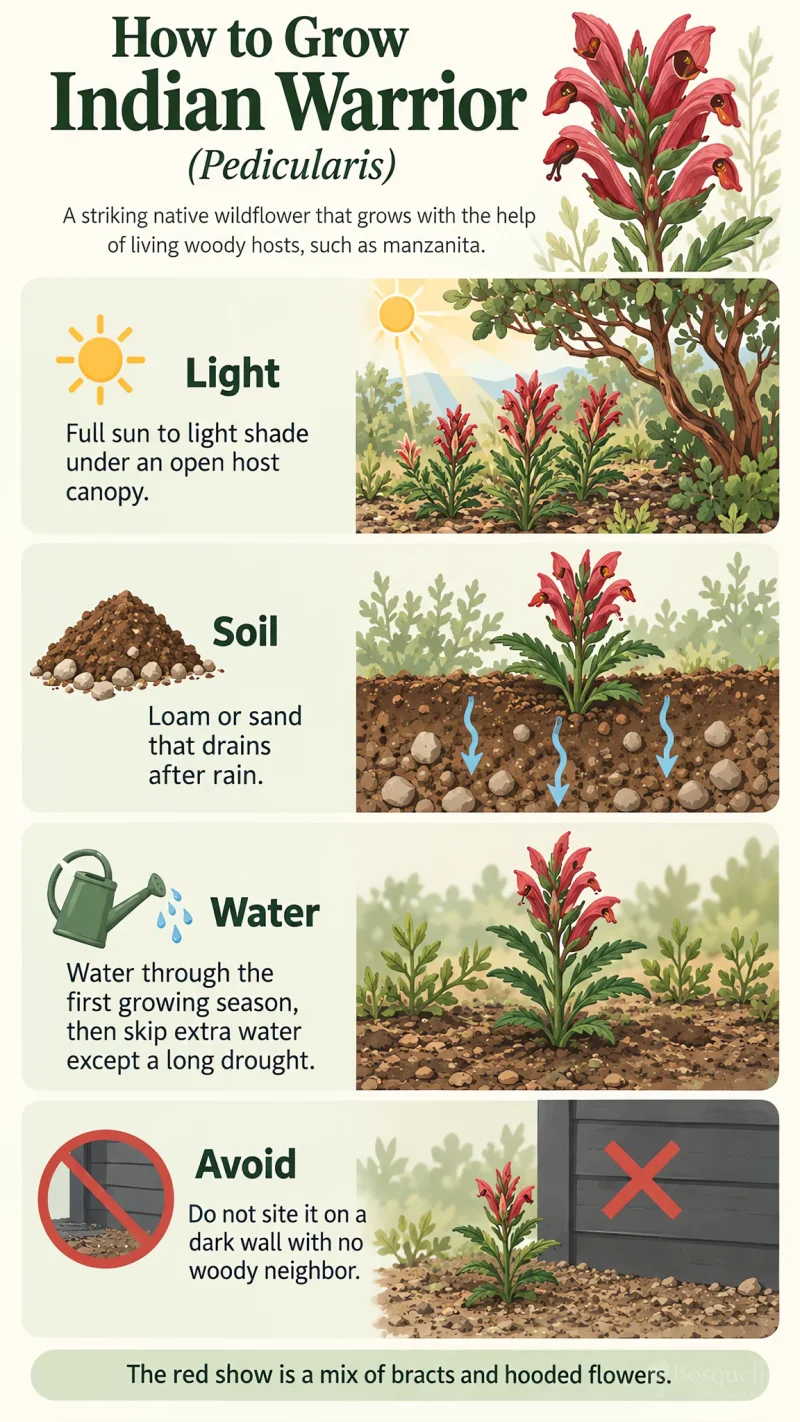
Give it sun, soil that drains, and a living woody host
| Factor | Recommended | Avoid |
|---|---|---|
| Light | Full sun to light shade under an open host canopy | Do not site it on a dark wall with no woody neighbor |
| Soil | Loam or sand that drains after rain | Do not plant it in a hole that stays soggy |
| Host | Sow among living manzanita, madrone, chamise, or oak roots already in the ground | Do not sow into empty bark mulch with no neighbor roots |
| Water | Water through the first growing season, then skip extra water except a long drought | Do not keep the crown wet after the plant is attached |
| Size | Leave room for about 1 to 2 feet of stem | Do not treat it as a tall screen grass |
Indian warrior is a California chaparral perennial with fern-like basal leaves and a dense spike of deep red flowers. It makes some of its own food, but it also taps neighboring woody roots through small connections called haustoria, most often manzanita, and sometimes chamise or oak. [1] Without a host it can still germinate, but the plant stays small and yellow. [2] Give it an open site that can dry between rains. Soggy ground around the crown is the primary cause of rot, not a missed watering after the plant is settled. For the shrub itself, see How to Grow Manzanita.
- Set it in full sun to light shade where a woody host already grows.
- Use soil that drains. Loam or sand is fine; a low wet pocket is not.
- Water through the first growing season so the seedling can find a host root.
- After that, skip extra water except a long drought. Do not fertilize.
How much sun does Indian warrior need?
Full sun to light shade. It often sits at the edge of manzanita or oak, not in deep shade with no host.
Does it need a host plant?
Yes for a reliable stand. Seedlings can sprout alone, but they stay weak unless they connect to woody roots. An empty bark bed is a poor bet.
Does drought bother it?
Skip extra water once it is attached to a host. A long dry spell is normal chaparral weather. Do not keep the crown wet.
When does Indian warrior bloom?
In spring. The show is a short flush of red spikes, not evergreen structure.
Sow in fall at the host's roots — do not transplant
Buy seed, not a dug wild clump. Moving a plant usually breaks the connection to its host, and nursery plugs of this species are rare. Sow where the plant will stay.
- Choose an established woody host already in the ground — manzanita, madrone, chamise, or oak.
- Sow outside in fall so winter cold and moisture break dormancy. If you chill the seed yourself, keep it cold and moist for about 30 days, then sow. [3]
- Scatter the seed at the drip line, among the host roots, and cover it with a dusting of soil. Press for contact. Do not bury it deep.
- Keep the seedbed lightly moist through germination. Do not feed.
- Leave the seedlings in place. Do not transplant. Do not dig plants from a wild stand.
When do I sow Indian warrior?
Fall is the usual window. The seed overwinters in the ground. Pre-chilled seed can go in after about 30 days cold and moist. Skip a hot midsummer sowing.
Can I transplant Indian warrior?
Usually no. Digging breaks the host connection, and the plant often dies. Sow where you want the stand.
Not Indian paintbrush — and not the big-bluestem named Indian Warrior
Indian paintbrush is Castilleja, a related hemiparasite whose show comes from colored bracts, not from fern-like leaves. If the tag says paintbrush, read How to Grow Paintbrush. [4] The big-bluestem sold as Indian Warrior is Andropogon gerardii, a tall prairie grass with turkey-foot seed heads. If the tag says bluestem or Andropogon, read How to Grow Big Bluestem. This catalog plant is the red chaparral spike with cut, fern-like leaves.
Is it the same as Indian paintbrush?
No. Paintbrush is Castilleja. This plant has fern-like leaves and a dense red spike. Both tap host roots, but they are not the same plant.
Is it the big-bluestem named Indian Warrior?
No. That is a tall prairie grass. This Indian warrior is a short chaparral wildflower. Read the Latin name on the tag.
The red show is a mix of bracts and hooded flowers. Look close: the true petals sit among the bracts on a short spring spike.
FAQ
Is there more than one kind of Indian warrior?
This catalog holds Pedicularis densiflora. Wood betony is usually Pedicularis canadensis, an eastern woodland plant we do not list. Elephanthead is another Pedicularis we do not list.
Can I grow it in a pot?
Only as a short trial with a host seedling in the same container, in a mix that drains. A patio pot without woody roots is unreliable. Empty the saucer.
Can I take cuttings or divide it?
Do not count on stem cuttings, and do not split a clump. The reliable start is seed sown at a living host.
Is it the same as Indian mallow?
No. Indian mallow is usually Abutilon, a different plant. This Indian warrior is Pedicularis densiflora.
Does it come back every year?
Yes as a perennial crown, if the host and drainage stay in place. The top dies back after bloom. New leaves return from the crown.
Can I use it as tea?
Do not harvest wild plants for tea, and do not brew the leaves. Buy seed if you want a garden stand.
Is it toxic to pets?
Keep pets from chewing leaves you cannot identify. Do not assume a wildflower is safe to eat.
Recommended plants

References
- [1] Las Pilitas Nursery -
https://www.laspilitas.com/nature-of-california/plants/3409--pedicularis-densiflora - [2] Wikipedia -
https://en.wikipedia.org/wiki/Pedicularis_densiflora - [3] Klamath Siskiyou Native Seeds -
https://klamathsiskiyouseeds.com/product/pedicularis-densiflora-warrior-plume/ - [4] Friends of Edgewood -
https://friendsofedgewood.org/warriors-plume
More first-season notes by plant are gathered in How to Grow Guides.
Updated: Reviewed by Bosquelle Editors