
Grow Indian pink in part shade, in moist soil that still drains. The plant is Spigelia marilandica, a woodland clump with scarlet tubes and a yellow star — not cardinal flower, and not a sun pink.
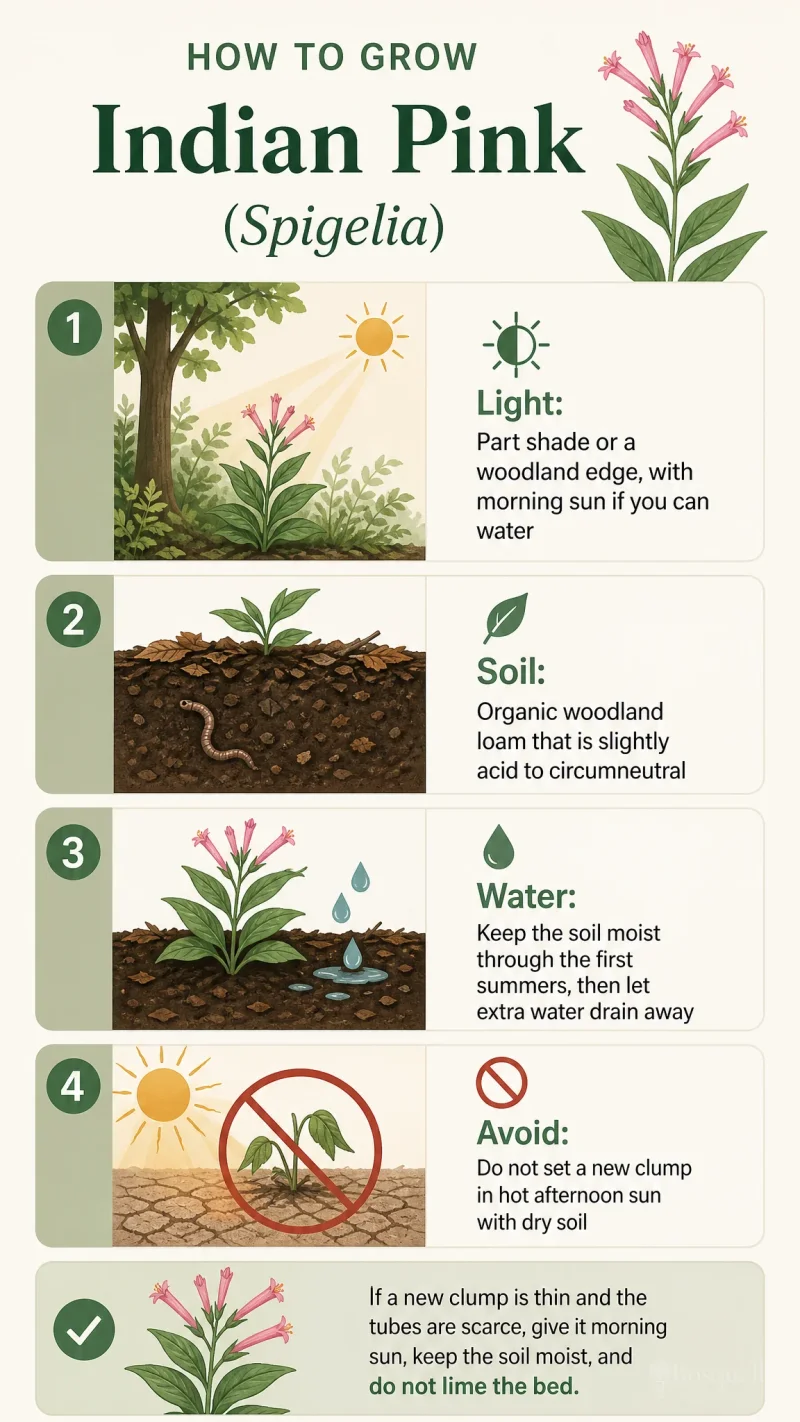
Give it part shade and moist soil that still drains
| Factor | Recommended | Avoid |
|---|---|---|
| Light | Part shade or a woodland edge, with morning sun if you can water | Do not set a new clump in hot afternoon sun with dry soil |
| Water | Keep the soil moist through the first summers, then let extra water drain away | Do not let a new planting bake dry, and do not leave the crown in a hole that stays wet |
| Soil | Organic woodland loam that is slightly acid to circumneutral | Do not lime the bed, and do not plant into packed mineral dirt alone |
| Size | Leave room for a 1 to 2 foot clump, about 12 to 18 inches from its neighbor | Do not treat it as a fast hedge |
Indian pink is Spigelia marilandica. It wants part shade and an organic layer that stays moist, then drains. Deep shade makes taller, thinner stems with fewer tubes. A woodland edge or morning sun makes a denser clump and more bloom, as long as you water in heat. [1] Hummingbirds work the scarlet tubes. The mouth of each tube flares into a yellow five-point star, which is the usual way to know you have this plant and not a wet-meadow spike. [2] Once the clump is settled, a short dry spell is tolerated. A new plant still needs even moisture through the first summers, because that is when a hot, dry bed stalls it. Do not lime the bed. The roots take in slightly acid to circumneutral ground, and lime pushes the soil the wrong way.
How much sun does Indian pink need?
Give it part shade or a woodland edge. Morning sun is fine if you keep the soil moist. Hot afternoon sun on dry ground stalls a new clump.
How do I water Indian pink in the ground?
Keep the soil moist through the first summers, then let extra water drain away. A settled clump can take a short dry spell. A soggy hole around the crown is a problem.
Plant in fall or spring, with the crown even with the soil
Plant a bought clump in fall, or in spring after the soil has warmed, into an organic bed in part shade. Set the crown even with the surrounding soil. Do not bury it, and do not drop it into a lime hole in the open.
- Pick part shade, or a woodland edge you can water. Hot, dry full sun at planting is the usual reason a new clump stalls.
- Work leaf compost or pine-bark fines into the top several inches of the bed. Do not lime, and do not amend only the planting hole.
- Slide the nursery clump out. Set it even with the soil. Do not bury the crown.
- Water it in, mulch lightly, keep that mulch off the crown, and keep the bed moist through the first summers. Space clumps about 12 to 18 inches apart.
How do I plant Indian pink?
Plant in fall or spring, in part shade, with the crown even with the soil. Water it in, and keep the bed moist through the first summers.
Not cardinal flower — and not dianthus or catchfly
Cardinal flower is Lobelia cardinalis, a taller wet-meadow plant with two-lipped red spikes later in the year. Indian pink is a 1 to 2 foot woodland clump. Each tube is scarlet outside and yellow inside, and the mouth opens as a five-point star in late spring. Read How to Grow Lobelia if the plant wants wet ground and a tall spike.
Chinese pink is Dianthus, a sun plant with pinked petals, not a woodland tube. Read How to Grow Dianthus if the tag is a bedding pink. Southern Indian pink is Silene laciniata, a western catchfly with fringed petals. Read How to Grow Silene if the plant wants a dry, bright bed.
Dragon's mouth is Arethusa, a bog orchid. Read How to Grow Dragon's Mouth if the plant is a single pink orchid in sphagnum, not a scarlet woodland tube.
Is Indian pink the same as cardinal flower?
No. Cardinal flower is a taller wet-meadow spike. Indian pink is a shorter woodland clump with scarlet tubes and a yellow star at the mouth.
Pick off spent tubes so the next ones keep opening
The cluster opens from the bottom up, so the lowest tubes fade while upper buds are still closed. Pinch those spent flowers so the plant keeps opening the rest of the cluster, instead of rushing into seed. [3] After the whole flush is finished, you can cut the stems back by about half. That often brings a smaller later bloom. [4] Do not shear the clump like a hedge, and do not cut into the crown in late winter when the plant is still underground.
- Watch the lowest tubes fade first. Pinch or snip each spent flower while upper buds are still closed.
- When the whole cluster is done, cut those stems back by about half if you want a later flush.
- Leave the glossy leaves in place through the growing season. They feed the crown.
- When the tops die in fall, cut dead stems to the ground, or wait until spring. Do not dig around the crown in late winter, because new shoots are late and easy to nick.
Should I deadhead Indian pink?
Yes. Pinch spent tubes so the next buds keep opening. After the flush, you can cut the stems back by half for a later bloom.
If a new clump is thin and the tubes are scarce, give it morning sun, keep the soil moist, and do not lime the bed.
FAQ
Is there more than one kind of Indian pink?
Spigelia marilandica is the plant here. Indian pink is the shop name. Woodland pinkroot and Carolina pink are the same clump. Compact named selections are still this species, not a second type in this catalog.
Can I grow Indian pink in a pot?
A pot dries too fast unless you can keep it in part shade and water it often. A woodland bed is the usual home.
Can I dig Indian pink from the woods?
Buy a nursery plant. Wild stands are uncommon in parts of its range, and collecting them is not the way to start a bed.
Is Indian pink poisonous?
Yes, if it is eaten. Keep pets and children from chewing the stems, leaves, or roots. Do not make a tea or a worm medicine from the plant.
How do I get more plants?
Divide a three-year clump in early summer. That method is on How to Propagate Indian Pink.
Related guides

Recommended plants

References
- [1] NC State Extension Gardener -
https://plants.ces.ncsu.edu/plants/spigelia-marilandica/ - [2] Clemson HGIC -
https://hgic.clemson.edu/factsheet/indian-pink/ - [3] Lady Bird Johnson Wildflower Center -
https://www.wildflower.org/plants/result.php?id_plant=SPMA3 - [4] University of Kentucky Nursery Crops -
https://nursery-crop-extension.mgcafe.uky.edu/content/spigelia-marilandica-propagation
This note is part of Spigelia Guides.
More first-season notes by plant are gathered in How to Grow Guides.
Updated: Reviewed by Bosquelle Editors