
Grow gloxinia in bright indirect light, and keep the mix evenly moist while it is in leaf. Florist gloxinia is Sinningia speciosa.
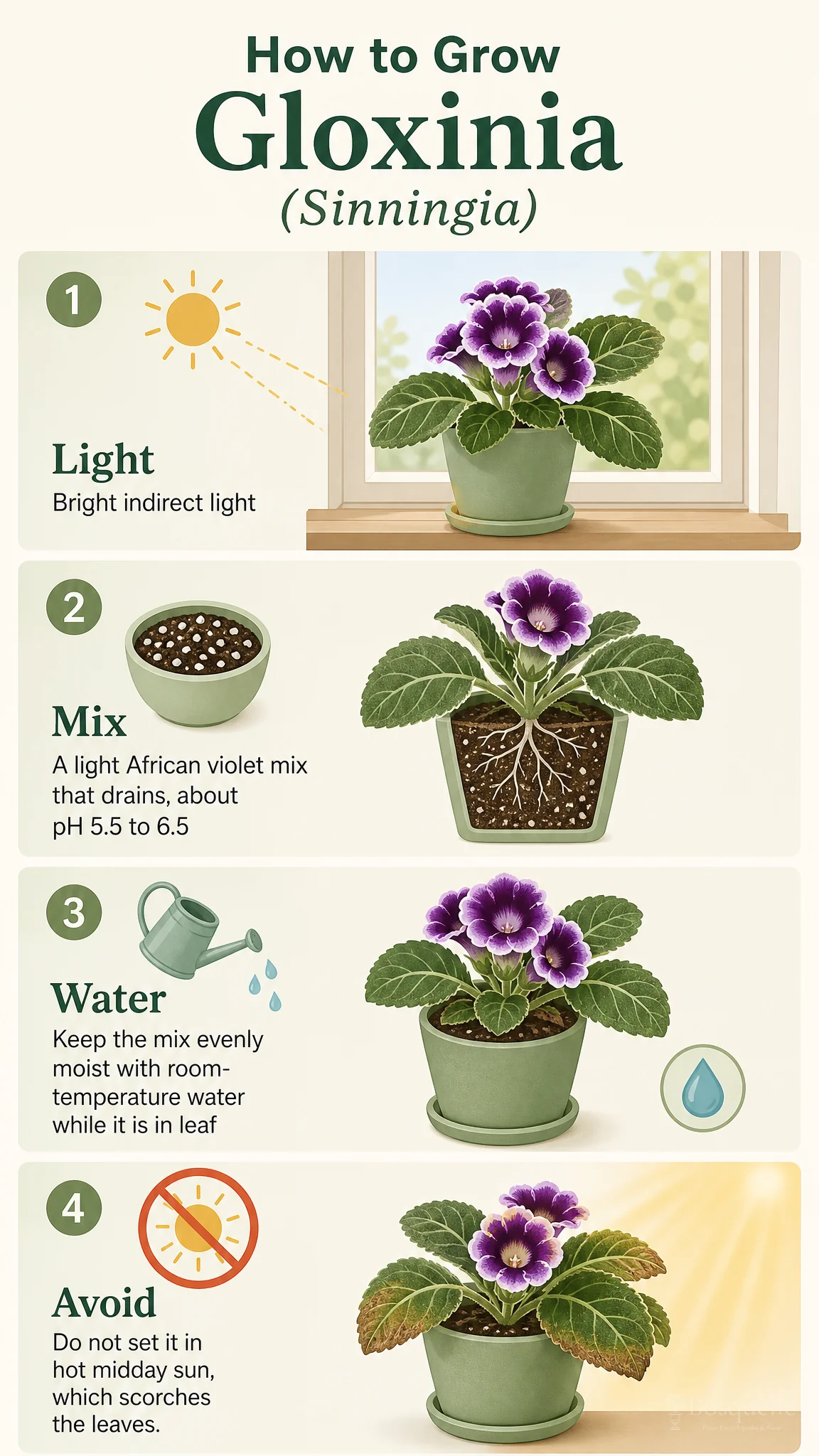
Give it bright indirect light, keep the mix evenly moist, and water the soil not the leaves
| Factor | Recommended | Avoid |
|---|---|---|
| Light | Bright indirect light; an east window, or a south or west window just beyond direct sun | Do not set it in hot midday sun, which scorches the leaves |
| Water | Keep the mix evenly moist with room-temperature water while it is in leaf | Do not wet the leaves or the crown, and do not let the mix dry while it is growing |
| Mix | A light African violet mix that drains, about pH 5.5 to 6.5 | Do not use heavy garden soil |
| Temperature | Ordinary indoor warmth, about 65 to 75°F, with nights near 65°F | Do not set it in a cold draft or on a heating vent |
| Humidity | A tray of moist pebbles under the pot | Do not mist the velvety leaves |
| Feed | A balanced liquid feed while it is growing and blooming, mixed as the label says | Do not feed a dry, resting tuber |
| Pot | A four- to five-inch pot with a drainage hole | Do not grow it in a pot with no hole |
gloxinia is a Brazilian houseplant that blooms from a tuber. Give it bright indoor light with no direct sun, and keep the mix evenly moist while leaves are up, because a dry spell drops buds and a soggy crown rots. [1] Water onto the mix, not the foliage, and use room-temperature water, because cold drops leave brown spots that do not wash off. [2] A florist pot bought in late winter or spring can bloom for several weeks if that mix stays evenly moist. [3] It wants more light than an African violet, so a bright window just beyond the sun's reach is the usual spot. If stems stretch, the room is too dim. If young buds abort, the mix dried, the air is too dry, or the light is too weak. [4]
- Set the pot in bright indirect light, and pull it back from hot glass at midday so the leaves do not scorch.
- Water with room-temperature water until the mix is evenly moist, then empty the saucer. Water under the leaves so the crown stays dry.
- Keep humidity up with a pebble tray. Do not mist, because trapped water spots the bells and the fuzzy leaves.
- Feed a balanced liquid fertilizer while it is in leaf, then stop when the plant heads into rest.
Deadhead spent flowers, then cut the plant back to two leaves for a second bloom
Each bell lasts about a week. Pinch spent flowers so new ones keep opening. After the first flush, cut the foliage back to the first two leaves so a second set of flowers can form. After that second flush, stop pinching and let the plant rest.
- Cut each spent flower stem down near the leaves, not just the faded bell.
- When the first flush finishes, cut the plant back to the first two leaves.
- Keep watering as usual through that second bloom, then follow the rest steps below.
How much light does gloxinia need?
Bright indirect light, such as an east window or a south or west window just beyond direct sun. Hot midday sun burns the leaves.
How often should I water gloxinia?
Keep the mix evenly moist while it is in leaf, using room-temperature water on the soil. Do not wet the leaves or the crown.
Why are the leaves spotting or the crown rotting?
Cold water on the foliage leaves brown spots. Water on the crown, or a pot that stays wet, causes crown rot.
After the flowers finish, rest the dry tuber in a cool dark place
Gloxinia is not evergreen. After bloom, the leaves yellow and die back to the tuber. That rest is how a tuber-grown plant can bloom again. Gradually cut back on water, then stop, and keep the tuber dry and cool for about two to three months.
- When the last flowers fade, water less often, then stop and let the leaves die. Trim the brown foliage off at the soil.
- Leave the tuber in its dry pot, and move it to a cool, dark place around 55 to 60°F. Do not water during this rest.
- Watch for new sprouts after about two to three months. Then lift the tuber, knock off the old mix, and pot it in fresh mix on Planting Gloxinia.
- Bring the pot back to bright indirect light and resume watering once growth shows.
Florist pots sold in bloom are often grown from seed for one show. Those plants may not make a strong tuber, so they are often composted after the flowers fade. A tuber you can feel in the pot is worth resting.
When do I stop watering after bloom?
When the flowers finish, water less, then stop and let the leaves die. Keep the tuber dry and cool for about two to three months.
Not hardy gloxinia, not an African violet, and not a true Gloxinia
Hardy gloxinia is Incarvillea, a Chinese perennial with ferny leaves and a taproot for a bed. If that is the tag, read How to Grow Hardy Gloxinia.
African violet is a related gesneriad that stays in leaf all year from a fibrous crown. Cape primrose is another relative with long strap leaves; grow that plant from How to Grow Cape Primrose if that is what you bought. Hot water plant is Achimenes, which trails from scaly rhizomes, not a florist-gloxinia tuber; see How to Grow Hot Water Plant.
True Gloxinia is a small South American genus that does not make this florist tuber. Bolivian Sunset sold as a gloxinia is Seemannia, an orange-red gesneriad, not this plant. Flame violet and chirita are related houseplants with their own care.
Is florist gloxinia the same as hardy gloxinia?
No. Florist gloxinia is Sinningia, a warm indoor tuber. Hardy gloxinia is Incarvillea, an outdoor perennial.
Is gloxinia an African violet?
No. It is in the same family, but it grows from a tuber, makes much larger bells, and rests dry after bloom.
Set the pot in bright indirect light and keep the mix evenly moist while leaves are up. Water the soil, not the velvety leaves.
FAQ
Do florist gloxinias come back after bloom?
A tuber-grown plant can rest dry for two to three months and bloom again. Many florist pots are raised from seed for one show and do not make a strong tuber, so they are often composted.
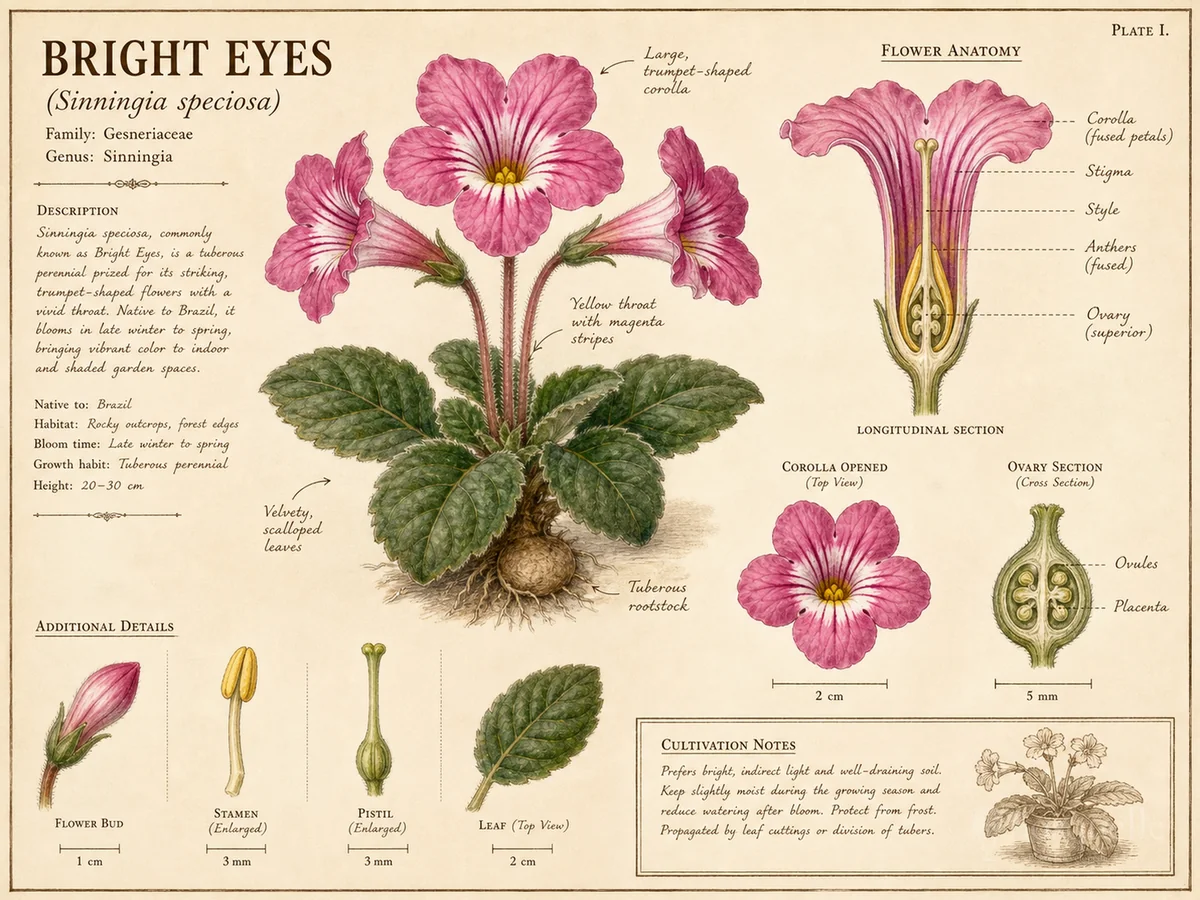
Is Bright Eyes a different plant?
No. Bright Eyes is a shop name for this same Sinningia speciosa. Use the same light, water, and dry rest.
Can I put gloxinia outdoors for the summer?
A sheltered porch with bright shade is fine in warm weather. Bring the pot in before a cool night, and never leave it out for frost.
Is gloxinia toxic to cats or dogs?
The ASPCA lists Sinningia speciosa as non-toxic to cats, dogs, and horses. Still keep pets from chewing the plant.
What about mites or fungus gnats?
Dry air invites spider mites. A wet peaty mix invites fungus gnats. Fix light, water, and drainage first; a spray job is not the usual start.
Related guides


Recommended plants
References
- [1] NC State Extension -
https://plants.ces.ncsu.edu/plants/sinningia-speciosa/ - [2] Clemson HGIC -
https://hgic.clemson.edu/factsheet/gloxinias/ - [3] Iowa State Extension -
https://yardandgarden.extension.iastate.edu/faq/how-do-you-care-gloxinia - [4] University of Missouri Extension -
https://extension.missouri.edu/publications/g6511
This note is part of Sinningia Guides.
More first-season notes by plant are gathered in How to Grow Guides.
Updated: Reviewed by Bosquelle Editors