
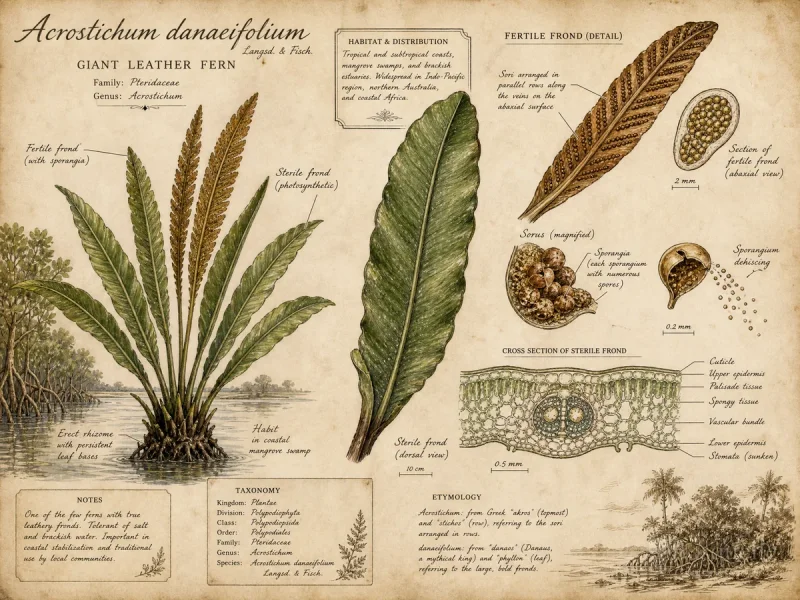
Grow giant leather fern in soil that stays wet. Giant leather fern is Acrostichum. Shops also say inland leather fern.

Keep the soil wet, and give it shade or sun only beside water
| Factor | Recommended | Avoid |
|---|---|---|
| Light | Part shade, or full sun only beside a pond, canal, or retention pond | Do not leave it in hot afternoon sun on dry ground — leaflet edges brown |
| Soil | Moist to flooded organic ground; sand, loam, or clay that stays wet | Do not plant it in soil that dries between waterings |
| Water | Keep the root zone wet. Standing fresh or brackish water is fine | Do not let the bed dry; fronds brown and the clump stalls |
| Salt | Coastal soil and some spray, with the roots kept wet | Do not set it on the most exposed ocean lot in unbroken salt spray |
| Kind | Giant leather fern for a wet pond edge, bog, or tall screen | Do not buy a florist leatherleaf and expect a 12-foot wetland clump |
giant leather fern is a 6-to-12-foot evergreen fern with leathery pinnate fronds. Site it in part shade, or in full sun only where the ground stays wet beside water. [1] Hot sun on a dry bank browns the leaflet edges, and people then think the plant is dying. If the bed can dry, water weekly so the roots never sit dry. [2] It is a hedge or specimen in moist ground, not a low groundcover, and it is not drought-tolerant.
How much sun does giant leather fern need?
Give it part shade, or full sun only beside water. Hot afternoon sun on dry ground browns the leaflet edges.
How often should I water giant leather fern?
Keep the root zone wet. Standing fresh or brackish water is fine. If the bed can dry, water weekly so it never sits dry.
Grow it in a large pot that stays wet
A patio bowl that dries between waterings is the wrong job. If you must use a pot, use a wide, heavy one that stays wet at a pond edge.
- Use a wide, heavy pot that will not tip when the fronds reach 6 feet or more.
- Fill it with a heavy organic mix that stays wet, not a gritty houseplant mix.
- Sit the pot in a tray, or at the pond edge, so the lower few inches stay in water and the crown stays above the waterline.
- Water so the mix never dries. A small indoor bowl is the wrong size for this clump. [3]
Can I grow it in a pot?
Only in a large, heavy pot that stays wet, usually at a pond edge. It is a 6-to-12-foot wetland clump, not a windowsill fern.
Plant in wet ground, with the rhizome just under the surface
Plant a nursery clump in wet ground in any frost-free month. Set the rhizome just under the soil surface, at the same depth it grew in the pot, and leave about 3 to 5 feet so the clump can open to 5 to 10 feet.
- Choose a pond edge, bog, or low wet strip. Skip a dry berm or a raised bed that dries.
- Keep the root ball wet while you work, and handle the soil ball carefully so it does not crack apart.
- Set the rhizome just under the surface. Backfill with the soil you removed, and water so the hole stays wet.
- Leave about 3 to 5 feet between plants. A mature clump can spread 5 to 10 feet.
- Mulch to hold moisture, and keep the mulch off the crown.
When should I plant giant leather fern?
Plant in any frost-free month, in ground that is already wet. Do not plant into a dry hole and hope to catch up with the hose.
How deep do I set the rhizome?
Set it just under the soil surface, at the same depth it grew in the pot. Do not bury the crown.
How far apart should I plant giant leather fern?
Leave about 3 to 5 feet. A mature clump can spread 5 to 10 feet, and it is not a low groundcover.
Split a crowded clump in warm weather
Division in warm weather is the practical start if you already have a clump. Replant at once in wet ground.
- Lift a crowded clump with a wide spade while the soil is wet.
- Slice sections that each have several healthy fronds and a firm piece of rhizome.
- Replant at once, just under the surface, and keep the new plants wet until new fronds stiffen.
Cut old brown fronds at the base
Cut old brown, salt-burned, or storm-torn fronds at the base. Do not shear the whole clump hard more than once a year. [4]
- Wait until a frond is brown, salt-burned, or broken. Green fronds still feed the rhizome.
- Cut that frond at the base with clean loppers.
- Leave the remaining green fronds in place.
- After a storm, take out snapped fronds the same way.
When do I cut back giant leather fern?
Cut brown or broken fronds at the base as they age. Do not shear the whole clump hard more than once a year.
Not florist leatherleaf — and not Boston fern
Florist leatherleaf is Rumohra, a glossy 2-to-3-foot fern sold as cut greenery, not this 6-to-12-foot wetland clump. Boston fern and macho fern are Nephrolepis house and patio ferns — see How to Grow Boston Fern. Leatherleaf mahonia is Oregon grape — see How to Grow Oregon Grape. Leatherleaf acacia is an arid tree — see How to Grow Acacia. Leatherleaf viburnum is a shrub — see How to Grow Viburnums. Golden leather fern is Acrostichum aureum, a mangrove cousin with fertile pinnae mostly at the tips; it is not a second shop card here.
Is giant leather fern the florist leatherleaf?
No. Florist leatherleaf is Rumohra, a smaller cut-flower fern. Giant leather fern is the wetland clump with 6-to-12-foot fronds.
Keep the soil wet, and cut brown fronds at the base so new fronds can take their place.
FAQ
Can I grow it from spores?
Spores cover the brown underside of fertile fronds, but a nursery clump or a warm-weather division is the usual start. Spore culture is slow and easy to lose to mold.
Does it come back after a freeze?
It is evergreen in a frost-free garden. A hard freeze kills fronds, and a long freeze can kill the clump. Do not treat it as a bulb you lift and store.
Are the fiddleheads the ones you eat?
Some Florida sources note young fiddleheads as edible. Do not pick them as a grocery crop. Grocery fiddleheads are usually ostrich fern, not this wetland giant.
Is golden leather fern the same plant?
Golden leather fern is Acrostichum aureum, the mangrove cousin. This catalog holds giant leather fern, the inland wetland clump.
Can I grow it as a houseplant?
No. It wants outdoor wet ground or a large pond-edge pot. A windowsill Boston fern is a different plant.
What else likes that wet pond edge?
Other wet-ground plants that take sun only when the soil stays wet. Do not pair it with a dry-bank shrub that needs the same bed to drain.
Recommended plants
References
- [1] UF/IFAS Extension -
https://ask.ifas.ufl.edu/publication/FP012 - [2] UF/IFAS Extension Nassau County -
https://blogs.ifas.ufl.edu/nassauco/2017/06/13/q-can-tell-giant-leather-fern-can-grow/ - [3] Botanapp -
https://botanapp.com/plant/acrostichum-danaeifolium - [4] Florida Native Plant Society -
https://www.fnps.org/plant/acrostichum-danaeifolium
More first-season notes by plant are gathered in How to Grow Guides.
Updated: Reviewed by Bosquelle Editors